Showing posts with label john bromfield. Show all posts

July 1, 2022

HOT CARS (1956)


This sixty-minute-plus American crime film stars John Bromfield in the best of his four Bel-Air Production films (see below), playing a man out to prove his innocence or regain his self-esteem. The film is fast-paced with a high degree of believability. The acting is not forced, with everyone doing a fine job for a low-budget project. Based on Hot Cars by H. Haile Chace, it is directed by Don McDougall and written by Don Martin and Richard Landau. It was produced by Howard W. Koch. Some wry comments are used by a couple of cast members to good effect. 

The opening jazz band score by Les Baxter sets an action tone while the viewer watches a 1955 Mercedes-Benz 190SL convertible being test-driven. Under superimposed screen credits, we watch Bromfield pull the sports car to the roadside so the potential buyer, and stereotypical bombshell, Joi Lansing, can take the wheel. She provides the only curves in the film and potential ticket sales, suggesting she is the movie's star in posters. Building customer relations is foremost in his mind, so they stop at Santa Monica's “Jack's at the Beach” bar for a drink and chat, hoping to close the deal. Before the drive back to the dealership, in the only unintentionally funny moment, he irresponsibly asks her, “What good is one drink without one for the road?” Though the salesman seems to have a heavy foot on the drive back to the dealership, they return without incident. She drives away in her giant 1956 Chrysler New Yorker convertible.


Bromfield's perpetually irate boss, Robert Osterloh, an auto-shyster of the first order, is savvy enough to know his clientele. He blasts him for wasting time with a high-class dame who has no interest in used cars. Bromfield is straddling the unemployment fence at this point. Enter Ralph Clanton, who appears to be interested in an old MG roadster for only $700. But “Honest John” Bromfield tells him it was used on the racing circuit, has been rolled three times, and will be nothing but trouble. Clanton appreciates his honesty, then drives away. Wanting to unload the dumpster roadster—and on his last nerve—Osterloh fires Bromfield. Clanton re-enters the picture by calling straight-arrow Bromfield about working for his own dealerships. The whole MG thing was just a ruse, as was Lansing's coy attitude. As soon as Bromfield discovers the hot car racket, he walks out.

But the salesman and his devoted wife suddenly have an urgent financial dilemma thrust upon them when their ill son needs surgery. Caught between a clutch and floorboard, Clanton accepts Bromfield's decision to return just as the always authentic Dabbs Greer enters the film. The detective asks the salesman to keep an eye out for any suspicious cars. Later that night, a shipment of hot cars is unloaded onto the lot, and in near panic, the semi-driver—a real hep cat—tells Bromfield, “Cut the [dealership] lights, man!” The driver has a habit of ending all his sentences with "man." The next day, Greer returns to look at a Chrysler, one of the hot cars yet to be moved behind the dealership. Bromfield's initial fear is temporarily unfounded because the detective simply wants to buy the car as an anniversary gift for his wife—she always liked Chryslers. Greer and his wife return that night, ready to sign on the dotted line. Bromfield is well aware that the hot car will not remain a secret very long. In hopes of dissuading Greer, he tries a couple of stalling tactics, then suddenly requires a larger down payment. Clanton's "auto muscle" finally shows up with a phony sales receipt for the car. Greer is very suspicious of the last-minute flip-flop. He levels some pointed comments at Bromfield when he returns one last time that night. Oddly, Greer walks away, down the sidewalk, perhaps not realizing he could have just parked at the dealership like he had done before. 

Two police officers want to question Bromfield about the murder of the detective, explaining why he was scripted to walk from the car lot. When he arrives home, his wife pleads with him to tell the whole truth and nothing but. The three men pay Lansing a visit, and not surprisingly, she denies ever meeting Bromfield. He says he can prove he was there, but she had the room “renovated,” and it is not as he described it. The salesman flees the beach house with the intent of tracking down the assassin. It leads to an exciting and authentic roller coaster climax at Ocean Park Pier in Santa Monica. The two men receive and give punches while being filmed from a coaster car in front of or behind them. Quite a ride for the viewer. Thankfully, no rear-projected screens. Jockeying for position, the henchman is thrown during a high-speed crest, catapulting a limp, stuffed dummy to the pavement below. Justice is served as the car sales team of "Clanton & Lansing" has been on law enforcement's radar for some time. In the end, Bromfield was never really a murder suspect; they just wanted his help. The film abruptly ends with the camera focusing on a "Closed" sign at the amusement park.

Notes: Bel-Air Productions was a joint venture between the director, Koch, and the independent producer Aubrey Schenck. These low-budget productions were all distributed through United Artists. Bel-Air usually offered realism on the cinematography front with its location filming. This movie is an eyeful for the automotive historian as it was filmed at Big John's and Johnny O'Toole's used car dealerships in Culver City, California. The film thanks both for their cooperation with an ending acknowledgment.

Bromfield starred in three other Bel-Air Productions of the period, some unintended amusement, less tidy, and generally inferior to this film. Check out The Big Bluff, Crime Against Joe, and Three Bad Sisters.

August 7, 2020

THREE BAD SISTERS (1956)

Those familiar with John Bromfield’s career, a real-life fitness enthusiast and hunky blend of Rory Calhoun and Steve Cochran, know that his previous Bel-Air Productions, Crime Against Joe, and The Big Bluff, the latter of which ranks on the same scale as this film. Arguably, his best of the bunch is Hot Cars, released the same year as this film. United Artists released this film, which was directed by Gilbert Kay and produced by Howard W. Koch. Again, Paul Dunlap provides Bel-Air’s music score.

Bromfield is questioned in a courthouse interrogation room about what happened when his small plane crashed, killing his passenger, a wealthy tycoon. Bromfield survived without a scratch. A civil aeronautics rep is not very civil, accusing him of orchestrating the crash—not an easy thing to pull off. The dead tycoon leaves his fortune to three daughters, two of whom are disturbed. So this seventy-six-minute film’s title may be most misleading. I submit two alternative titles, “One Out of Three Ain’t Bad” or simply, “The Sisters of Annoyance Manor.”

The conniving middle sister is Kathleen Hughes, at times attempting a coy Monroe vocal interpretation. Her robotic smile, accompanied by verbal venom, gets increasingly creepy as her eyes grow larger, all Adam Schiff-like. She wants the other two-thirds of the estate and bribes Bromfield with a substantial amount to keep his murder slate clean. She also wants him to lather on the charm for the firstborn, Sara Shane, executrix of their father's estate, in the hopes she will not marry their father’s attorney. Shane is the only sister with a conscience, but not the only one with psychological issues.

Standing in a bathing suit, Shane's inner thoughts try to conjure up the courage to dive from a rocky cliff into raging waves among rocks over a hundred feet below. Apparently, a summer challenge among the sisters. Surprising every viewer, the pilot grabs her from behind and says it would be a shame to damage such a lovely fuselage. The scene changes to the interior of the cliff-side mansion, where the youngest sister, Marla English, introduces herself to Bromfield as any seductive tart might. She is annoying to all the characters in the film. Later, along with the females in the audience, she gets a glimpse of the hunk using an electric razor—without a shirt. He never shaves his chest, though. Bromfield, a , does a lap in the pool and then comes out drenched. It is that kind of film.

An additional annoyance is a snippy aunt, who thinks Bromfield is a liar, taking advantage of the sisters one by one, and that her brother would never have committed airplane suicide. Where she gathered that idea, I do not know, since social media was in the far distant future. She does have a knack for eavesdropping on the telephone with subsequent misinterpretations. Things get a bit uncomfortable as the family, plus the attorney, sit around the mansion lounge waiting for Auntie to pounce on Bromfield with accusations. Pouncing. Also, one of English’s favorite pastimes.

At about this point, Hughes’ character takes the annoyance factor to a whole new level with lies and syrupy, fake sincerity. Her jealousy and demented behavior drive her to beat English across the face with a riding whip, eliminating her from any Bromfield competition. Naturally, the instinctive thing to do after a good whippin’ is go for a high-speed drive. Not sure the purpose or how they could possibly help, Bromfield and Hughes dash to another car to pursue—at one point going off-road, circumnavigating a tree. I hope the stunt drivers were well-paid for their work. English no longer has any purpose in living. Her shallowness had few boundaries.

Back at “Annoyance Manor,” thick-headed Auntie has a bullet waiting for Bromfield, but he grabs the gun from the old bat. He and Shane leave the mansion and head to the airport. He tells her the whole truth about the accident and that the monetary “contract” the tycoon offered him was a huge Hughes forgery. He confesses his love for her and charts a course to the “wedding capital” of the West. Yuma, Arizona? Bromfield turns out to be everything contrary to Auntie’s stubborn thinking and becomes the most sensible executor of the estate. She still hates him. I suspect he will close off the mansion’s third floor with a separate outside entrance for the aunt.

April 3, 2020

FORGOTTEN FILMS: TV TRANSITION

Though typically overshadowed by Hollywood's A-list, there were respectable performances by numerous actors and actresses who never became major film stars. A common occurrence was their transition to the new medium of television, often becoming familiar faces in homes across America. These periodic posts offer insight into their transition.


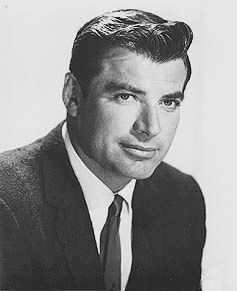
John Bromfield: Farron Bromfield (1922-2005)

John Bromfield was a leading man in B-movies during the mid to late 1950s who possessed a fine voice and a square-jawed handsomeness. While still in his mid-twenties he became a contract player for Paramount Pictures. His early acting gigs placed him shoulder-to-shoulder with some big names in Sorry, Wrong Number (1948) and Rope of Sand (1949). Bromfield was an obvious candidate for leading man status by mid-century. His brief career churned out such forgotten films for Bel-Air Productions as, The Big Bluff (1955), Three Bad Sisters (1956), and Crime Against Joe (1956), co-starring another transition to television, actress-singer Julie London. Like most of these features, the film possessed some unintentionally funny moments in between London’s comatose performance. A decent script and on-location filming helped make Hot Cars (1956) his most authentic of the era. His role for Universal International Pictures, Revenge of the Creature (1955),  “earned” him cult status, after a fashion.

Bromfield’s transition to television was instant, bringing him notoriety from living rooms across America. The syndicated modern-day western series, The Sheriff of Cochise (1956-60) was a big success as officer Frank Morgan chased bandits by station wagon, not on horseback. The Chrysler Corporation was a sponsor and late episode viewers could see a DeSoto Fireflite Explorer station wagon complete with a shotgun clipped to the driver's side door panel. Due to the show’s success—thanks to Bromfield, location filming and accurate portrayal of law enforcement—he was made an honorary deputy by the real sheriff of Cochise County. Morgan was promoted to U.S. Marshall status and the entire state of Arizona was under his purview and the third season gained a new title, U.S. Marshal. Bromfield embraced the television medium and the show wholeheartedly. His co-star for one season, Stan Jones, playing Deputy Harry Olson, was the creator of the series.

Note: Bromfield was born in South Bend, Indiana, and soon developed strong athleticism. Hollywood knew him as a health enthusiast. Female fans knew him as a hunk. After leaving acting abruptly in 1960, he produced sports shows. Before being discovered by an acting agent he was a tuna fisherman. He returned to those roots in retirement as a commercial fisherman off Newport Beach.

May 14, 2016

CRIME AGAINST JOE (1956)


Handsome John Bromfield plays the title character from a neighborhood where everyone has known him since childhood. It is a familiar story of guilt until proven innocent. In a nod to the twenty-first century, the nearly thirty-year-old Korean War vet still lives with mom. The neighborhood sees him as an out-of-work artist bum and a frequent heavy drinker. He is so disgusted with his talent that he tells his mother he is going to get drunk. Like his late father. She is very understanding.

His car ends up at a burger joint where his high school alum, Julie London, works as a carhop. Obviously drunk, she suggests he call a taxi from there. He requests his cabbie pal, Henry Calvin, to come and get him. Calvin keeps addressing London as his girl. That may be the first hard-to-believe moment: that London and rotund Calvin are an item. The second might be Bromfield as a drunk. It is a borderline comedy routine. Stumbling home in the early morning hours, he encounters Patricia Blair sleepwalking and kindly sees her home, her father answering the door in total embarrassment. 

Not being depressed enough about his artistic talents, a girl is murdered who happens to have in her possession a high school class pin. Like the one Bromfield cannot locate. Blair’s father is called in as Bromfield’s time alibi. He is so embarrassed over his daughter’s sleep disorder he denies ever seeing him. Bromfield’s past sessions for “battle fatigue” also go against him as does his frequency of destroying his unsuccessful female portrait paintings. Painting is hard. With no solid evidence but he being their only suspect, the condescending district attorney thinks they have their man. He does not understand art either. The final, hard-to-believe moment is that the whole neighborhood thinks Bromfield should be run out of town on hearsay like so many other opinionated movie extras. London provides a bogus alibi to free Bromfield. The DA is incensed. The high school pin suspects are narrowed down. The film’s closing moments offer up a rapid twist, revealing the murderer.

Note: Bromfield is always solid in his Bel-Air Production projects. He had bills to pay like everyone else. This film benefits from location shooting, adding a historical look back for Los Angeles natives. London is not as polished. She just does not seem that interested in the role while posters try to sell the movie on her sultry figure.

April 16, 2016

THE BIG BLUFF (1955)


The big bluff is John Bromfield, looking dashingly untrustworthy with his rare pencil mustache and nearing the high point of his career. He loves a nightclub entertainer. They are both being pursued by her estranged husband. Untrustworthy is exactly how he sees Bromfield. Thankful that this is only seventy minutes, it is still an intriguing, if implausible, noir. The last ten minutes are the reason to see the film through with a slick double-twist. The film was produced by Planet Filmplays and distributed by United Artists. One word of caution, it is directed by W. Lee Wilder, the less-talented brother of Billy. On the brighter side, Fred Freiberger wrote the screenplay and cinematography by Gordon Avil. Freiberger gained notice about a decade later as a writer or producer for several popular television series.

The black and white film opens at the bedside of a rich widow, played by Martha Vickers, terminally ill with a heart condition. Her secretary and doctor think it best not to tell her, feeling a positive outlook would be best for her. The doctor also suggests a move to a more remote part of Los Angeles for peace and quiet. The views from her window are spectacular if the smog ever clears. Robert Hutton gives a rather comatose performance as the doctor.

While dining out the secretary meets Bromfield who learns about Vickers and her health, aka wealth. He wines and dines the rich widow, then marries. He does his best to wear her down with late-night parties and physical activity. But to his disappointment, all this exercise improves her health. Diabolically, the financially restrained con man speeds up the process by replacing her medication with sodium bicarbonate in a second pill container. The real medicine is his backup to his vow, "I'll take care of her" (for as long as he can stand it). 
Vickers is annoying, acting like a schoolgirl, constantly gushing over Bromfield, unable to see through his over-the-top behavior. But her secretary has no doubts after noticing two identical pillboxes. The doctor, along with a detective, tests the pills and confirms something is truly wrong with Bromfield. 

Bromfield suddenly becomes nasty to his wife, ranting and raving. It is simply a cover to storm off and arrange a future with his girlfriend, and then return to confess his intimate indiscretions. He puts the "sin" in sincerity. With some carefully planted evidence, the fix is in. And there is that estranged husband.