January 26, 2019

DEATH IN SMALL DOSES (1957)


From a Saturday Evening Post exposé by Arthur L. Davis, this film is based on factual accounts. The film was directed by Joseph M. Newman, who had several notable B-movies already under his clapboard. A jazz-inspired score by Emil Newman and Robert Wiley Miller is used effectively over opening credits, all in modern, lowercase letters. This low-budget Allied Artists production is a well-cast “call to action” about the excessive use of addictive, mood-altering drugs. The viewer is locked in from the opening scene with headlights glaring down a dark highway. The theme is established as the driver, to stay awake, downs a handful of amphetamines, known as “bennies” (Benzedrine) or “co-pilots” to truck drivers. His subsequent hallucination drives him over a cliff.  As is often the case with any old movie, regardless of budget, there are a couple of unintentionally funny scenes of note.


Handsome, likable Peter Graves plays one of the numerous FDA agents sent undercover to find out who is supplying drivers with illegal pills. This may be the best B-movie production of his career as a man with undercover experience. His “off the top of his head” suggestion for a phony alias and routine cover for this sort of thing is pretty funny. And not even questioned by his supervisor. He decides to be a widower from...um... Indianapolis...um...who has been drifting for...um...five years, working at various...um...jobs. Perfect!


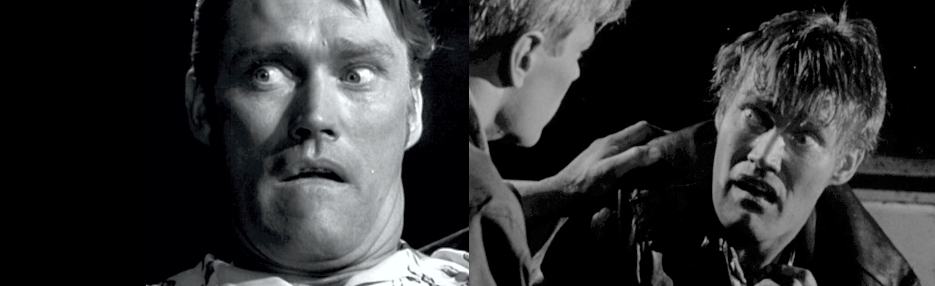
You will not forget Chuck Conners' standout performance. One might think he is overacting. On the contrary, he sells the harmful effects of drug addiction vividly. Connors does ham it up as a hopped-up hepcat big-rig driver. He and “Bennie” can go the distance on the highway or the dance floor. His flirtations with the diner waitress, Merry Anders, are a favorite pastime. Sleeping is for losers, in his altered mind. When Graves becomes a border in the same house as Connors, the automobile buff will wonder who owns the Thunderbird convertible curbside. Once Connors “blows the cameraman off his feet” with his first appearance, the owner is revealed. His climactic, hallucinogenic ride almost drives him insane, and nearly kills Graves in the process, before getting him the medical help needed.

Mala Powers, who runs the trucker's boarding house, looks sheepishly uncomfortable when Graves checks in. Like she killed her cat a couple of hours before, after he tore her curtains to shreds. Graves' phony backstory plays to her emotions, and they soon become attached at the lips. She will be quite surprised to learn he is just a professional doing his job. Typically, Harry Lauter is just too nice as Power's thoughtful “brother-in-law.”


Routine stops at a service station introduce us to the owner, Robert B. Williams, as “Dunc.” The amiable character is the driver's primary pill physician, but he is not the kingpin. When the pill-pusher gang finds out the identity of Graves, he is abducted and taken to a remote location. Against his will, Williams is also “taken for a ride” and then commanded to dig a grave for Graves. Sensing a chance to sway Williams' actions, Graves tells him he is also dispensable. “Dunc, you had better make that two graves.” After that unintended pun, Williams places the shovel upside the head of the drug kingpin. After a few stray and deadly bullets, Graves returns to town to wrap up his assignment. Powers' hysteria of being arrested at the end is a bit awkward.

January 12, 2019

WHEN GANGLAND STRIKES (1956)


CARUSO STRIKES MAYBERRY

This is not two television episodes edited into a movie. Its premise, from a story and screenplay by John K. Butler and Frederick Louis Fox, centers around a big city mobster who wants his trial moved to a small community, Rosedale, where he will likely go free by a jury of no peers. The moviegoer knows he committed murder in an alley. The bowling type. The mobster plans to blackmail the town's elder prosecutor because he knows the secret he has kept hidden for years. The not-so-horrible secret is kept for a while, but out of fear, the prosecutor throws the trial in the mobster's favor. The Republic Pictures release is planted firmly on the mediocre side of town. Perhaps an explanation of the awkward and misleading title is in order. A gangland mobster shoots a key witness in a bowling alley right after the guy rolls another one of his strikes. You can believe that if you want.


Thanks to the ubiquitous criminal, Anthony “Duke” Caruso, the opening would suggest a hard-hitting crime drama. Script “bookends of excitement” are used to keep the slow middle section from collapsing. Dramatic scene transition music sometimes would fit a sitcom of the era. The downtown studio set is as clean and stainless as the people who live there. Every automobile is newly washed and waxed. With its clichéd dialogue and characters popping up without any permission to do so, this film could have been made ten to fifteen years earlier. By golly, Andy Hardy would feel right at home here.

Directed by R.G. Springsteen, everyone rolls through the film competently, however. Playing the seasoned and genial pivotal character is Raymond “Pops” Greenleaf, the lovable and infamous prosecuting attorney. The Ben Matlock of Rosedale. The courtroom scenes are, thankfully, brief, but are not anchored in any reality. The cast is a “gang load” of B-movie or television performers. Caruso's ex-con airhead girl is played by Marian Carr. She thinks the world of him...calls him “Dukie.” He does not reciprocate her sentiments. Young John Hudson plays an up-and-coming prosecutor and fiancé to the cute and wholesome Marjie Millar. She seems lifted straight from a Roy Rogers serial. More embarrassing is watching Slim Pickens do his one-dimensional, rural bumpkin character. He is so one-dimensional, his character's name is actually “Slim Pickett.” His elementary-level humor hardly ever satisfies. Again, playing a sheriff is Paul Birch. Uncredited roles go to Mayberry alums from The Andy Griffith Show, James Best, and Dick Elliot.

Caruso is eventually subpoenaed by the court for a second murder. His memorized “attendance” at a piano concert is his alibi. But Greenleaf knows more about the pianist than Caruso and his detailed questions destroy him on the witness stand. Out of nowhere comes a startling solo piano score underlying the scene. Caruso loses his temper and attempts to shoot his chauffeur because he thinks he betrayed him on a shady conjecture from Greenleaf. How he got into the courthouse with a handgun, no one cares. It is the final bookend of excitement in the film. Ditsy Carr hopes that “Dukie” will not be put away long. Caruso's legal adviser sardonically replies that it will be just a couple of days, then they will turn on the electricity. As expected, she does not get it.

Note: It is difficult to categorize this film. On one hand, a studio laugh track would be appropriate, yet the criminal element casts its shadow. In spite of its flaws, this forgotten historical slice of Americana is generally pleasing. At seventy minutes, it may be the perfect movie to watch on a smartphone. Simply because one can.

December 29, 2018

PICKUP ON SOUTH STREET (1953)


This Cold War spy film, co-written and directed by Samuel Fuller for 20th Century Fox, earned modest success at the box office from a tight budget. With great pacing and solid performances, the film is nicely supported by a score that is, at times, elaborately arranged by the significant film composer, Leigh Harline. In a general sense, the film can be distasteful and made it controversial in its day. Over the years, reading between the screenplay lines, many Twenty-First Century critics have placed the film on a pedestal for those very same reasons. In contrast, moviegoers of the era were able to quickly categorize the film upon exiting the theater. And their reviews were mixed. Reviews were decidedly one-sided for Fuller's remake in 1967. A full-color disaster starring a dull James Brolin and a miscast Jacqueline Bisset made the original screenplay a talk-fest of major proportions, lacking any style or intrigue. 


The film opens on a crowded New York City subway train as Government agent, Willis Bouchey, has his eyes trained on Jean Peters, whose dark lipstick, false eyelashes, and dress convey her persona. Also sandwiched between them is a professional pickpocket, Richard Widmark, who deftly steals Peters' wallet during the jostling ride. Neither knows the vital contents inside. Widmark just hopes to inherit some cash or jewels. Peters' ex-boyfriend, Richard Kiley, has told her the wallet contains stolen business secrets, unaware that she has naively gotten herself wrapped up in a Communist plot. Widmark persistently denies he stole any microfilm, but the detectives, sensing he is not on the level, offer him a deal to clear his record if he hands it over.


A scoundrel living in a wooden shack along the New York harbor, Widmark is not exactly living on easy street in his one-room “clubhouse.” He does have a nifty winch system he can raise and lower to retrieve his chilled beer. Cleverly hidden in the false bottom of his “beer box” is his plastic-wrapped safe for his “take-home pay.” Always nicely attired with plenty of confidence, surely he lives elsewhere. He ends up being somewhat of a likable chap despite his cocky, aberrant behavior. He soon 
discovers the microfilm's national significance. 

For most of her roles, seemingly in the same wardrobe, I can only take Thelma Ritter in small doses. Here she again plays the savvy, wiseacre informant to the police. A knowledge she has accrued since childhood, I gather, as a school's classroom was either not available or school was just not her thing. She knows the crime underbelly better than the police. She is called in to identify the pickpocket's style based on Bouchey's observations. A mugshot quickly pinpoints Widmark. Her value to the police department has deadly consequences, however.

Kiley demands Peters get the microfilm from Widmark as only she can. Thinking he has an ace up his sleeve, Widmark plans to seek a huge cash reward for the film. But Kiley's plan goes awry as Peters takes his place. Upon her return, Kiley finds a key frame missing. He takes his anger out on her. Time being critical, Communist agents order Kiley to deliver the film as is. Recognizing Kiley from his earlier attempted visit, Widmark tails him onto the subway train where he pickpockets his handgun. The film exchange is witnessed in a subway station restroom, then Widmark chases Kiley through the subway for the film's climax.

Note: Jean Peters sells this performance of a woman who has lived off the streets most of her life, earning a “living” as needed. Like Ritter, she has connections. Unlike Ritter, she is on the opposite end of the visual spectrum. She has never known real respect or unconditional love, but Widmark makes an attempt. In the early scenes, with an airy dress more suited for the beach, it is not exactly what June Cleaver would ever consider. I cannot imagine another actress who could fill this part as well. If ten years younger, perhaps Ida Lupino. The other female options of the era would either have been too sophisticated or too overt.

December 15, 2018

THE GIRL WHO DARED (1944)


This unmistakably B-movie, with its confusing title, was produced by Republic Pictures and tells of a harrowing weekend with a large cast arriving at a mansion to argue and accuse one another of murder. A second plot concerns stolen radium, which may be easy to find in all the shadowy darkness. This well-performed mystery was directed by the Western matinee staple, Howard Bretherton, who would end his directing career with two television episodes of The Adventures of Superman. This could be the only film with two future DC Comics characters. See my note below. It is a bit confusing to keep the character names straight, to say nothing of the twin ladies who swap clothes. Who is related to whom, or how these people seem to know each other, takes a while to unravel. You will witness the ever-present shadowy figures, lightning, thunder, a pair of hands that clip telephone wires, and women who faint easily, though a simple drink of water revives them. Frankly, I would consult a physician about the fainting spells. The levity is provided by the butler, Willie Best. Highly respected in the business and one of the hardest-working character actors of Hollywood's golden era. 


The opening is somewhat clever. First, the background image under the opening credits is a skull and crossbones symbol. When the credits fade, the camera zooms out to reveal it to be part of a personal invitation as it is being signed. Secondly, brother and sister, Kirk Alyn and Lorna Gray, stop at a service station with minor car trouble. Upper crust Alyn impatiently yells at the lowly mechanic to “look” at the engine; it has a “bad miss” in it. The guy in the overalls, Peter Cookson, is the assumed mechanic. He overhears their party destination and then informs them the engine “looks” like it will need more time to fix. They accept his offer to drive them to the party, then he returns to the station, removes the overalls, and thanks the lazy station owner for the use of them to change his own tire. 

John Hamilton and his on-screen wife are hosting a weekend party that has been all the rage. At least they think so. One of those events that comes around every year, in which you dread an invitation but feel obligated to accept. The planned main event—the only event—is to have their six guests experience the ghost of a sunken pirate ship that appears annually, late at night, right on cue. Like teenagers on a scavenger hunt, everyone gets into their rain slickers and hikes amid lightning and thunder to Heron Point. Off in the distance is Hamilton’s theatrics. To make sure the guests sleep well, he later tells them the ghost was not real, just a device he created for the annual party (yay). Over the years, one would think word had gotten around about this charade. Especially as Hamilton says no one comes up here except by invitation. The “ghost thing” quickly wears thin as one cast member is murdered before returning to the house. Then another, later on.


Cookson returns and removes the distributors from all the guests’ sedans, not allowing anyone to escape. When greeted at the door, it is not long before he becomes the guy in control. No one questions “the mechanic” or why he is interested in what goes on at the ostentatious house. After everyone discovers he is no longer in the house, they assume he is the murderer. But he has better things to do with his time. Find stolen radium. It is at this point that I assumed Gray is the “girl who dared” carry a handgun loaned to her by her cousin, Hamilton, for safety. She is not afraid to point it out, finding Cookson twirling around in the woods with what appears to be a nightclub waitress’s cigar and cigarette display case, but with knobs and lights, supported by a strap around his neck. My initial interest would have been about that case, but she ignores that and accuses him of murder and, well, walking around funny. She learns that Cookson is actually an insurance detective, and (Missy) he knows how to use his radium detecting equipment. Before returning to the house, they discover a secret tunnel and the dead bodies. The ending wrap-up is done in a whirlwind fashion, so you should probably take notes throughout the movie.

Note: There were many atmospheric, house ghost movies during this decade. One may wonder about their constant appeal, but I guess it was an escape from the war. At only fifty-five minutes, it made for a shorter evening for moviegoers. A likable movie to discuss around the office water cooler or cigarette machine on a Monday. Kirk Alyn continued to act into the 1980s but will always be remembered as the first actor to play Superman. The dependable, low-tier actor, John Hamilton, ended his career a decade later, famously as editor of the Daily Planet on television’s The Adventures of Superman series.

December 1, 2018

FLIGHT TO HONG KONG (1956)


This budgeted black-and-white crime drama was directed and produced by Joseph M. Newman of, This Island Earth, fame. Newman finished his career in television. There are no dull moments in this eighty-eight-minute film as it leaps from, as one poster puts it, the “sin-capitals of the world” from Hong Kong to Tangiers, Macao, Tokyo, and San Francisco in an effort to keep the lead actor in business and alive. A Sabre Productions film, it was formed by associate producer, Victor Orsatti, and distributed by United Artists. Orsatti would later join Rory Calhoun to help form Rorvic Productions. The forgettable music score is composed by Albert "B-movie" Glasser. In mock-documentary fashion, the film initially opens with a British officer explaining the worldwide effort to bring crime syndicates to justice. Not a bad film, just a quickly forgotten one. But it is well cast and acted, with Calhoun a charming scoundrel. Unfortunately, the dialogue was obtained from a folder marked, “Movie Clichés.


Handsome and self-confident, Calhoun is a lady magnet. No one knows this better than himself. He comes off as a respectable businessman in the skeptical “import-export” business on his flight to Hong Kong. That is what he tells his fellow passenger, the equally charming Barbara Rush, a bestselling author. They hit it off like two college seniors who imagine each might be “the one.” The airliner is transporting industrial diamonds and is hijacked for this very reason. This comes as no surprise to Calhoun, the mastermind behind it. The plane is forced to land on an abandoned runway, totally disrupting everyone's dinner plans. In subsequent happenstances, when he and Rush meet, Calhoun is mysteriously called away on “business.” Unsuspecting, he becomes the central character for her next novel. Calhoun becomes increasingly unreliable by the week, which is no surprise to his long-time girlfriend, Delores Donlon.

No longer working on his own, Calhoun has become an operative for a crime cartel. Things have gone swimmingly for him, but there is hanzi on the wall that his carefree life may be hampered by his personal elimination. His fellow operative, Pat Conway, would like nothing better. With Calhoun's confidence at an all-time high, he decides to freelance. Never do that to the boss of a crime syndicate. Calhoun's fear and desperation increase as the film progresses. He fakes his own kidnapping, then double-crosses the syndicate in a savvy display of violence by rigging a ceiling fan with a grenade taped to the top of each blade. When the fan is turned on, the connected string tightens and sets off the mortal blasts. He is assumed dead among the gang members. Calhoun departs with an alias and a million dollars in diamonds. Paraphrasing Mark Twain, the report of Calhoun's demise has been highly exaggerated.


Constantly on the run, he racks up a lot of frequent flier miles and pockets full of airline peanuts. An entire year later, he tracks down Rush in San Francisco and crashes a party thrown by her publisher on behalf of her latest book success about a charming deceiver she met on one of his many flights, entitled "The Calhoun Story." In an understatement, she is surprised. Especially by his acknowledgment that he has a new identity. He thought she would find that pretty cool. To his surprise, she has moved on with someone else. Personally embarrassed, Calhoun storms off, wandering the streets of San Francisco in search of a safety plan as the gangsters close in. A loyal friend gets him passage on a steamer back to Hong Kong. He contacts his life-long mentor, played by Soo Yong, and also reunites with Donlon. Calhoun's realization that his diamond-filled briefcase has brought nothing but trouble, he attempts to give it back to Conway and walk free. Knowing what he knows, however, they cannot let him go “unattended.”

Note: One of my old movie pet peeves is transportation continuity. Airliners seem to provide the most problems. Low-budget films are notorious offenders. Accessing ideal stock footage can be understandably difficult or expensive. However, I do not understand why it happened so frequently. Padding the film's length, perhaps. In most cases, a transitional scene to another location would suffice. These editing details are sometimes blatantly obvious. The poor continuity in this film is a good example. Under the opening titles, we are witness to stock footage of a Pan American Stratocruiser in flight and its landing. The film's director takes over to finish the journey from Tokyo to Hong Kong on a fictitious airline called “East Asiatic Airways.” Acceptable, but during the flight, the plane morphs into a United Airlines airliner and then lands in Hong Kong as a Pan American DC-6. All those changes, with not one passenger missing their boarding gate. Locating their luggage is a different story.

November 17, 2018

THE PRIZE (1963)


This rather long, illogical Communist spy yarn, distributed by MGM, fits the era and is more suspense than thriller, more nonsense than common sense. Director Mark Robson formed the Irving Wallace novel into a blend of intrigue and sarcastic wit.  Alfred Hitchcock's influence is quite evident, even in the glaring process screen backgrounds, but there is certainly nothing low-budget about this film, what with the lead cast's salaries and crew in Stockholm. The intricate plot takes about fifty minutes to get propelled, while the subplots lengthen the film with no relevance after exiting the theater. Right from the opening credits, with its use of snare drums and syncopated rhythms, you may guess correctly that Jerry Goldsmith wrote the score.

Newman arrives in Stockholm with skepticism about receiving his Nobel Prize in Literature. His lack of Nobel enthusiasm and less-than-classy behavior does have its effect on attendees. Newman tells the press he has not written a book in years and wonders why he was nominated in the first place. The committee is aghast to learn he has maintained a living by writing pulp fiction detective novels. All their noses automatically turned upward.

Elke Sommer, in her first American role, serves as Newman's assistant upon arrival. She is strictly by the book and expects no hanky-panky on the drive from the airport. Every moviegoer knows it is just a matter of time before she succumbs to Newman's bright blue eyes. Her character is one-dimensional and not thoroughly defined, relying only on her memorable attractiveness and stacked hair. Which was all that was needed for most males of the era. No one came out of a Sommer film stunned by her acting skills. Do not confuse this film with another of her roles in The Oscar (1966). That film takes the prize for the most embarrassing high-profile film of the Sixties. I digress.


On a 180-degree career path to Sommer is the classically pretty Diane Baker. Her upper-class, reserved appeal is her strongest asset for her intermittent role, with little to suggest she is integral to the script. She plays the niece of Edward G. Robinson's
 pivotal character. But there is little for him to do. He is also on the Nobel ticket but is kidnapped by the Communists with his “identical twin brother” taking his place. The plan is to move Uncle Edward behind the Iron Curtain, giving his brother the propaganda opportunity to make disparaging remarks about the U.S. during his acceptance speech. When Robinson 2.0 unites with Baker, it is not clear if she is part of the scheme or not. But Newman notices a change in Robinson's manner upon their second meeting, but no one takes him seriously except a couple of Communist agents. Newman becomes their primary target. His wit goes into hiding.


For a writer with little appetite for real-life dangers or the expertise to handle such, Newman manages a couple of fantastical escapes. His processed “Hitchcockian” fall into the river is reminiscent of the falling scenes in Vertigo. How he survived such a free fall, one may wonder. However, the real prize goes to the scene with the Communists trying to run him down on an iron truss bridge. Not successful, the agents pursue on foot. A farm truck approaches the bridge in a blur. Newman runs to the opposite side of it. After it passes, the agents are dumbfounded by his vanishing act. Even if Newman knew where to get a superhuman handgrip on the side of the truck, the force would have pulled his writing arm from his shoulder socket! His screams of agony would have made him easy to track. But there he goes, clinging to the side of the truck, face to face with a goat, in 007 glory. It is a ridiculous moment.

In the end, Newman has the Nobel thrust upon him anyway, making little sense after insulting the Nobel committee, nor for doing anything to warrant it. Like former President Obama receiving his Nobel during his first year.

Note: On the road to a career peak, after a few speed bumps, this movie is tailor-made for the likes of Newman. An anti-establishment figure with grumpy witticisms. Doubt there were other “A-listers” as appropriate, though James “Our Man Flint” Coburn comes to mind. Not necessarily James Dean, had he lived. Newman inherited a couple of roles that were slated for him. Then again, Dean, displaying his lack of interest in the Nobel Prize upon his arrival in Sweden, may have bested Newman's portrayal.

November 3, 2018

CLOSE-UP (1948)


This seventy-six-minute drama offered one or two surprises during its first run, but it is no surprise today that it was produced by a small studio with the male and female leads somewhat resembling more famous Hollywood celebs. Distributed by Eagle-Lion Films for Marathon Pictures, it is a pretty good tale of fleshing out a Nazi war criminal who has never been brought to trial. The film begins on a comedic note, allowing the characters to endear themselves to the audience. It is never a dull moment with quips flying left and right. Thank the screenplay by John Bright and Max Wilk for these. Additional dialogue was supplied by the director, Jack Donohue. The humor takes a back seat, however, as the plot unfolds.


Alan Baxter 
is a newsreel photographer in New York City. At times, he appears and sounds like a young, nasal-toned James Gregory. He opens the film with a voice-over that introduces his character and sets the stage for his tale. While on assignment for a high-fashion shoot outside a bank, he unknowingly films a Nazi war criminal, Richard Kollmar, exiting the bank. One of Kollmar's operatives was at the same location and realized the danger of releasing the photos. He buys those frames of film based on a phony story. But it is only a print. Kollmar demands the original negative.

Enter magazine reporter, Virginia Gilmore, looking familiar as the then-current, more famous Jane Greer. Baxter, being a gentleman, is always on the lookout for an attractive female. Gilmore's silk stocking-wrapped ankles are the ticket. They hit it off, one reporter to another. But hold that thought. Baxter is kidnapped by another Kollmar associate, Phillip Huston, posing as a policeman. He and his henchman take Baxter aboard the intimate surroundings of a Staten Island ferry. I was hoping there would not be a “chase” in such small quarters with the usual up-and-down staircase pursuit. But Baxter is in constant motion and does a nifty getaway by stepping onto another ferry going the opposite direction at the dock. All feasible. Director Donohue handled it well.


Still needing the negatives, a goon is sent to kill Baxter's boss, but he never leaves the office. The film's negative remains on his dead body. Baxter gives instructions to his waiting cabbie, Sid Melton, to take the canister to the police if he does not return. Unsuspecting Melton is hit on the melon, and the negative is again on the move. The film switches to an “ankle cam,” focusing on a pair of post-war nylon stockings. In the background is her boyfriend, Huston, as the audience gasps to learn instantly of Gilmore's backstory. In the meantime, Kollmar hired a seaplane to fly him out of the country. Huston accompanies him with Baxter restrained at gunpoint. Huston has plans to double-cross Kollmar, who suspects as much. Huston is eliminated, and Kollmar dashes to the plane with Baxter in pursuit. A sympathy call from Gilmore sent the police to the docks. Kollmar's “ticket” is canceled, and the seaplane heads for open waters. Despite the well-meaning call, Gilmore is going to be without nylons for some time.

Note: Comedian, Joey Faye, (above left), plays Baxter's assistant and is responsible for a big dose of the humor. He pretends to be a cool operator with a camera and the ladies. He has better fortune with the former and comes off as the unknown fourth stooge with the latter. Faye should be appreciated for his delivery, timing, and physical comedy. He ends the film on a comedic note. Not being entirely incompetent, he had the foresight to bring his camera to the shore to film the ending, headlining story. As he steps backward, he falls into a motorcycle sidecar as it speeds away. His camera, still rolling.