Showing posts with label suspense. Show all posts

July 18, 2025

SLEEPERS WEST (1941)


Distributed by Twentieth Century Fox, this seventy-four-minute mystery sets a brisk pace with an energetic, Irish-tinted opening theme by Cyril Mockridge. It is adapted from the novel,
Sleepers East (1933), and the 1934 film, about a ten-hour train trip from the Midwest to New York, not to be confused with Sleepers, Awake, a Lutheran hymn by Philipp Nicolai, made famous by Johann Sebastian Bach in 1731. But I digress. The screenplay is full of dialogue: suspenseful, sometimes tedious, and amusing. Although the climax speeds things up, there is only an attempt at action for this entry.

Lloyd Nolan plays Michael Shayne, the fictional private detective created in the late 1930s by Brett Halliday. He rolls along as a cool, confident detective with a witty delivery in his occasional New England accent. Nolan is certainly likeable in the role. A character who would prefer to calm things down before things get violent. This is the second of seven Shayne mysteries for Nolan and perhaps the most enjoyable.


Before boarding The Comanche from Denver to San Francisco, Nolan bumps into his ex-fiancė, Denver newspaper reporter Lynn Bari. Their repartee and zingers are fun. Discovering that she will be on the same train, he gets excited, "It'll be like old times, travelling around together!" "Oh no," says Bari, "Travelling with you, I always wound up alone." The fun ends when both recall who left who at the altar. His assignment is to protect a surprise trial witness, Mary Beth Hughes, who sneaks aboard as a medical patient and serves as his cue to reestablish contact.

Hughes' testimony will free an innocent man accused of murder and throttle the chances of an unethical politician's advancement. The screenplay initiates an inconsequential subplot between her and Jean Louis Heydt. Hughes eventually feels comfortable enough to share her slow, detailed backstory of why she is on the train. After dozing, I discover he is abandoning his family to "find himself" by himself in South America. He proposes they get away together so she will not need to testify. 


Bari's unethical fiancė, a lawyer and associate of the crooked politician, suggests she might have a big scoop if she locates the witness by using Nolan. Under his cabin door, Bari slips a note suggesting Hughes needs to see him immediately. Noting the distinct handwriting, he knows who wrote it. He leads Bari on. She finds him in the train's drawing room, where he is assumed to be hiding Hughes. He says she may be looking for a woman he saw with "fuller brush eyelashes." Their clichéd 
Banter does provide Nolan with some zingers, but Bari tries to make the scene funnier than written. 

Known for his comedic chops, Edward Brophy (above with cup) adds periodic comic relief as a railroad detective, dashing at the last moment to get on board. Self-conscious, he does his classic puzzled double-takes with a wrinkled brow when he feels his appearance or character is subtly being insulted. He is having difficulty discovering who he is assigned to follow. To add embarrassment, he receives a telegram near the end of the film stating that the agency accidentally booked him on the wrong train. 

In a shocking, unexpected scene, the passenger train hits a scale model fuel truck, igniting its fuel inside the cab, killing the engineer, and disabling the locomotive. Nolan needs a vehicle or someone to take him to Ogden. Character actor George Chandler is your man. He brags about his Ford Model-T, open-air automobile, in great mechanical detail. But Nolan just needs to get going. Bari overhears their conversation. Nolan momentarily steps away, and she, Hughes, and Heydt are now Chandler's passengers, leaving Nolan to fend for himself. By himself. The home of a kindly Eastern European lady provides the trio with shelter because Chandler's beloved car has stalled. He cannot understand how this could happen. Nolan arrives in time to tell the whole truth about Hughes, and Bari's underhanded kindness is just for headlines. Hughes convinces Heydt to return to his family, and they "forever-do-part."

The film ends on a happy note at a diner where Hughes is now a waitress. 
Bari broke her engagement with her duplicitous, self-serving fiancė somewhere through Nevada. Nolan wants to rekindle his romance with Bari and vows to put a ring on her finger again. Putting him at bay, she orders a sandwich with lots of onions, and he protests multiple times. Relenting, she changes the order. Garlic instead. The sandwich killed their future. She never reprised her role in the series. Hughes, on the other hand, returned, each time as a different character.

Note: Ben Carter provides laughs as a porter welcoming Heydt aboard the train. Carter mathematically explains how long it will take to arrive at the next town, with eyes looking upward in thought and a confusing mixture of addition and subtraction. Heydt had transferred his cash to his suitcase. Carter later enters his cabin to straighten things, but he accidentally drops the suitcase to reveal the contents. He is dazzled by the nine or ten thousand dollars, then quickly says, "Get behind me, Satan, and tie my hands!" He embellishes the amount to another porter, Mantan Moreland, who then raises the amount. In the end, the last porter raises the amount to five hundred grand!

July 12, 2021

STEP DOWN TO TERROR (1958)


Bicycling is a joy for most youngsters. The freedom to roam outdoors is inherent and often enhanced as an adult with the added adventure of touring. As with any transportation choice, however, there is a risk of serious injury. Just ask the main character, played by Charles Drake. His childhood head injury from being hit while riding his bike scrambles his brain, eventually resulting in a dual personality with uncontrollable behavior. 
The thought-provoking title of this seventy-six-minute film is subtly illustrated underneath the title above. In this first remake of the Hitchcock classic, Shadow of a Doubt, it does not offer the same dark and creepy vibe. 

This American crime film is directed by Harry Keller and produced by Joseph Gershenson for Universal-International Pictures. It was written by Mel Dinelli with input from Czenzi Ormonde and Sy Gomberg. I find no credits for the music score, so I assume it is from Universal's stock library. But the opening is powerfully ominous and at least deserves a mention. Besides Drake, the film stars Colleen Miller in one of her more visible roles and a relative newcomer to the big screen, Rod Taylor. Everyone is first-rate in this rather overstuffed story. 


It is no surprise that Drake's opening caustic verbal attack on his landlord indicates he has a problem, an underlying anger much deeper than just being irate about his landlord for popping in unexpectedly. However, he is all smiles in a phone booth when next we see him, suggesting a highly respected, sweetheart of a guy coming home to visit mother, sister-in-law Miller, and her seven-year-old son. When a family member disappears without a trace for six years, it would seem to arouse some sort of suspicion. But the unassuming relatives are ecstatic to have him home. The script throws suspicion his way in due course, perhaps subconsciously hoping his mental nightmare will finally come to an end once and for all. Drake embodies a psychopath in subtle fashion despite his handsome, winning smile and straight-arrow appearance.


Drake gifts Miller with an expensive ring engraved with the initials of no familial connection. Another lie appears to explain it. His heinous life starts to unravel—loosened by guilt—and he is helpless to stop it. Taylor, two years away from fame as H.G. Wells, is a lead policeman on the trail of the philanderer. Miller first finds his revelations preposterous until he tells the origins of the ring's bogus engraving. It leads to a serious falling out with her brother-in-law. Drake is “Uncle Charlie” only to his nephew, who has nothing to fear from him, being overly protective of the boy's safety on his bicycle.

The inane climax is the film's weakest element—ironically involving a bicycle. Drake avoids hitting the Schwinn with a slow speed turn—sped up to a humorous Herman Munster level—with his DeSoto convertible—windshield flattened—ending up completely upside down in tall grass. As if positioned there by a crane hired by the studio. Hmm. Miller absorbs her family's dark secret at the hush-hush funeral. Perhaps a commissioned statue in honor of the town's "ideal" native son. 

April 12, 2021

QUIET PLEASE, MURDER (1942)


George Sanders’ character is another prime example of his trademarked, egotistic roles, playing a cool, malevolent criminal. He not only steals the film but also a priceless Shakespeare manuscript. Having admired the work for some time, he half-jokingly asks the museum guard if he could take it home. "Over my dead body!" The request is granted. Of note is Sanders’ minuscule twitch of his upper lip as he fires. I imagine this little detail never originated at the director's suggestion. Working in tandem is Gail Patrick, who sells his forged copies to unsuspecting collectors while posing as a legitimate expert. One wonders how long this “partnership” will last. They appear to tolerate each other only for the monetary rewards of deception. An example is when Patrick enters his study, and he senses she is in a mood, as he calls it. "Hello, Lady Dracula. How many butterflies have you tortured since lunch, hoping one would turn on you?" A criminal psychologist would have a field day studying their askew personalities.


Unknown to Patrick, her latest sale went to a Nazi agent, Sydney Blackmer. She is flippant about this detail, but Sanders is livid knowing his reputation. Blackmer will recognize the forgery and that the transaction used Nazi funds. Words get around. Enter Richard Denning, a detective with a witty script. He is dandy in the role. Confident, handsome, and charming, nothing fazes him. It is too bad more roles like this were not part of his resume. He is on his self-evident trail of Patrick, who equally pours on the charm. Denning welcomes that part but also suspects a double standard.

At this point, the character shell game gets a bit confusing for everyone involved, including the audience. Patrick sets Denning up for a rendezvous with Sanders at a library. Within earshot of Denning, he passes himself off as a homicide detective. Keep in mind Sanders would not recognize Blackmer or Denning if he stumbled over them in the card catalog department. Blackmer gets a tip that Denning is Sanders and demands his money back. Sanders’ henchman, mistakenly assuming Blackmer is Denning, murders him, and the library is locked down on Sanders’ instruction. He is there to steal rare, valuable books, and the wrong murder is not going to waver his plan. Feel free to read this paragraph twice.


Sanders arranged for his operatives to pose as police investigators, and they let no one in or out. He improvises like the conniving pro he is and suggests the priceless books should be sent to “headquarters” for safekeeping, with one librarian offering him a valuable Thomas Jefferson document as well. Patrick informs Denning of Sanders’s real identity in her self-serving way. In a desperate need to do something, Denning escapes through a library window. He is quickly brought back inside. He supposedly went out to check the correct time. Denning marches down the hall and in mock revelation, “Ah, I’ve been here before!” Both Patrick and Sanders suspect some disloyalty is afoot due to the unraveling events.


An air raid blackout provides a bit of suspense. Still pressing Denning for the whereabouts of the priceless books, Sanders, assuming he and Patrick are an item, will inflict pain on her unless he talks. The arrogant thief then philosophizes about her thriving on pain and the adrenaline rush of possibly getting caught. The blackout is cut short by the detective's double-cross on Sanders, the books are discovered where Patrick hid them, and Denning gives her a verbal lesson about the dangers of ice in her veins. The film wraps with Sanders in handcuffs and Patrick fearing that another of Blackmer’s henchmen will find her.

This Twentieth Century Fox project was first released at the very end of 1942 in New York City, with a nationwide distribution a few months later. It was directed by John Larkin, who also penned the screenplay. The film noir vacillates between serious and humorous, making it a pretty fast seventy minutes, yet do not expect it to escape the clutches of a routine detective mystery. Not routine is that the movie is predominantly confined inside a library. This accounts for the “Agatha Christie” tongue-in-cheek title. The location provides plenty of doors to open and close and dark aisles to go down, creating some bad press for a library’s quiet spookiness, especially alone on the third floor. After sunset. To convince the viewer they are actually in a library, nearly every pistol is equipped with Hollywood’s phony “silencer.” The film holds its own as wartime encouragement. Things might have gone terribly wrong with a less competent lead cast or a different director.

Notes: The character actor, Byron Foulger, in an uncredited role, plays the persnickety library manager with a considerable amount of humorous anxiety. Especially as the air raid warden for the library. He is in total command, and the rules must be followed to the letter. He tells everyone to remain calm and not run as he sprints frantically, arms flailing, into action to retrieve his helmet. Another character of note is the bald mute aide-assassin in Blackmer’s service, played by Kurt Katch, who communicates through sign language and carries a rope that accommodates several neck sizes. Apparently, Peter Lorre did not get a casting call. A special note about Lynne Roberts, the helpful librarian to Denning. She stands out as the most genuine person in the movie, waiting for her guy to return from the war front.

February 22, 2021

FRIGHT (1956)


This gullible talk-fest with a sleep-inducing pace and a puzzling title was directed and produced by W. Lee Wilder, the younger B-movie brother of Billy, who turns out another questionable production in his nearly forgotten career, one of six films for Planet Filmplays. His son, Myles Wilder, penned the original story and screenplay, which addresses hypnotism and reincarnation. The future comedy writer could have had a lot of fun with this film two decades later. These sixty-eight minutes were distributed by Exploitation Productions, a credit that does make some sense. The only thing alluding to fright is the use of a Theremin as it oscillates its way into the anonymous score by Lew Davies in his first and final film. Putting aside the disjointed opening score, the cinematography in the opening sequence suggests an exciting crime drama as the authorities chase a murderer. Savor these first three minutes or so. After this, any fright—other than that lady in the poster—comes to a grinding halt.


Through long-distance hypnosis and simple word associations with an escaped murderer, Frank Marth, psychiatrist Eric Fleming is able to prevent his plunge into the East River from the Queensboro Bridge. Accomplished over a distance of about five city blocks thanks to a microphone, speakers, and a searchlight burning Marth's retinas. In the gathering crowd is Nancy Malone, whose indirect hypnosis provides Fleming another opportunity to perform his magic. After a few consultations, he unveils her belief that she is the reincarnated spirit of a Baroness. The moviegoer suffers through her dual personality. Likewise, the non-charismatic Fleming has a dual-acting personality—credible one moment, then lackluster and stiff—indicating his inexperience in this, his second feature film. Malone does not burn up any film frames either, as both seem to be in the midst of a final rehearsal. I suspect Wilder shares a chunk of responsibility for this.


Malone could be nuts, but she is not joking. Her subconscious is taken over by the long-dead Baroness—as the legend goes—who had an affair with a Crown Prince. Not exactly undying love; they made a vow to die together rather than live apart. Fleming wants the genuine Malone back for himself, and since “Mithter Marth” is scheduled to be executed anyway, he hypnotizes him to play the Crown Prince. The film's convoluted journey preposterously concludes by reuniting the imaginary lovers one last time. The Crown Prince of Marth is expected to shoot—with what sounds like a cap gun—Baroness Malone. Her reincarnated self falls to the floor, releasing the hold on her, and the genuine Marth is quickly ushered back to his cell. It takes a death row murderer to get away with a reincarnation killing. I hoped I had been hypnotized by the end, but alas, I woke up entirely on my own.

Note: Some posters made it a point to include under the main cast, “featuring an all-star New York Broadway cast.” Not sure that mattered after the premiere. A bit more significant today is witnessing the beginnings of four future television regulars. Fleming is well known for the popular western, “Rawhide,” though his full potential was never realized due to a fatal freak accident. Malone went on to a prolific television career as an actress, director, and producer. Marth set a non-stop pace in lead and supporting roles. The versatile actor could not be typecast and went on to appear in just about every major American prime-time show during the Sixties and Seventies. Finally, Myles Wilder went on to write for many successful television comedies during the same decades. His father, however, never progressed beyond the hokum in this film.

January 18, 2021

NIGHT TRAIN TO PARIS (1964)


Ending in an appropriate sixty-five minutes, this film’s lackluster direction by actor Robert Douglas never becomes an exciting espionage yarn, hinting that he should stay in the television medium where he was best suited to direct. The repeated filming of the same sequences only lengthens the film. He uses a momentary rocking camera motion only for the train’s first interior filming to my annoyance. An opening jazz score by the modest British composer, Kenny Graham, assumes a treat ahead as if to mimic Henry Mancini. The underlying cartoon train graphic—I expected the Pink Panther as the engineer—shaves any dangerous edges off the film. So one might anticipate a little humor, and that is all one gets. Unlike a secure day train, only on a night train does one experience death. Filmed by Shepperton Studios in London, it was released by Twentieth Century Fox. It assumes a cool caper television pilot that the networks passed on.


The excitement begins and ends with two men exchanging wrapped deli sandwiches...er...a reel tape and cash at a phone booth. The guy with the cash never makes it home. The other guy retains a fake reel as a deception. The scene shifts to the office of an airline travel agency and its public relations man, Leslie Nielsen, a former intelligence officer in the OSS. He is charming and flippant, but not convincing, whether serious or comedic. Squeezing laughs out of an unfunny script by Harry Spalding is not easy. At this stage in his career, Nielsen is not a notable star, yet the average television viewer in America at the time would recognize his face if not his name. For any fan of Nielsen's comedic career crescendo, it may be difficult to entirely remove him from his Lt. Frank Drebin character. 

Arriving at his office in a modest tribute to the hairstyle of the bride of Frankenstein's creation is Alizia Gur in all her exotic allure. A frequent guest star on many American television shows during the period, her acting has not matured since her single Bond film appearance. She arranges a meeting between Nielson and Hugh Latimer—credited as playing Jules Lemoine—a fellow OSS officer who wants his pal off to Paris for a secret mission to deliver the (real) tape containing defense information. But Latimer's fake reel becomes his fatal drawback. Upon discovering his body, Nielson gathers unknown material from his apartment for a tedious waste of film. Without any music score, it seems even longer.


Nielson poses as an assistant to a professional photographer, and to further the gambit, they take along two models, one of whom turns out to be an impostor. Gur fills in as a third model. But even before packing for the special New Year’s Eve Bear Ski Club train, the photographer is stabbed in the back by the short-spiked end of a ski pole. I might have believed his immediate demise had he been struck in a carotid artery. With Gur as his companion,
Nielson arrives at the costume party in a “Groucho Marx” prop—Drebin undercover. By midnight, the party is in full swing with era music and “ants in your pants” dancing.

On board is the large, high-cholesterol Eric Pohlmann, responsible for all the deaths in the film. The ski club has an inebriated bear mascot that interacts with Nielson for no apparent reason. The mascot gets a throttling as well, and after the boat docks, Pohlmann dons the bear costume to the unknowing travel agent. Their confrontation in Dunkirk is pretty silly, but it was not meant to be. He is able to beat the bear costume into submission with repeated blows to the stomach. Meanwhile, Gur’s been busy with her own plan for the tape, and her inept pursuit of Nielson is preposterously dull. Nielson ends the film with a lighthearted, freeze-framed expression in Police Squad fashion.

Notes: Hugh Latimer is credited with playing Jules Lemoine. Adding some confusion, he is introduced to Gur as Georges Freneau. She claimed to be a friend of Lemoine, yet, oddly, she never flinches when his undercover name is mentioned.

Finally, back in the day, a ferry shuttled specialty trains from Great Britain to France across the English Channel. Once docked in Dunkirk, the train would continue on to Paris and Switzerland’s slopes. Despite the film’s title, neither the audience nor the cast ever gets to Paris. Perhaps a more accurate, but less intriguing title, “The Dunkirk Night Ferry.”

May 16, 2020

SIX FROM THE SIXTIES


6 FROM THE ‘60s BLOGATHON

My selected films all have lasting appeal. My main justification for including them. One may be compelled to watch any of these films to its completion, despite where one enters. Admittedly, the lone low-budget film, “Blast of Silence,” will play much better if one starts at the beginning. My thanks to Classic Film and TV Café (linked above) for hosting this blogathon. There is no bigger cheerleader of the movie genre than “Rick’s Café,” the one not in Casablanca. In sequential order by release date:

Blast of Silence (1961)
This quirky film, in all its stark simplicity, is singularly in its own category. Even the title is a dichotomy. Allen Baron produced, directed and stars in this dark film about a contract killer. It packs a wallop unlike the other five. His oddball approach suggests a university student allowed the artistic freedom to do whatever he wants. Baron blows his classmates away and gets that "A" grade. With essentially no budget. Filmed during a frigid Christmastime in New York City, Baron stares straight ahead, not aware of any decorated storefronts as real-life pedestrians—unaware they are being filmed—appear as “extras.” The periodic low camera positioning or the shadowy goodness may remind one of an expressive art film. Rarely has location shooting looked so expensive. The viewer follows a lonely, emotionally damaged and disgusted hitman by way of Mel Davenport’s narration, done distinctively by the wood-chipper voice of Lionel Stander. The voice-over is the defining element of this film, serving as an assessment of Baron’s pessimistic life. This is probably the cheapest, most expensive-looking film to begin the Sixties.

The Great Escape (1963)
This famous American war film produced and directed by John Sturges, is perhaps the quintessential “buddy movie” with a cast so popular, the entertainment value belies its nearly three-hour length. Unforgettable is Elmer Bernstein’s score with a rather quirky opening theme with dominant tubas that seems to contradict the seriousness of war. Casting American actors as prisoners is perhaps its only flaw—deviating from the historical account in Paul Brickhill’s novel. But considering their charisma—many nearing the peak of international stardom—the entertainment value is undeniably high and accounts for its endearment. Filmed in Panavision, it is embedded with characters that were long-remembered after leaving the theater. Few could forget the likes of The Cooler King, The Scrounger, Big-X, The Tunnel King, The Forger, and The Manufacturer. The viewer is instantly rooting for them. A conglomeration of several nationalities—all likable chaps—work in concert for a common cause. The humor is measured and appropriate as an escape is planned almost immediately. Enjoy Garner scrounging up material, McQueen swashbuckling on a motorcycle with Bernstein’s driving score, the claustrophobic Bronson digging the tunnels or Coburn escaping simply by bicycle.

It's a Mad, Mad, Mad, Mad World (1963)
Nostalgia can enhance a film. While favorite moments may change with subsequent viewings, this epic still affects the funny bone thanks to Stanley Kramer’s fast-paced, action-filled direction, a good script, wacky automobile chases, a slap-stick ending with a comedy troupe of historic proportions. The all-star cast is only rivaled by a non-stop list of cameos by seasoned actors and actresses. The film re-appropriated the term epic, previously defined in “Spartacus.” It also required an intermission. But funny it was not. The sheer scope of this frenetic, silly romp will have your senses worn to a frazzle by the end. One must mention Mickey Rooney and Buddy Hackett trying to fly a chartered plane after their alcoholic pilot knocks himself out. Through panic attacks and pulling enough “Gs” to render them unconscious, they remain cautiously optimistic. Then there is this. After double-crossing Jonathan Winters, Phil Silvers is also interested in that buried cash under the big “W.” He puts his trust in a local boy who suggests a shortcut over the steepest, rockiest terrain imaginable for a 1948 Ford only to end up in a river that submerges his convertible.

Charade (1963)
What a Christmas present for anyone with tickets to this film’s premiere. They certainly got their money's worth, what with a suspense thriller, romance and comedy all rolled exquisitely into one. This film will have one smiling for nearly all of its hour and thirteen minutes. Henry Mancini's theme song accompanied by Maurice Binder’s animated titles opens the film. If one is not enchanted by then, the first scene at the ski lodge will certainly do it. The repartee between Cary Grant and Audrey Hepburn sets the stage for a non-stop who-done-it that is indelibly linked to them. The latter has serious trust issues. One might fantasize that their screen time together was shot in one take. This globetrotting caper will have the senses immersed in the stylish Paris cinematography, interesting characters, moody lighting, plot twists and humorous one-liners. Foretelling his future trademark sardonic delivery, Walter Matthau’s introductory scenes are perfect and he is deceptively likable. There are two FBI agents with questionable tactics, George Kennedy with his metal hand providing some menacing humor and James Coburn as the terrifically named Tex Panthollow. A timeless classic.

The Train (1964)
In contrast to the likes of “The Longest Day,” this American war film centers on a small faction during the late stages of World War Two. The top-notch screenplay about looted French art treasures by the Germans, pits two single-focused individuals, one trying to run a train, the other trying to stop it. Directed by John Frankenheimer, an early master of complicated continuous scenes, it is superbly filmed in black and white, accompanied by an unobtrusive score. The unique camera work, location filming and the realism of actual railroad operations make for a captivating story. It is another tour-de-force for Burt Lancaster, despite his lack of a French accent. His character’s commitment to stopping a German train with its unrelenting dangers and obstacles embodies the term “hero.” It also provides an opportunity for Lancaster to showcase his athleticism. This astonishingly well-crafted film also stars Paul Scofield as a German officer determined to possess the ill-gotten artwork. The arrogant Colonel’s self-obsession blinds him from inevitable defeat. Finally, Jeanne Moreau has a pivotal role as a French sympathizer, initially surmising Lancaster’s “personal vendetta” would endanger her countrymen. Enthralling throughout.

Bullitt (1968)
Appropriate praise has been placed on the ground-breaking chase scene within this film. Amazing considering its brief screen time, but the film seems made up of gravitating brief moments. Lalo Schifrin’s jazzy “cat and mouse” score to set up the chase—as well as his main theme—carries just as much impact. Beyond this presumed “car guy film,” Steve McQueen is at his apex in a role perfectly suited for his subtleties. One particular scene has Bullitt returning to the hotel where a contract killing took place. There is no dialogue. No music. Only the sound of highway traffic coming through an open window. Contemplating how the murder could have happened, his minute expressions, eye movements and body language make this seemingly dull scene very powerful. Another defining element concerns his co-star, Robert Vaughn, in a hospital communication station. Foretelling the tension coming in the famous chase, the two characters come to terms. They do not like each other. Bullitt’s tolerance reaches its peak with the self-aggrandizing Chalmers. “You work your side of the street, I’ll work mine.” It is a beautiful “un-acted” scene, making it overwhelmingly realistic. A quality that sums up the entire film.

March 27, 2020

THE MAN ON THE EIFFEL TOWER (1950)


This American, eighty-seven-minute noir mystery released by RKO Radio Pictures was directed by Burgess Meredith. He also stars, along with two other high-caliber actors, Charles Laughton and Franchot Tone. The original director, Irving Allen, gladly departed after a barrage of tomatoes was thrown his direction, chief among them, Laughton. The film was somewhat of a team effort as it was co-produced by Tone and Allen. A minor but noticeable point, there are no French-speaking actors within a three-mile radius of the Eiffel Tower. Even a local newsboy speaks perfect English. The fine music score by Michel Michelet provides appropriate themes, especially the first ascent up the tower. Ansco Color's overall "burnt-sienna" murkiness certainly degrades the enjoyment of this complicated, suspenseful thriller with a disjointed story and jarring edits. Still, it would not be difficult to imagine that this film might have been a celluloid classic in more capable hands. In my astute assumptions, few will bother watching this film. Hench, a few spoilers below.

The story begins with a mousey Meredith, again wearing thick eyeglasses, a prop that may have made an impression on him. There is at least one other film role where he is cast with “coke-bottle” lenses, though his most noted role was as the bookworm in the television series, The Twilight Zone. Similar to that episode, his lenses get broken after stumbling, this time over a corpse in the dark. Out of the shadows appears a pair of slacks with shoes or feet wrapped in burlap. Perhaps this unexplained detail was to establish an abnormal individual. Let the speculations begin. He taunts Meredith with his commands, and the viewer is (literally) in the dark as to their connection or why Meredith is at this location. Leaving behind numerous fingerprints and a pair of broken spectacles, Meredith is arrested for the murder.


The manic-depressive, egocentric intellectual medical student wash-out, and Meredith's mystery man is Tone. A creepy sociopath responsible for the corpse, the wealthy aunt of the spineless Robert Hutton, who nervously paid to have it done. As a “favor” to tie up any loose ends, Tone also kills the aunt’s maid, hoping to pin both murders on the unsuspecting Meredith. Blackmailing Hutton for a chunk of the inheritance is also part of his scheme. In a subplot seemingly lifted from a separate movie, Hutton completes an infidelity trio with wife, Patricia Roc, and Jean Wallace. Roc is quite aware of her husband's affair with the latter, and the ladies exchange sarcastic barbs, like two sisters who do not get along. 


Mush-mouthed Laughton plays the pipe-smoking Jules Maigret, a fictional French police detective created by writer Georges Simenon. Laughton usually steals every scene with facial expressions and body language, sometimes humorously, as in the handwriting analysis scene regarding Tone’s notes. He does not believe in Meredith’s guilt, so he arranges his prison break to have him tailed. To Laughton’s ire, his men lose him after he jumps from a bridge into the river. I guess it never occurred to them to follow his slow swim along the river’s bank and wait for him to come ashore. Laughton methodically goes about his investigation while Tone taunts and mocks his progress. First in phone calls and messages, then in person, in the tower’s open-air restaurant. Dining together, we first witness Tone’s eccentricity with his diatribe against Laughton. The tower is his sanctuary and a metaphor for being above everyone else. He suggests to Laughton that, with his seeming lack of evidence, he will never be caught.

There are a few exciting moments in the film. The first has a young William Phipps chasing Tone on Parisian rooftops. The climactic tower scene also makes for good filmmaking, but suggesting Tone can climb preposterously fast in leather dress shoes on the angled grids of iron is beyond belief. The only thing more unbelievable is having the introverted, first-time tower climber, Meredith, rapidly chase him up the tower in retribution. The ending is not what you might expect after the killer ascends to the tower’s top platform. Laughton asks him to climb down. Yet knowing Tone’s self-imposed courage and importance, maybe just let him jump.

June 29, 2019

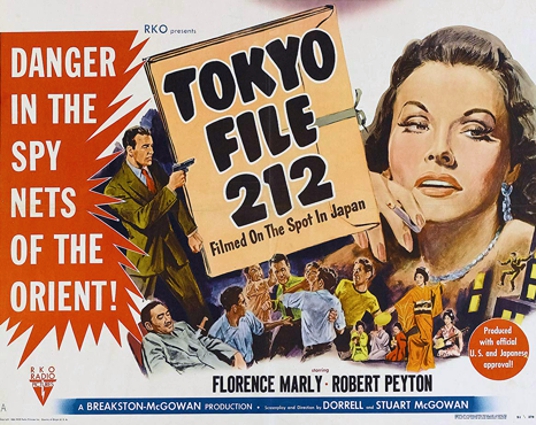
TOKYO FILE 212 (1951)


This American-Japanese double-billed film, distributed by RKO Radio Pictures, could not get any more “B.” From the start of filming to it being put "in the can" took about two months. The acting is okay, but any scintillating dialogue was left in a manila folder, perhaps File 207. The bland dialogue may be an effort to suggest the film was “shot as it happened” using the everyday people involved. I am being kind. Except for some actual military personnel, it is simply a cast of unknown actors in a speculative story filmed entirely in Tokyo, a Hollywood first. It is an innovative take on the Korean War, suggesting Communist spies were working from Japan to sabotage American operations. Certainly not a preposterous premise. Despite the film’s average packaging, the pacing is good, and the Tokyo settings add realism and mystery. Albert Glasser’s rousing opening score certainly gets your attention. The eighty-four-minute movie was not a success, with mixed reviews from critics and ticket buyers alike.

The story is told with voice-overs by a U.S. Government Agent, the sometimes billed, Robert Peyton. His voice and mannerisms seem too intimate for the big screen and better suited for television, where one can get small but perceived as big. The bulk of the movie is told in flashback after a briefcase bomb explodes near his chins. Since he is telling the story, we know he survives the blast, but we do not know what miracle befell him. The climax does have a logical, eye-opening resolution. Officially, he was not a body double for Fred MacMurray, but one might disagree, below.


After checking in at the front desk, Peyton finds Francis Marly, a mature Euro-tart making herself at home in his room. Perhaps the funniest thing in the movie is that she talks seductively in the third person. Being a debonair geek, he is attracted to her "fit of flirts." We are never sure if she can tell the truth. They become an odd team even though he suspects her of being a Communist sympathizer.

Peyton came to Japan to find an old college classmate, Katsuhiko Haida, who is suspected of joining the Communists. Haida’s father tells Peyton of his son’s backstory in a World War II Kamikaze 101 class, where they use scale models for practice. One student is slapped by the tough instructor for timidly and repeatedly not zooming his plane in the right area of a carrier model, thanks to an improper grip on the model. No successful Kamikaze 101 student gets a typical diploma. They get funeral rites. But the war comes to an end, and Haida is crushed that he will never be able to go on frequent Kamikaze missions. He is despondent and vulnerable to Communist propaganda.


The leader of the Communist ring, Tetsu Nakamura, is all very honorable when in Peyton’s presence. Just a sweetheart. Peyton’s informer, however, tells him to be wary of his secret ingredient when he dines with him. Poison. Peyton makes an attempt to add a bit of (awkward) suspenseful humor to this scene. 

The girlfriend of Haida is played by the exceptionally cute Reiko Otani. She is abducted by the Commies, then dumped on the road without so much as an apology. While in the critical care unit, Haida secretly visits, and they express their undying love for each other. Never use any form of the word “dying” in her presence at this point. Haida has an epiphany and is no longer on the dark red side, using all his kamikaze skills to defeat Nakamura. For Peyton, it is on to File 213.

Note: The film provides the moviegoer with good exposure to mid-century Japanese culture. If the film has any assets, it would be this. Many of these scenes carry no dialogue as we follow Peyton through the streets and bars of Tokyo. This in itself saved a ton of production money. There is a scene in a sleazy Japanese-only bar where rowdy, drunk, tattooed men are doing what they would not do unless in a crowd. There is a fully clothed female dancer, after a fashion, on a table. When Peyton and Marly enter in search of Haida, the place becomes dead silent. like two Jewish men entering a Nazi bar. The U.S. Military Police tell them that the bar is off limits and suggest, for their own safety, that they leave.

March 9, 2019

SMALL SCREEN ENDEAVOR


NIGHT CHASE (1970)
A Fugitive Can Never Stop Running

Cinema Center 100 Productions, a five-year-run theatrical film production company of the CBS Television Network, is responsible for this ninety-five-minute television “thriller-ette” based on a story by producer Collier Young, former husband to Ida Lupino and Joan Fontaine. It was directed by Jack Starrett, with Mort Stevens taking the helm as music supervisor, who shows great restraint in using Laurence Rosenthal's score. It is a good eight minutes into the film before we hear any instruments, letting the sounds of everyday life at an airport terminal and the banter between two very different men draw us in. Some nice jazzy touches from time to time. I liked this film when I first viewed it, thanks almost entirely to Hoyt Bowers' casting the small screen wonder, David Janssen, opposite Yaphet Kotto. This is a character study of two men from diverse backgrounds thrown together by happenstance, with one a dreaded backseat driver and the other becoming his underpaid psychologist.


It is not a difficult stretch to imagine this is a hypothetical sequel to the popular series, The Fugitive. Janssen remains on the run even though his knees cannot take any more pounding. He hires a cab, going against his usual wily evasive tactics. We find him looking down at the floor a lot with sporadic Kimball-like comments. He embarrassingly glances from side to side, still wary of his relentless pursuit. He changes his name, of course, and lets his sideburns grow to further bamboozle the police. He even boards a bus near the film’s end. Fred Johnson has been serving time in federal prison, yet Janssen continues to run, but for a different reason. Lieutenant Gerard is not interested. He has had enough.

The film opens with a leg cam following Janssen to a hotel room, where he opens the door and fires twice. He has little doubt the man responsible for his second wife’s divorce papers was killed. So devastated by his impending divorce and assumed murder rap, he is convinced he has little reason to live. His small handgun, now two bullets shy of a full chamber, is still with him. He may have to use it on the police or himself. 


The film remains intriguing well past the halfway point. The subsequent night drive encounters, Janssen’s amazing pool shooting skills, and Kotto’s attempted escapes are captivating. As an example, when Kotto writes a note of help to a service station attendant, the fugitive suspects as much and rips the paper from the clipboard before it leaves the taxi. Everything holds together until the San Diego Zoo segment drags on for fifteen minutes with repeated insertions of screaming monkeys or growling tigers. This, too, may remind one of The Fugitive's two-part finale in an abandoned amusement park. A few obvious stunt doubles earn their pay climbing walls and such. The passenger, for all his high salary smarts, is not nearly as grounded as the driver, who finally convinces his fare that there is no prison term hanging over him and zero chance of ever seeing that one-armed man again.

Note: This premise is simple: a long, expensive taxi fare from Los Angeles to San Diego. Some might find the film boring, but it is a good effort, especially after rediscovering it long after you have forgotten about it. Kotto has first-hand experience of running and incarceration. He tries to persuade Janssen to stop running. A difficult sell to a guy who successfully ran for four years to keep out of death row. I can only imagine selling the script to the network chiefs about two men in a taxi on a one-hundred-twenty-mile night drive with very little chasing. Still, not nearly the difficulty Roy Huggins had with selling his Fugitive concept. 

November 17, 2018

THE PRIZE (1963)


This rather long, illogical Communist spy yarn, distributed by MGM, fits the era and is more suspense than thriller, more nonsense than common sense. Director Mark Robson formed the Irving Wallace novel into a blend of intrigue and sarcastic wit.  Alfred Hitchcock's influence is quite evident, even in the glaring process screen backgrounds, but there is certainly nothing low-budget about this film, what with the lead cast's salaries and crew in Stockholm. The intricate plot takes about fifty minutes to get propelled, while the subplots lengthen the film with no relevance after exiting the theater. Right from the opening credits, with its use of snare drums and syncopated rhythms, you may guess correctly that Jerry Goldsmith wrote the score.

Newman arrives in Stockholm with skepticism about receiving his Nobel Prize in Literature. His lack of Nobel enthusiasm and less-than-classy behavior does have its effect on attendees. Newman tells the press he has not written a book in years and wonders why he was nominated in the first place. The committee is aghast to learn he has maintained a living by writing pulp fiction detective novels. All their noses automatically turned upward.

Elke Sommer, in her first American role, serves as Newman's assistant upon arrival. She is strictly by the book and expects no hanky-panky on the drive from the airport. Every moviegoer knows it is just a matter of time before she succumbs to Newman's bright blue eyes. Her character is one-dimensional and not thoroughly defined, relying only on her memorable attractiveness and stacked hair. Which was all that was needed for most males of the era. No one came out of a Sommer film stunned by her acting skills. Do not confuse this film with another of her roles in The Oscar (1966). That film takes the prize for the most embarrassing high-profile film of the Sixties. I digress.


On a 180-degree career path to Sommer is the classically pretty Diane Baker. Her upper-class, reserved appeal is her strongest asset for her intermittent role, with little to suggest she is integral to the script. She plays the niece of Edward G. Robinson's
 pivotal character. But there is little for him to do. He is also on the Nobel ticket but is kidnapped by the Communists with his “identical twin brother” taking his place. The plan is to move Uncle Edward behind the Iron Curtain, giving his brother the propaganda opportunity to make disparaging remarks about the U.S. during his acceptance speech. When Robinson 2.0 unites with Baker, it is not clear if she is part of the scheme or not. But Newman notices a change in Robinson's manner upon their second meeting, but no one takes him seriously except a couple of Communist agents. Newman becomes their primary target. His wit goes into hiding.


For a writer with little appetite for real-life dangers or the expertise to handle such, Newman manages a couple of fantastical escapes. His processed “Hitchcockian” fall into the river is reminiscent of the falling scenes in Vertigo. How he survived such a free fall, one may wonder. However, the real prize goes to the scene with the Communists trying to run him down on an iron truss bridge. Not successful, the agents pursue on foot. A farm truck approaches the bridge in a blur. Newman runs to the opposite side of it. After it passes, the agents are dumbfounded by his vanishing act. Even if Newman knew where to get a superhuman handgrip on the side of the truck, the force would have pulled his writing arm from his shoulder socket! His screams of agony would have made him easy to track. But there he goes, clinging to the side of the truck, face to face with a goat, in 007 glory. It is a ridiculous moment.

In the end, Newman has the Nobel thrust upon him anyway, making little sense after insulting the Nobel committee, nor for doing anything to warrant it. Like former President Obama receiving his Nobel during his first year.

Note: On the road to a career peak, after a few speed bumps, this movie is tailor-made for the likes of Newman. An anti-establishment figure with grumpy witticisms. Doubt there were other “A-listers” as appropriate, though James “Our Man Flint” Coburn comes to mind. Not necessarily James Dean, had he lived. Newman inherited a couple of roles that were slated for him. Then again, Dean, displaying his lack of interest in the Nobel Prize upon his arrival in Sweden, may have bested Newman's portrayal.