Showing posts with label mystery. Show all posts

July 18, 2025

SLEEPERS WEST (1941)


Distributed by Twentieth Century Fox, this seventy-four-minute mystery sets a brisk pace with an energetic, Irish-tinted opening theme by Cyril Mockridge. It is adapted from the novel,
Sleepers East (1933), and the 1934 film, about a ten-hour train trip from the Midwest to New York, not to be confused with Sleepers, Awake, a Lutheran hymn by Philipp Nicolai, made famous by Johann Sebastian Bach in 1731. But I digress. The screenplay is full of dialogue: suspenseful, sometimes tedious, and amusing. Although the climax speeds things up, there is only an attempt at action for this entry.

Lloyd Nolan plays Michael Shayne, the fictional private detective created in the late 1930s by Brett Halliday. He rolls along as a cool, confident detective with a witty delivery in his occasional New England accent. Nolan is certainly likeable in the role. A character who would prefer to calm things down before things get violent. This is the second of seven Shayne mysteries for Nolan and perhaps the most enjoyable.


Before boarding The Comanche from Denver to San Francisco, Nolan bumps into his ex-fiancė, Denver newspaper reporter Lynn Bari. Their repartee and zingers are fun. Discovering that she will be on the same train, he gets excited, "It'll be like old times, travelling around together!" "Oh no," says Bari, "Travelling with you, I always wound up alone." The fun ends when both recall who left who at the altar. His assignment is to protect a surprise trial witness, Mary Beth Hughes, who sneaks aboard as a medical patient and serves as his cue to reestablish contact.

Hughes' testimony will free an innocent man accused of murder and throttle the chances of an unethical politician's advancement. The screenplay initiates an inconsequential subplot between her and Jean Louis Heydt. Hughes eventually feels comfortable enough to share her slow, detailed backstory of why she is on the train. After dozing, I discover he is abandoning his family to "find himself" by himself in South America. He proposes they get away together so she will not need to testify. 


Bari's unethical fiancė, a lawyer and associate of the crooked politician, suggests she might have a big scoop if she locates the witness by using Nolan. Under his cabin door, Bari slips a note suggesting Hughes needs to see him immediately. Noting the distinct handwriting, he knows who wrote it. He leads Bari on. She finds him in the train's drawing room, where he is assumed to be hiding Hughes. He says she may be looking for a woman he saw with "fuller brush eyelashes." Their clichéd 
Banter does provide Nolan with some zingers, but Bari tries to make the scene funnier than written. 

Known for his comedic chops, Edward Brophy (above with cup) adds periodic comic relief as a railroad detective, dashing at the last moment to get on board. Self-conscious, he does his classic puzzled double-takes with a wrinkled brow when he feels his appearance or character is subtly being insulted. He is having difficulty discovering who he is assigned to follow. To add embarrassment, he receives a telegram near the end of the film stating that the agency accidentally booked him on the wrong train. 

In a shocking, unexpected scene, the passenger train hits a scale model fuel truck, igniting its fuel inside the cab, killing the engineer, and disabling the locomotive. Nolan needs a vehicle or someone to take him to Ogden. Character actor George Chandler is your man. He brags about his Ford Model-T, open-air automobile, in great mechanical detail. But Nolan just needs to get going. Bari overhears their conversation. Nolan momentarily steps away, and she, Hughes, and Heydt are now Chandler's passengers, leaving Nolan to fend for himself. By himself. The home of a kindly Eastern European lady provides the trio with shelter because Chandler's beloved car has stalled. He cannot understand how this could happen. Nolan arrives in time to tell the whole truth about Hughes, and Bari's underhanded kindness is just for headlines. Hughes convinces Heydt to return to his family, and they "forever-do-part."

The film ends on a happy note at a diner where Hughes is now a waitress. 
Bari broke her engagement with her duplicitous, self-serving fiancė somewhere through Nevada. Nolan wants to rekindle his romance with Bari and vows to put a ring on her finger again. Putting him at bay, she orders a sandwich with lots of onions, and he protests multiple times. Relenting, she changes the order. Garlic instead. The sandwich killed their future. She never reprised her role in the series. Hughes, on the other hand, returned, each time as a different character.

Note: Ben Carter provides laughs as a porter welcoming Heydt aboard the train. Carter mathematically explains how long it will take to arrive at the next town, with eyes looking upward in thought and a confusing mixture of addition and subtraction. Heydt had transferred his cash to his suitcase. Carter later enters his cabin to straighten things, but he accidentally drops the suitcase to reveal the contents. He is dazzled by the nine or ten thousand dollars, then quickly says, "Get behind me, Satan, and tie my hands!" He embellishes the amount to another porter, Mantan Moreland, who then raises the amount. In the end, the last porter raises the amount to five hundred grand!

May 1, 2023

SHACK OUT ON 101 (1955)


This movie surely got lost on its opening weekend, but no need to apologize for their efforts. You will enjoy this rather unconventionally titled film. One might think this is a filmed stage play as ninety-five percent of the film takes place in a diner [set] along California's Highway 101. The viewer gets hooked in the first five minutes, and past this point, the plot slowly unfolds. A story not about the life of Pie, but centering around a common theme during this period: national security. This slow-burn film has an interesting mix of humor and mystery during the “who do you trust” era. Condense this down to under sixty minutes, and you would have one of the better
Alfred Hitchcock Hour episodes.


All the diner's patrons interact with numerous one-on-one conversations. There is Lee Marvin, a character who swings from lecherous slob to comical buddy. Everyone's cliched short-order cook. If Marvin seemed to be underappreciated mid-century, he did not go unnoticed. He is quite versatile here, handling a pivotal dual role. He has a lot cooking, but it is not chili. Keenan Wynn, the sarcastic eatery owner, does not like Marvin's attitude and apparently his cooking. Their verbal jabs is the daily routine. He and Marvin have the funniest scene during their weight-lifting challenge. It is full of sarcastic insults as each tries to "out man" the other. Lean and lanky, Marvin is hilarious.


Throw in smokey-voiced tenor, Frank Lovejoy, with a few secrets; throw in a naive waitress, Terry Moore, and you have a reason to show up at the diner. Despite her top billing, this is Marvin's film. If you are expecting Whit Bissell to show up, then you will not be disappointed. He plays the D-Day buddy of Wynn’s character. Len Lesser (Seinfeld’s Uncle Leo) and Marvin seem to have a long-standing relationship. Their odd mock "boxing match" at arm's length with opposite ends of a towel between their teeth would seem to have a childhood history.

Note: This eighty-minute suspense drama was directed by Edward Dein with a twisty screenplay by him and Mildred Dein. It was produced by William F. Broidy Productions and released by United Artists Pictures. The ever-present Paul Dunlap offered up the music score, starting off with a jazzy jukebox number.

March 6, 2023

TWENTY PLUS TWO (1961)


This American mystery film is directed by Joseph M. Newman and is adapted from Frank Gruber's 1961 novel of the same mysterious title. Ten years into Gerald Fried's career is a period-specific jazz band score. The prolific television composer's opening theme here suggests a private eye caper. Close enough. The film was released by Allied Artists Pictures (uh-oh) and stars David Janssen, Jeanne Crain, and Dina Merrill, with a dandy performance by Jacques Aubuchon. Fans of Janssen will be pleased, if not the entirety of the film. His downplayed trademark acting skill is well suited for this role. This film is sandwiched between Janssen's television success with the Richard Diamond series and his phenomenal hit, The Fugitive. There are touches of both characters in this film, from his potential smile twitch at the right side of his mouth, a general awkward nervousness, and his occasional glib humor. I have centered my comments only on the actors and the production. There are no spoiler alerts except this one: far left, the poster suggests Ellie Kent is an integral part of the film. On the contrary, she has an uncredited bit part, and a viewer's sneeze will make one miss her entirely. 

Set ten years after his Korean War service, Janssen plays an investigator [privately] specializing in locating lost heirs and perhaps bringing closure to any unresolved issues. His interest is piqued by a teenage girl who went missing a decade prior—perhaps dead or alive. It leads to encounters with a detective associate, the mother of the missing girl, and a former flame. Surprisingly, such a talkative film holds one's interest thanks to Janssen's performance and a well-paced script. Not all “talkies” come off this well.


The early scene between Janssen and Aubuchon—tailing him everywhere—lays down the personalities of both characters. Aubuchon needs his services to locate his brother, who may be using an assumed name. His sophisticated demeanor and superior attitude are amusing and off-putting to Janssen, whose humorous counters to his proposal are subtle highlights. Just who is using assumed names in this film is something Janssen needs to unravel. This in itself provides most of the script's twists.

Coming off his role in The Magnificent Seven is Brad Dexter, once again at his smarmy best. No one, including the viewers, trusts this guy. Crain is the past flame of Janssen, who insists on rekindling those dying embers. Her "Dear John" letter, while he was in the war, still stings after ten years. Time to move on, you two! One wonders why her character is even in this film, but she has a connection to Janssen's investigation.

The production itself has its problems. One is the year that the young girl disappeared from school. It is not consistent throughout the film—like the film editing. I have not spent enough time figuring out how the Twenty Plus Two title fits into this film since I have not read the book. Who has? Perhaps it is the year of the missing girl's birth advanced to what would be her current age: twenty...plus two. Except that Merrill is thirty-eight! There is a ten-year flashback in the final third of the film set in Japan that might have been less of a surprise had the film used the alternate title, It Started in Tokyo. During this flashback, Janssen's acting persona comes off as much younger—an awkward young adult—something Merrill does not accomplish. This brings up a problem early in the film when Janssen and Merrill are seated on a United Airlines flight.

He cannot quite place where he has seen her. She apparently has no clue who he is. This makes sense until that late flashback blows this whole scene to smithereens. How a highly trained investigator is unable to recognize the woman with whom he had a pivotal fling simply because of her altered hair color is beyond reason. Maybe the hint of "crow's feet" emanating from her eyes threw him off. The suspension of disbelief should not have to stretch this far. It is kind of like Richard Kimble "dying" his hair black for four years. Oh, wait.

Note: On the positive side, whereas low-budget film companies were notorious for switching aircraft mid-flight, United Airlines provided all the airline footage. So the Douglas DC-8 remains constant throughout the film. 

August 1, 2022

ALLIED ARTISTS PRODUCTIONS

I am highlighting three of the five crime movies released by Allied Artists—each roughly an hour long—that are all quite routine. The films center around the Los Angeles police department and, in particular, a no-nonsense police lieutenant, the low-energy Bill Elliott. He seems out of place in a modern-day setting after his popular cowboy daze. 
 

DIAL RED O (1955)

This slow-moving, sixty-three-minute film, directed and written by Daniel B. Ullman, is as predictable as daylight. Not as obvious at the time was Allied Artists Production's intention to produce four more crime mysteries over the next two years. Rather intriguing [confusing] is that the symbol “O” actually represents the zero on the phone's dial. Apparently, the operator can offer a great deal of assistance no matter the circumstance. In a nutshell, the film opens with a mysterious, intriguing escape from a veteran hospital's psychiatric ward. A war-torn, highly decorated World War II and Korean War veteran seeks his wife, who is preparing divorce papers. His escape initiates an all-out manhunt, not really sure if the veteran is unstable or what his plans are for his wife's life. The police department enlists the help of an undercover policewoman, played by Elaine Riley, to help locate the escapee.

Keith Larsen plays the even-tempered, well-mannered veteran whose potential contact with his wife, Helene Stanley, is his only reason for going AWOL. In fact, he plans to return to the hospital that evening. But the audience is way ahead of him as we learn she is involved with Paul Picerni, a Realtor paying for her fancy apartment. In the habit of making demands, she wants Picerni to also get a divorce. Immediately. Temper's flair, he is slapped, and he judo-chops her to death, as his combat and Realtor training come into play. He returns to his office to call a few clients as an alibi for his whereabouts. By happenstance, Larsen spots his realty office lit up. The two Marine buddies have a cordial reunion with Larsen, hoping he has seen or heard from his wife. Picerni's devious wheels start turning. He contacts the police about his concern over Larsen's visit. Larsen is jailed but bamboozles the officer with a clever combat trick and escapes. Marlin Skiles' score finally makes itself evident as the escapee heads straight for Picerni, and the two combat-trained vets share a few bullets in total darkness. But you cannot bamboozle Elliott's good judge of character. That, and Stanley's autopsy, reveal a detail that dooms Picerni.

Note: Bill Elliott, popular cowboy star for the past two decades, plays Lt. Andy Flynn in this first outing. He is the constant in the series. It was soon brought to Allied's attention that there was a real Andy Flynn in Los Angeles law enforcement, so for the remaining films in the series, the lieutenant becomes Andy Doyle. Elliott is about as tight-lipped as a ventriloquist and appears to really miss the slow pace, prairie campfires with his horse, Sonny.

________________________________________________________


SUDDEN DANGER (1955)

Tom Drake "guest stars" in this week’s episode of television's "CSM: Crime Scene Mystery" series. Except this film was never meant as home entertainment, being the second film from Allied Artists Production, Inc., about a Los Angeles detective, Bill Elliott, solving another crime with repeated questioning and methodical deduction. Like the other films in the set of five, it is a talky procedural offering with zero excitement until the last-minute climax. Viewers will know that point when the otherwise dormant Merlin Stiles' score explodes. With less professional performances, the film could have been a laugh-fest. Elliott seems a bit less wooden than in his first installment, and he is able to smile appropriately in this routine whodunit.


The film opens under the credits as we watch men's shoes and dog paws walk on a sidewalk. The Thom McAn's belong to Drake, and the paws to his seeing-eye dog. The German Shepherd barks and refuses to go inside their apartment. The natural gas smell is heavy, and he yells for his mother, but it is too late. Elliott investigates the apparent suicide of the woman, a clothing manufacturing company executive. There is substantial evidence that does not support suicide, and all eyes are on her son, who lost his sight years earlier due to his mother selecting what she thought were eye drops. Feeling pretty embarrassed since that day, her insurance policy designated it to go toward his eye surgery. After a successful operation later, he feigns his blindness under sunglasses around his mother's attorney and insurance agent in the hope of finding clues to the murderer. Drake is helped by his girlfriend, Beverly Garland, a swimsuit fashion designer for the company. Typically, near the halfway point in the film, Elliott already knows who staged the suicide.

Note: Minerva Urecal plays the apartment manager where Drake lives. Her negative attitude causes trouble for him when she gives false details to Elliott. This frequently happens when someone does not have any facts to back up their opinions. Another Hollywood stalwart, Frank Jenks, plays a bartender with his usual facial contortions. Garland more often than not played strong characters—like in this film—when she was not screaming at a creature in a science fiction film.

__________________________________________________________


FOOTSTEPS IN THE NIGHT (1957)

This film opens with a teaser. We see a man leave his motel kitchenette to find his poker partner dead in the other room. This all plays out as the camera focuses on a record playing part of a jazzy Marlin Skiles score. A flashback repeats the scene in sequence as the movie unfolds. Directed by Jean Yarbrough, this is the fifth and final film series by Allied Artists Productions Inc. that follows detective Bill Elliott with the Novocaine upper lip. A man of controlled emotions with suits bought off the rack. Don Haggerty plays his partner, and they sort of echo the Dragnet series at times during their idle, barely humorous, chit-chat. This sixty-two-minute film is a talk-fest of interviews between witnesses and those who are anxious to help the department track down a murderer. Pretty boring stuff with Elliott not quite fully awake. He headed for the “Sunset Retirement Corral” after this film. Never mind the poster. Amazingly, no women were attacked in the film.

Douglas Dick, looking at times like the higher-foreheaded brother of actor Roger Smith, has had a serious gambling problem in the past, but when we are introduced to his character, he has put all that behind him. Thanks, in big part, to his fiancée, Eleanore Tanin. His acquaintance and motel neighbor, Robert Shayne, has not kicked the habit and pesters Dick into playing a small-stakes game of poker with him. Shayne is not meant to be likable in his brief role. In order to clear some debt and put Shayne in his place, Dick decides to clean him out, then suddenly calls it quits. Shayne is irate that he is not given the chance to win it back and promptly leaves the room in a huff—to get ice for their drinks. The opening scene returns, though the viewer never witnesses the murder.

We later learn of the somewhat humorous premise about the world's fastest strangler, played by Gregg Palmer. In his confusion between two different motels with similar names, he accidentally kills Shayne in bungalow 8 at the wrong motel. The “Bungling Bungalow” strangler intended to kill and rob James Flavin, another bungalow 8 motel occupant. In the murderer's defense, he and Shayne share a similar appearance from behind. Elliott does not figure Dick for a killer, but Haggerty, who never saw the opening scene, bets otherwise. See Dick run. See Dick get apprehended.

Flavin is a spark of fun in an otherwise droll screenplay. Noted for being a typically high-strung Irishman, he is an extrovert of the highest order in this film. A flamboyant salesman who flashes his big-money roll around to attract big business. Spend money to make money. He drives a station wagon loaded with every option. Where he gets his car serviced plays a pivotal role in his future. Elliott wants to use him to flesh out the strangler. Flavin finds the plan exciting until he is informed that he will be the bait for the killer. His excitement wanes momentarily.

Palmer has finally caught up with Flavin in the correct motel just as Elliott planned on his 36” x 24” stakeout drawing. Before strangling Flavin from behind, the baiting police step in. The killer pushes Flavin into Elliott, escapes, and drives away. The gunshot sound effect during this ”exciting” ending sounds like any number of old Saturday morning cowboy shoot-em-ups. Palmer speeds off, leaving the viewer wondering if he gets away. We are suddenly back in the squad room to wrap up the movie with “Deadpan Elliott” explaining to Dick and Jane...er...his fiancé what exactly happened. Tucked neatly within the dialogue is a reveal that Palmer was actually wounded during his getaway. He did not get far and lived a simple life on behalf of the state.

Note: Elliott's other two Allied films are Calling Homicide (1956) and Chain of Evidence (1957).

July 25, 2022

D.O.A. (1950)


This film is hardly unknown to any film buff, and there are countless reviews of its groundbreaking premise. It is one of the great films in cinema, regardless of the budget. I have elected to focus only on some memorable elements that stand out. Few movies ever opened with this level of intrigue. First up is the captivating opening sequence under opening credits. The innovative behind-the-back view of Edmond O'Brien—under a driving Dimitri Tiomkin score—as the viewer follows his brisk walking down the hallway of a police station—is always on pace with O'Brien's gait. If a director is saddled with a routine script, just hire Tiomkin to better the film. To his surprise, the police have been trying to locate him. To their surprise, O'Brien is there to report his own murder. If there was ever a film needing a big flashback, this is it.

The story and screenplay, written by Russell Rouse and Clarence Greene, of intertwining characters, need the moviegoer's full attention. Probably a tad long at eighty-four minutes, it is directed by Rudolph Maté and produced by Leo C. Popkin. The cinematography by Ernest Laszlo is as powerful as Tiomkin's score. This "mystery murder" has indeed become a classic.

O'Brien's performances are rarely subtle. Here, he possesses all the pent-up rage of an accountant and notary public who is not dead yet. His backstory ramps up while on vacation. The director includes a laughable and silly slide whistle sound effect numerous times whenever O'Brien spots a female, which would seem to indicate his main reason for a vacation. A noisy sales convention party in the adjoining suite gets his attention. The salesman and their locally acquired female companions want to paint the town, and the accountant is invited. It is a bad omen for O'Brien, whose drink is unknowingly switched at the bar. 

Later, feeling ill, he visits a hospital that sets up a second powerful sequence about the physicality of O'Brien. After getting the doctor's diagnosis from swallowing a deadly luminous toxin, he bolts from the office in wide-eyed panic. I have always been impressed with actors of this era running full bore in Florsheim dress shoes on pavement. Forrest Gump has nothing on Frank Bigelow. The thirty-five-year-old fluidly descends down the hospital's long set of outdoor steps—feet are two blurs. I like to assume this was done in one take. He sprints down crowded sidewalks and across mid-town traffic, setting a new notary speed record with pedestrians unaware that a film is in progress. At the point of exhaustion, he momentarily pauses in front of a newsstand beside a display of LIFE magazines. He then begins a slow walk, gradually picking up determination as Tiomkin's score accelerates with O'Brien's pace. His anger propels him to solve his murder in under forty-eight hours. His secretary, Pamela Britton—hopelessly in love with her boss—is frustrated with his vague answers over the phone. He spares her the bad news, but has no time to chat. The film then settles into a rather routine and somewhat confusing mystery of characters disconnected from the viewer.

Britton provides an early lead about a bill of sale for the toxin, something her boss notarized. In the pursuit of truth, the accountant discovers others have died under mysterious circumstances, all continually intersecting with characters under police investigation. They all filter down to the guy who knows too much, O'Brien. The final confrontation between the murderer and the murdered ends the flashback. O'Brien, in one final laugh-out-loud moment, leans over to speak Paula's name to the police chief, the ever-present Roy Engle, then quickly pushes himself sideways and instantly disappears behind the desk.

Note: There is an indelible performance by Neville “Chester” Brand, the ever-so psychopathic henchman hired to kill O'Brien more rapidly. Before ushering him into a waiting sedan, Brand pokes his gun hard into O'Brien's stomach, who doubles over in pain. Delighted by the pain inflicted, the smirking Brand informs him, “You're soft in the belly!” Chester's expressions and crazed, side-eye views of O'Brien while "driving" the studio car are priceless.

December 21, 2020

COVER UP (1949)


 THE MURDER THAT SAVED CHRISTMAS

This light mystery is hard not to like from its opening scene thanks to the appeal of Dennis O'Keefe and Barbara Britton. In their first clever exchange, Britton pretends to have not noticed O’Keefe on the train even though he sat across from her, facing backward. He is skeptical of her memory and hooks her, "You know I snore pretty badly when I ride backward." “Not true...your eyes were open all the...” His icebreaker is successful. Their delightful dialogue—though not unique—is provided by a screenplay by Jerome Odlum and Jonathan Rix aka O'Keefe. They do a fine job of not revealing the climax in the early stages where one simply has to endure the last thirty minutes or so. Both know how to keep a secret under wraps. United Artists’ released the eighty-three-minute film in February though the story is set at Christmastime. Ignore the poster suggesting this is a hard-hitting murder story.


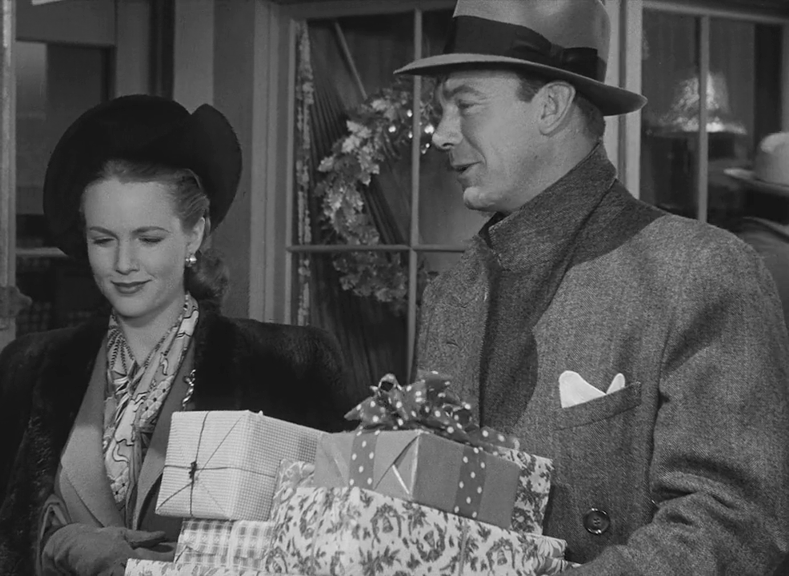
The leads are heading to a small mid-western town where everyone knows who's who. Britton is coming home for the holiday. She lights up the screen with every smile and may never have looked more appealing. Her teenage sister may be the film's cliched annoyance. She is all ga-ga over O'Keefe, an insurance investigator. He is arriving to confirm an apparent suicide but all clues lead to an obvious murder. He should feel right at home in a role he often played. He certainly knew his strengths. Much to O’Keefe’s disappointment, clues are pointing to Britton's father—
the likable Art Baker. His Luger is the assumed murder weapon with his vintage beaver coat figuring into the evidence. However illogical, the small town wants to ignore the past incident.


O’Keefe gets little cooperation from William Bendix, the county sheriff, who also owns a Luger. Falsely depicted in the poster above, he is about as violent as Jed Clampett. The two pros have witty chemistry from their first meeting. The sheriff’s cryptic behavior does not endear him to the investigator initially. Bendix tries to change the suicide subject more than once, suggesting twice he abandon cigarettes and switch to a pipe, his preferred habitual mode. O’Keefe says it is okay—
he owns stock in a cigarette company. The sheriff knows the truth will eventually unravel, but he is not keen on helping the investigator.


It is a rapid climax as the incident is revealed by a single witness. The man killed was not liked by anyone. He was bent on destroying the town, the people, and their future, with hate and gossip. So whether suicide or murder, the locals considered it good fortune. Children will long remember the murder that brought new joy to Christmas.

Notes: There are three characters with amusing scenes. First up is Bendix’s deputy, Dan White, who has no dialogue, finding it more convenient to simply shrug or point. But we first see him hanging up the phone at the end of a conversation! O’Keefe tells him to tone down his chatter on one visit.

Then there is the theater scene with an inquisitive and savvy youngster, George McDonald. He turns around and stares at O’Keefe and Britton for a while before giving opinions about the lame movie playing and some romantic advice. By then, O’Keefe is trying to buy him off with money for another theater across the street. Except the kid has seen that movie. He finally gets what he wanted all along: money for bowling. He and his buddy duck out of the theater.

But by far the most amusing performance is by Baker’s maid to end all maids, Doro Merande (above right). She is a walking encyclopedia of everything that goes on in the family and in town. Her unique delivery suggests she is completely daffy, yet her astute, cutting opinions are delivered like compliments. Her exchanges with O’Keefe are highlights. In their final greeting at the door, he jokingly grabs her at the shoulders, lifts her off her feet, and feigns an attempt to kiss her madly. She is aloof yet not completely against his advances. Later, to help cover for Baker during the investigation, she deliberately sets fire to his old college coat, destroying any evidence of it. She nonchalantly confesses to him before abruptly leaving the scene, "I had a little accident with your beaver coat. I was cleaning it, and it caught fire...burned up completely."

September 4, 2020

FOREIGN INTRIGUE (1956)


Directed and produced by Sheldon Reynolds for Sheldon Reynolds Productions but not starring Sheldon Reynolds, this mystery was a box office success for United Artists in spite of an involved, twisty plot and some confusing characters. Reynolds’ one-sheet resumé includes producing the television show of the same name at the same time. He was quite repetitive. American audiences were familiar with the star of this seemingly long, one-hundred-minute film, but not so much the co-stars. Introduced are Geneviève Page as Dominique and the blonde Ingrid Thulin as Brita. An intriguing character of amusing danger is played by Frederick O'Brady as "Mr. Spring." Except for the lone American, Mitchum, I have referred to the cast members by their character names. The slow-burn plot is not short on intrigue. Enjoy the beautiful camera work with lavish interiors and cinematic outdoor locations. One should appreciate Bertil Palmgren for his excellent cinematography during the final climactic scenes. The dark shadows cast by village archways and rich colors add visual intrigue to this film. The tension mounts with Durand’s two tones from a woodblock percussion instrument—a similar effect of water dripping in a drain pipe. But an unresolved ending may make one throw the remains of the popcorn at the screen, however.


The classically-inspired piano solo composition, appropriately entitled “The Foreign Intrigue Concerto” by Charles Norman, opens the film as Victor Danemore returns to his mansion after surveying his enormous flower garden. At the same time, along the French Riviera, Mitchum enters the film to purchase Danemore’s airline tickets. His exit is in a sleek 1949 Delahaye 135 Cabriolet Chapron, accompanied by a frivolity of strings. Paul Durand’s music is never quite right as Mitchum traverses a beautiful high stone arch bridge in a distant shot—foreshadowing the likes of some early James Bond movies—the music here is a vivid mismatch of scene and score as soft flutes take over, setting entirely the wrong mood. The music is better suited for Mitchum net-hunting butterflies in a field. Visually, that would be intriguing.

Mitchum enters the mansion—chest first—to find Danemore on the floor in a position that would be uncomfortable for someone alive. He informs Danemore’s young wife, Dominique, who is not exactly grief-stricken. All the viewer knows at this point is that Mitchum was hired a few years back to write a glowing account of Danemore’s past life. Glowing but fabricated. Not until near the halfway point does one learn that Mitchum is a reporter. But he cannot get any straight answers on how he obtained his wealth. The intrigue gets underway in a complicated intertwining of tales and characters. Mitchum is particularly perplexed by the shadowing of the bald-headed Spring. Throughout the movie, Mitchum seems so relaxed that he probably suspects what is around the next corner. On the contrary, he is flummoxed at every turn. His most frustrating mystery is why so many want to know if Danemore said anything before he died. Sometime after the funeral, in all her feigned sweetness, Dominique pays Danemore's estate representative a visit to request a sealed document. But she is permitted only to verify that it is sealed. He opens the safe, and the screen fades to black. For a second, I thought I passed out. Mitchum stumbles upon another dead body. 


In an effort to unravel the two recent deaths, Mitchum sets off for Stockholm to meet a man associated with Danemore. Unfortunately, the man is no longer living. His daughter, Brita, is there to greet him. Whenever these two are together, Durand’s score erupts with more strings in a bouncy, slightly baroque repetitious ditty. The American is quite smitten with her playfulness. Brita suggests her mother may be able to shed some light on her late husband's connection, yet Mitchum hits another brick wall.

Spring returns as the self-invited guest in Mitchum's hotel room. They share some sarcastic banter while Mitchum shaves. Nonchalantly, Spring informs him of his orders to kill him for that visit to Stockholm. He slowly lifts a small handgun, then Mitchum knocks the gun from his hand with a towel and an uppercut decks him. After he awakes, Spring rubs his jaw in total puzzlement as to why he was punched so hard since they are good friends. It is back to Vienna for Mitchum, where he is finally enlightened about Danemore’s past from four national representatives (below). They request that he proceed with his prearranged night meeting with Spring. Conveniently hidden from his view, Dominique (bottom) approaches Mitchum at gunpoint with a partnership proposal or else. Those foreign officials are nearby, and she is arrested. 


Note: When Dominique pays a condescending visit to Brita and her mother, it is an editing whiplash of sorts. As the mother appears to further elaborate on her husband, the scene abruptly changes to Mitchum looking through Spring’s suitcase. A few words with Spring, and we are suddenly back to the three ladies as Dominique blabs on about Mitchum romancing Brita, only to get the truth on Danemore and blackmail her with that truth. Then it is back to Mitchum and Spring. Then back to the ladies as Dominique leaves the premises with a threat. It all reminds me of many of today’s television crime dramas, where they incorporate the assumed attention span of a gnat into the story.

July 17, 2020

STREET OF CHANCE (1942)


This early film noir was directed by Jack Hively and it established a number of noir elements that would be used throughout the next decade and beyond. There are moments of excellent cinematography work by Theodor Sparkuhl as his camera may pan out to see where the action is going or for scene transitions. The closing scene, in particular, with an elevated camera, is cleverly handled. The seventy-four-minute film was produced by Sol C. Siegel for Paramount Pictures and generally received good reviews.

Burgess Meredith stars as a man who suffered amnesia nearly a year before the film begins. Not knowing who he was, he assumed a fictitious person. A subsequent blow to his head opens this film which actually eliminates that fictitious character. Yet it creates a second dose of amnesia. Somewhat humorously, and a departure from the typical amnesia gimmick, Meredith now has amnesia about his previous year with amnesia. He is left to figure out who he used to be and why he is being aggressively pursued by men in felt hats. His inner thoughts are periodically inserted as voice-overs. Though Sheldon Leonard is an all-business detective this time around, the audience nor Meredith are sure at first, given Leonard’s trademark delivery, if he is a gangster or not. All Meredith knows is Leonard’s bullets are a bit too close.

Meredith reunites with his wife after their lost year apart. Both are unclear where he has been since “going out for a quart of milk.” With not a single question about his supposed “nervous breakdown,” his former employer hires him back. It takes a couple of days, but Meredith pieces together his old life, taking a chance back on the street where he thinks his troubles started. Second-billed Claire Trevor recognizes him from the old neighborhood and provides shelter from Leonard—who suspects him of the murder of a wealthy family member whom Trevor has been a servant. She does not realize she fell in love with the guy who no longer exists. She is puzzled by his searching questions. They arrive at the mansion where he meets the family’s invalid, elderly matriarch, who was an eyewitness to the murder. Oddly, Meredith realizes she is also mute after glancing over at her...wheelchair? Or so it appears. Through a form of sign language, blinking her eyes once for yes, twice for no, Meredith discovers who committed the murder.

During the final scene, Leonard is on the premises and hears the murderer’s confession. There is a struggle with a handgun and it fires in the unintended direction—one of Hollywood’s most used devices—killing the murderer. The overhead camera boom then ascends up from the mansion’s living room seemingly bursting through the roof in the process. The camera moves with Leonard walking through the movie set and exiting the front door as the boom returns to a ground-level perspective. He lights a cigarette and moves off-screen as a distant “smoker's cough” echoes through the night. Pure speculation about that last bit.

Note: There are a couple of contrived stagings when Leonard pursues Meredith. First is when the two men pass each other on opposite sides of a hand-carried protest sign, obscuring their view of each other. On the heels of this scene, Leonard ducks into a barbershop but does not recognize Meredith behind an avalanche of shave cream.

May 8, 2020

HOLLOW TRIUMPH (1948)


THE QUADRUPLE DO'H!

Based on Murray Forbes’ novel of the same title, this film is better known by its reissued title in the United States, “The Scar.” A title that best clarifies the film’s pivotal detail. This film noir crime drama is supported by a top-notch cast, but do not expect gripping action. Still, few faults here. It was directed by Steve Sekely and released by Eagle-Lion Films. The oldest of seven little Foys, Bryan, was the executive producer while its dual-role star, Paul Henreid served as producer. A dynamic score by Sol Kaplan enhances the film. Riveting at times. The cinematography by John Alton is also noteworthy with some interesting camera positions, lighting, and point-of-view perspectives.

The film opens promisingly as the viewer discovers that the soon-to-be-released prisoner, Henreid, is an intelligent, well-educated man and med school dropout with a tendency toward violence. Lacking zero prison reformation, he wastes no time picking up where he left off. He gathers a team for a big heist at a gambling casino, run by mobster Thomas Browne Henry, the actor with an eagle profile. The robbery goes badly, with Henry eliminating half of Henreid’s team, then placing a hit on each remaining thief.


Henreid escapes by train to another town where his brother, Eduard Franz, has arranged a desk job for him. However temporary. But the manager’s condescending attitude deliberately causes tension, and after repeated badgering, Henreid sends the manager to the office floor with a single right cross. Upset at his brother’s firing, Franz is more upset that Henry’s men have tracked him to his current location. Henreid seeks a foolproof cover and a chance encounter with a dentist, John Qualen, who mistakes him for his friend and psychoanalyst working in the same building. To Henreid's amazement, he has an identical twin from another mother. The doctor and Henreid also share the same accent and vocal range. What luck! Except the real doctor has a scar on his left cheek. Maybe the right?


Illegally searching the twin’s office after hours, Henreid is surprised from behind by the office secretary, Joan Bennett, who kisses her preferred physician. She instantly realizes her mistake and I assume is quite puzzled by her suspended disbelief. On the other hand, as much as she likes the doctor, his scar always bothered her a wee bit. Henreid charms his way into her life. They seem to have a future together until Henreid suavely calls off their “unfortunate timing.” The story of her life. He needs to “disappear.” Joining Bennett in the suspended disbelief ward is the audience that witnesses a contrived identity swap.

Weeks pass, and Henreid gets a job at an automotive service garage. It is from here that the doctor’s car will be returned after servicing, and Henreid takes the service call as a favor to a fellow employee. Confusingly, he has grown a mustache of a useless purpose, perhaps to further distance himself from…himself. Henreid uses a photographic print of the doctor to copy the scar reflected in a mirror. His med school studies were not totally wasted by performing a bit of surgery on his own left cheek. Zero grimacing. A few scenes later, the scar looks like a decades-old scar, skipping the logical progression of a healing scab. For all his smug cleverness, he was unaware he was looking at a flopped image due to incompetent photo processing. DO'H! He first discovers this upon disposing of the doctor’s body. DO'H! In too deep to turn back, he masters the doctor’s handwriting, and his med school studies in psychology continue by using the doctor’s library. All the while, Kaplan’s powerful score intensifies these vignettes.


Henreid now has the perfect cover by tuning out his patient’s chattering while under the guise of a calm demeanor, offering incompetent advice. In quintessential form, gentle Qualen returns for a charming scene in the doctor’s office, unknowingly relaying to the impostor doctor of his past encounter with the twin. He is a wee bit flummoxed, as well. He apologizes for not realizing the doctor’s scar is on the opposite cheek he thought it was.

In a rather slick scene, Henreid takes a phone call while in his fake office and is enlightened to learn the dead doctor had his own girlfriend. Deftly, Henreid covers his identity over the phone and goes with the flow. To make sure he identifies her, he not only chooses the location to meet but suggests, out of pure devotion, of course, that she select an orchid to wear and charge it to his account. He smoothly fakes his way through the evening at a frequented casino, yet he mistakenly calls the ever-present dealer by the wrong name. He is corrected with a blunt reply. 

Aware of Henreid’s studies in psychology, Franz reenters the picture to seek help in finding his brother...from his assumed brother. Oh, brother. He informs him that Henry and his men have been arrested, so there is no reason for his brother to keep hiding. DO'H!

Bennett’s suspicions deepen after overhearing a patient say that her recent sessions seem different. Knowing now that the real doctor has not been in the office for days, she suspects what Henreid has done. Finally. It is a well-acted, powerful scene when they confront each other before she boards a ship, torn between reality and what might have been. Yet still holding out hope the imposter might join her. He does rush to the dock but two thugs corner him, thinking he is the real doctor, who owes a casino a lot of money and is further in debt up to his clipboard. DO'H! It is a tough sale for Henreid to convince them that the doctor they seek has a scar on the opposite cheek.

Note: The automotive service garage provides a humorous scene for Henreid’s fellow, unassuming employee, Alvin Hammer, who shares his passion for a career as a professional ballroom dancer in spite of his short stature. With hand gestures as proof, he believes this disadvantage can be masked by projecting an illusion of height. Henreid could not care less what he aspires to as he glances around the garage, purposely distracted by the inventions in his mind.

December 15, 2018

THE GIRL WHO DARED (1944)


This unmistakably B-movie, with its confusing title, was produced by Republic Pictures and tells of a harrowing weekend with a large cast arriving at a mansion to argue and accuse one another of murder. A second plot concerns stolen radium, which may be easy to find in all the shadowy darkness. This well-performed mystery was directed by the Western matinee staple, Howard Bretherton, who would end his directing career with two television episodes of The Adventures of Superman. This could be the only film with two future DC Comics characters. See my note below. It is a bit confusing to keep the character names straight, to say nothing of the twin ladies who swap clothes. Who is related to whom, or how these people seem to know each other, takes a while to unravel. You will witness the ever-present shadowy figures, lightning, thunder, a pair of hands that clip telephone wires, and women who faint easily, though a simple drink of water revives them. Frankly, I would consult a physician about the fainting spells. The levity is provided by the butler, Willie Best. Highly respected in the business and one of the hardest-working character actors of Hollywood's golden era. 


The opening is somewhat clever. First, the background image under the opening credits is a skull and crossbones symbol. When the credits fade, the camera zooms out to reveal it to be part of a personal invitation as it is being signed. Secondly, brother and sister, Kirk Alyn and Lorna Gray, stop at a service station with minor car trouble. Upper crust Alyn impatiently yells at the lowly mechanic to “look” at the engine; it has a “bad miss” in it. The guy in the overalls, Peter Cookson, is the assumed mechanic. He overhears their party destination and then informs them the engine “looks” like it will need more time to fix. They accept his offer to drive them to the party, then he returns to the station, removes the overalls, and thanks the lazy station owner for the use of them to change his own tire. 

John Hamilton and his on-screen wife are hosting a weekend party that has been all the rage. At least they think so. One of those events that comes around every year, in which you dread an invitation but feel obligated to accept. The planned main event—the only event—is to have their six guests experience the ghost of a sunken pirate ship that appears annually, late at night, right on cue. Like teenagers on a scavenger hunt, everyone gets into their rain slickers and hikes amid lightning and thunder to Heron Point. Off in the distance is Hamilton’s theatrics. To make sure the guests sleep well, he later tells them the ghost was not real, just a device he created for the annual party (yay). Over the years, one would think word had gotten around about this charade. Especially as Hamilton says no one comes up here except by invitation. The “ghost thing” quickly wears thin as one cast member is murdered before returning to the house. Then another, later on.


Cookson returns and removes the distributors from all the guests’ sedans, not allowing anyone to escape. When greeted at the door, it is not long before he becomes the guy in control. No one questions “the mechanic” or why he is interested in what goes on at the ostentatious house. After everyone discovers he is no longer in the house, they assume he is the murderer. But he has better things to do with his time. Find stolen radium. It is at this point that I assumed Gray is the “girl who dared” carry a handgun loaned to her by her cousin, Hamilton, for safety. She is not afraid to point it out, finding Cookson twirling around in the woods with what appears to be a nightclub waitress’s cigar and cigarette display case, but with knobs and lights, supported by a strap around his neck. My initial interest would have been about that case, but she ignores that and accuses him of murder and, well, walking around funny. She learns that Cookson is actually an insurance detective, and (Missy) he knows how to use his radium detecting equipment. Before returning to the house, they discover a secret tunnel and the dead bodies. The ending wrap-up is done in a whirlwind fashion, so you should probably take notes throughout the movie.

Note: There were many atmospheric, house ghost movies during this decade. One may wonder about their constant appeal, but I guess it was an escape from the war. At only fifty-five minutes, it made for a shorter evening for moviegoers. A likable movie to discuss around the office water cooler or cigarette machine on a Monday. Kirk Alyn continued to act into the 1980s but will always be remembered as the first actor to play Superman. The dependable, low-tier actor, John Hamilton, ended his career a decade later, famously as editor of the Daily Planet on television’s The Adventures of Superman series.