Showing posts with label 1949. Show all posts

May 6, 2026

CANDADIAN PACIFIC (1949)


There are several Westerns that have dealt with the railroad's progress to the West Coast during the nineteenth century. Few center on Canada's railroad venture, however. This, then, is the film's only unique element. It opens with current footage of a Canadian Pacific train and voiceover narration about what is to unfold with the findings of a surveyor. Told in flashback, the ninety-five-minute film is directed by Edwin Marin and produced by the prolific Western genre producer, Nat Holt Productions, of film and television fame. Jack DeWitt and Kenneth Gamet wrote the screenplay. The unmistakable sound of small cannon shots when revolvers are fired could only come from 20th Century Fox. The great Dimitri Tiomkin was snagged for the music score, but it nearly vanishes during the film. Expect gunfire, explosions, a fist-fight or two, greedy villains, and a provoked Indian attack. And a lot of green color. In the end, justice prevails for a happy ending to an otherwise routine Western.

If there is a single disappointing element concerning this film, it is the two-color processing known as Cinecolor, a less expensive alternative to Technicolor for independent producers, like Holt. The slightly fuzzy appearance is perhaps the result of the color being "out of register."  The majestic Canadian Rockies never looked more pathetic. The waffling of green and brown outdoors, albeit with hints of orange and faded blue sky, assaults your eyes. Blacks and grays are nonexistent. The color of most interior scenes is reasonably accurate. It appears to be the worst black-and-white colorization attempt until the more recent, cheap digital app conversions. Cinecolor was used superbly for Albuquerque (1948), another Western with Randolph Scott, produced by the successful team of Pine-Thomas Productions. See the notes below.

The film's lead is a no-nonsense, dependable surveyor, Scott. He is again provided a script with a few witty and charming quips and comebacks. Totally removed from his stoic persona, particularly funny is his hilarious, scooped greeting surprise from a top bunk, “Hey… looo,” to a passing Jane Wyatt below, one of two railroad crew doctors. Though she is on the same page romantically, her unyielding pacifist beliefs—choosing negotiation over bullets—are not the “railroad ties” that bind. She refuses to understand that evil must be eliminated, and it usually does not provide opportunities for negotiationLaunching her film debut is Nancy Olson, Scott's first love. She accounts for herself vividly in her film debut at the start of a busy “under-the-radar” career.

A bit bizarre is the real-life thirty-year age difference between Scott and Olsen. A sizable age gap was typical during Hollywood's Golden Age, but this film may have set some sort of record. There is no attempt to suggest she is older than twenty-one. The lead's other love interest, Wyatt, is just under forty, making her the more logical match for growing old in sync.

Scott's nemesis is a myopic villain, Victor Jory, whose saboteurs cause numerous construction delays and the deaths of workers. In true Jory fashion, he delights in his destructive plans. Scott's long-time friend and the railroad's dynamite expert for clearing land is J. Carroll Naish. In a gravitating role, he is a bit over-the-top with his "old man" character and has his share of humorous lines. 

Notes: In 1948, Eastman and Ansco/Agfa introduced improved color film stocks in America, allowing Cinecolor to refine its limited two-component system and achieve more realistic color reproduction. The Albuquerque film benefited from careful studio and costume design that compensated for these limitations, resulting in a "technicolor-like" palette than that of this film. They worked in a lot of orange and turquoise in sets and costumes, colors Cinecolor was known to enhance anyway.
Several scenes were filmed in the studio with a blurred background scenery projection. The filming in the red rocks of Sedona, Arizona, also worked well with the color process. The dull, brownish tones of this film may be the result of the producer, Holt, finding it difficult to handle the overwhelming full color spectrum of Canada's natural scenery. 

Speaking of bizarre, to facilitate Naish's escape from a few attacking Indians, he offers each "dynamite cigars," knowing their cliched craving for tobacco. The preoccupied Indians, inhaling the unlit ends of the sticks, do not see him ride off, but the explosions verify a gruesome outcome. Not that this was ever a reality, the filming faux pas is certain to anger those without any common sense. The scene would have been written out of the script if the producer understood that absurdity has no place in any turn-of-the-century Western tale.

January 22, 2025

ABANDONED (1949)


When I began my selected movie reviews in 2015, I never imagined I would comment on eight films starring the same actor. A record. Dennis O'Keefe had an authentic acting style and a knack for delivering charm and witty quips like few others. Using a few pseudonyms, he was also an under-the-radar screenwriter. From my perspective, O'Keefe hits all the right buttons in my B-movie world.

Distributed by Universal Pictures, this seventy-nine-minute film is a police versus crime melodrama like many others. But the subject matter sets this film apart. William Daniels' cinematography raises the bar, as does Joseph Newman's rapid pace directing. 
As per the era, camera filters transform daylight into nighttime. The film stars Dennis O'Keefe, Gale Storm and Jeff Chandler. O'Keefe appears to extend his character from the film Cover Up, of the same year, with his oft-used charming, witty characters. I would have liked more of a balance between this and his previous T-Men role. One of my earliest posts. Storm restrains her typical bubbly light performances, while Chandler's periodic appearance as a no-nonsense police chief fits him. He also provides opening and periodic voice-over narration for a pseudo-documentary style as if ripped from actual cases. 


Storm inquires about her lost sister at the missing person's bureau at the city hall. Happening upon the scene is crack news reporter, O'Keefe, who overhears the conversation and charmingly offers his services to help her locate her sister, sensing a headline story or maybe hoping for a date. William Bowers' snappy dialogue has several characters delivering witty quips, but none more often or naturally than O'Keefe. He and Storm team upafter a fashion—and he is compelled to test some witty quips out on her. Expect an eventual "get to know each other" moment with small talk as they stake out a residence inside his sedan. Oh yeah...they like each other. 

Someone is tracking them and it sets up another set of clever dialogue. Raymond Burr is yanked from behind and the reporter lifts a revolver from Burr's coat and sarcastically states, "I know. You couldn't sleep so you just decided to take your gun out for a walk." The private eye's client has him also trying to find the sister's whereabouts. The three head for the city morgue and discover the sister is no longer missing, an assumed suicide victim. The sister's out-of-wedlock baby establishes the controversial crux of the film, a baby black market of illegal adoptions. Burr's client is society matron, Marjorie Rambeau, the despicable ring leader of a criminal crew, led by the menacing Will Kuluva. 


Under assumed names as a married couple, O'Keefe and Storm arrange the adoption of her niece with the two-faced Rambeau—suddenly all sweetness. She spends her off-hours distributing Bibles as cover for her operation. The anticipation of leaving the racket and a large payoff, Burr intercepts the transfer and Storm is given the baby and instructed to wait at the house until further notice. Burr is now up to his neck in Kuluva. Not being a very stealthy private detective, he is apprehended by the gangster and undergoes matchbook armpit torture to extract facts. A first (and last?) in film torture to my knowledge. Burr quickly becomes useless to Rambeau. With a knock at the room's door, Storm just opens it without asking who it is, assuming it is O'Keefe. Thus begins the climax, the only tense action in the film, with an implausible car crash and Universal International's gunshot sound effects. Narration closes the story with, "...This did happen in the city which may be your home."

Note: Some who 
discover this film more recently tend to be cynical about the production, impatiently finding it boring. Interestingly, the reviews closer to the release date are generally more favorable. Though mid-century film aspects are dated today, the acting and character development can stand the test of time. One should understand the historical era to give a fair assessment. 

April 3, 2023

THE THREAT (1949)


The film opens dramatically during a night prison break and a constant barrage of machine guns blazing willy-nilly, hoping the guards might hit something moving other than the opening credits. It is an attention-grabbing scene often used during this era. All of which is unknown to Detective Michael O'Shea, recuperating at home from a broken rib. A phone call from the police inspector, Robert Shayne, informs him about the breakout of a notorious homicidal criminal, who had sworn to kill those who placed him behind bars. O'Shea, being number one. Rather than obey his wife's wishes, he goes into action without a single grimace from that rib injury. But before he can even start his patrol car, he is kidnapped by the cold-blooded killer. Few films start so compellingly. That cannot be said of the ending.

Typical of O'Shea's B-movies, one would never call him truly tough, especially when compared to Charles McGraw, in another evil role. With gasoline prices hovering around thirty cents per gallon, the criminal trio is happy to burn the police car's tank as they make the rounds delivering “death warrants” on a District Attorney and nightclub singer, Virginia Grey, in a familiar role at odds with a man who thinks she squealed on him. Like many in today's films, it is another criminal who does not comprehend why he spent time behind bars in the first place, preferring to blame others for his despicable lifestyle.


Known only by McGraw's alias, an unsuspecting Don McQuire is hired to pick up a load in his moving van at a designated location. He gets a bit suspicious after seeing what is loaded into his van: a police car. This weighs heavily on McGuire's conscience. The van is later abandoned and unloaded, and he tries to beg off and return with his van. But all seven end up at a dilapidated shack in the desert, thus beginning the brief slowdown in the film. Suspended disbelief is needed when they enter the dusty, cobweb-infested shack that appears to have not been inhabited for twenty years. McGraw growls out a command for Grey to make some sandwiches. Pretty amazing she could find anything ediblecertainly nothing to spread on or meat to place between two slices of rock-hard, moldy bread. Those “sandwiches” do appear to be simply two slices of bread. Yum. 

Not fully grasping the gravity of the situation, McQuire again demands to be set free, swearing not to rat on the gang as he heads for the door. McGraw, stone-cold, calmly addresses him by name. Knowing he will probably be shot, he angrily takes his seat back inside. McGraw uses O'Shea to send a misleading message to Shayne over the police car's radio. But he uses a “code name” that only his wife will understand. The gang stays put until the arrival of their escape plane, leading to their portion of the loot. The hostages are rightfully concerned that there is only room for three passengers upon takeoff.

This RKO Radio Picture film is a hard-hitting sixty-six-minute crime drama from a screenplay by Dick Irving Hyland and Hugh King from King's own story. Edited by Samuel E. Beetley, it is supported by a music score by Paul Sawtell. Though not the first film noir that comes to mind associated with Charles McGraw, this obscure film is a good one to finish out the 1940s.

Note: O'Shea's police training seems to get the upper hand on McGraw from the adjoining, locked, hostage room, but the killer starts firing randomly through the door, hitting O'Shea in the leg. Already known for his high threshold for pain, the bullet in the leg nor the broken rib fazes him in the least when he drops down from the rafters onto McGraw. Welcome to "make-believe" shack.

May 2, 2022

LIPPERT PICTURES SERIES

Robert L. Lippert controlled a successful low-budget American film production and distribution company from 1948 to 1956, producing short, fast-paced westerns and crime films with a penchant for obligatory humor and the occasional jarring edits. This is my fourth of seven Lippert films.


TREASURE OF MONTE CRISTO (1949)

Though the opening narration tries to justify why this movie has "Monte Cristo" in the title, there is no mention of swords or high-waist tights. Well-directed by William Berke and distributed by Screen Guild Productions, it attempts to bring Alexandre Dumas to modern-day San Francisco, complete with a prison escape of sorts. It is another fast-paced Lippert production making a likable film from a constrained budget. And it only removes a mere seventy-eight minutes from your life. It is one of Lippert's better films, centered around a descendant of the Count and his sizable fortune. As expected, some would like to intercept that treasure. The duped descendant tries to unravel reality during one of his most improbable weeks. The location cinematography by Benjamin Kline puts the viewer on the streets. He even uses a "gun cam" behind the gun's barrel of one detective firing bullets. A competent score by Albert "B-movie" Glasser is well-utilized.

Dashing Glenn Langan is the descendant, a Second Mate on the shipping freighter, Pacific Queen. After dropping anchor, he rescues an assumed damsel in distress, Adele Jergens—the real-life wife of Langan. He and Jergens never looked better than in this film. I doubt anyone in the theater believed her backstory about her mental hospital stay, so her guardian could control her wealth. But Langan does. Jergens wants an "arranged" marriage to deflect her pursuers. So it is off to Reno. He becomes the latest Hollywood simpleton completely unglued by a female's lying lips.


In the captivating opening scene, the Cristo fortune liaison is knocked unconscious while recovering in the hospital. Paralyzed, except for the ability to move his eyes, Langan visits him in hopes of discovering his point in the film. It sets up an unintended funny moment. Needing yes or no answers, he suggests the patient move his eyes back and forth, left to right, for the appropriate reply. But it appears he is simply looking at one side of the room, then the other, in terror of the strange noise of an attacker. Blinking would have had a less humorous outcome. While Langan leaves the hospital, the liaison is permanently silenced, with Langan set up to take the fall.
The traditional flashing newspaper headlines inform the viewer of his sentencing to die quicker than his marriage ceremony.

It is rare to find Steve Brodie in an educated professional role, yet true to form, he is a crooked underworld lawyer with a studio caterpillar mustache passing himself off as Langan's best defense. But his scheme already included Jergens, and he plans to throw the case, removing Langan from any inheritance. Despite his limited screen time, he provides the only spark in the film. Something he often did.

From a story by Aubrey Wisberg and Jack Pollexfen, the screenplay is intelligent enough, once it gets past Dumas' original intention. In keeping with a number of Lippert productions, a bit of amusing obligatory dialogue is spliced in late in this film. Sid Melton, the weasel working on Brodie's behalf, abducts Jergens, ushering her into a waiting car. Rising above his comical looks, he assumes he might be worthy of her attention. "You know I'm single?" Her deadpan reply is, "I can understand that." She gets shuttled around again by Brodie, and she frightfully asks, "What are you going to do?!" He replies, "Two things, and you're the second."

Note: Langan's character was taken in as a young child by an Italian family. His “Papa” and two sons visit him behind bars on more than one occasion. Papa is played by Michael Vallon “witha-the-worsta” stereotypical Italian accent. In keeping with their criminal heritage, the two sons later spring Langan during a prison transfer, shooting out a tire on the police vehicle and arranging for his change of clothes from a well-planted panel truck.

April 18, 2022

THIEVES' HIGHWAY (1949)


This film is based on A. I. Bezzerides novel, Thieves' Market. Who better to write the screenplay? Directed by Jules Dassin and distributed by 20th Century Fox, it includes stunning cinematography by Norbert Brodine in and around San Francisco. Without a doubt, the most enduring element of the film is Dassin's directing, capturing the wholesale produce world. I had no idea fruit delivery could be so cut-throat. He also subjects the viewer to the realism of an unreliable delivery truck with a drivetrain held together by sweat and blood from the owner's knuckles. Not far behind on the enduring scale is the cast of Richard Conte, Millard Mitchell, Lee J. Cobb, Valentina Cortese, and Barbara Lawrence.

Fans could not get enough of Conte, yet he is nearly typecast as another optimistic WWII veteran returning home to disappointment. The role is tailor-made for him as he seeks justice and revenge—not necessarily in that order—for his father's debilitating trucking accident. Conte spends the film trying to settle the score with Lee J. Cobb in a "plastic toupĂ©e." He is a swindling produce racketeer responsible for the “accident” and stealing his father's shipment. His trademarked angry frown is enough to sell his character. He is the classic bully who lacks any real courage and is ultimately downsized by Conte's tenacious pursuit—speaking of bleeding knuckles.


The aforementioned rickety, decades-old delivery truck owned by Conte's father is now in the greasy hands of his partner, Millard Mitchell, who consistently comes across as the most average soul one could encounter. The viewer is never aware he is acting. A character not loaded with book learning but is in command of an abundance of common sense. He is so genuine here that one believes he really can repair the heap of abuse he is driving. On Conte's first meeting with him, they bump heads about money owed to his father, but Mitchell stands his ground on principle. This appeals to Conte's ethics. Mitchell is all too familiar with Cobb's tactics, and after their verbal sparring, they agree to exact revenge on him.

The partners cross paths with two wholesale scavengers competing for a profit, a rotund Jack Oakie—aka Slob—and his driver. Oakie provides subtle comic relief with a jolly nature but a shady approach whose primary purpose is to finagle a way to deliver produce with as little work as possible. Noting the heap Mitchell is piloting, it becomes routine to follow the truck in the hope it will die a quick death, inherit his load, then split the profits. But Oakie's underlying good nature grows on his competition.

Cobb's deeds continue by crippling a tire on Conte's truck. After the blowout, he pulls over onto the roadside bank of sand or loose dirt, his truck listing to one side. Why anyone would try to jack up a truck under these dangerous conditions makes little sense, nor is it a surprise that something bad will probably happen. When the ancient jack collapses under the sandy soil, it provides the film with its first tense moment. But you cannot crush a lead actor at this point in a movie. Following not far behind is his lifesaver, Mitchell, who later discovers way too late about his cut brake lines during a clichĂ©d downhill mountainous route. The scavengers witnessed the crash, and the sabotage is all too familiar to Conte. To keep him at a distance, Cobb arranges a “girl for hire,” Valentina Cortese, to distract him. Her sensitive performance relaxes the film's middle, and she is wise beyond his understanding, even suggesting his fiancĂ©e, Barbara Lawrence, is not as true to him as he thinks.

Thieves' Highway is a film noir that has plenty of content to pace it, yet its ninety minutes plus seems a tad long. It is a satisfying film for the most part, yet not the first film noir that comes to mind about truck drivers. Except for the fruit angle, this melodrama seems all too familiar. Still, given the competent cast with Conte in another signature role, I imagine moviegoers were not disappointed.

Note: Considering Conte's cool projection of warmth, it is difficult to picture either Dana Andrews or Victor Mature in the lead role. Both were bandied around as the lead during the film's development. Mature had his own decent trucking film eight years later, The Long Haul.

March 7, 2022

LIPPERT PICTURES SERIES

Robert L. Lippert controlled a successful low-budget American film production and distribution company from 1948 to 1956, producing short, fast-paced westerns and crime films with a penchant for obligatory humor and the occasional jarring edits. This is my second of seven Lippert films.


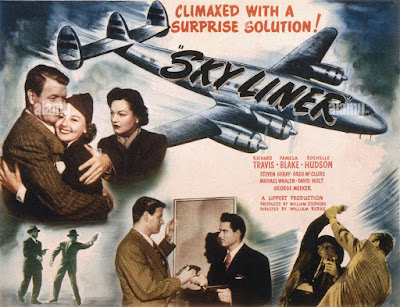
SKY LINER (1949)

Sky Liner is a sixty-one-minute espionage film that takes its time getting airborne. As a double-billed, lower-bunk-bed offering, it lacks all the excitement expected in a crime film. Had it been released today, it would have gone directly to subscription streaming. It is Cold War mania as a handsome FBI agent gets caught up tracking down pesky Communists on a westbound flight. The storyline is a bit hard to follow with an opening set-up leaving the viewer wanting explanations, mostly about who signed off on the haphazard music score. Lippert Pictures produced a boring yet fast-paced film. Quite a feat. On a positive note, the second half of this film is more interesting. Perhaps the only recognizable actor in this “air-noir” is Richard Travis, yet he is mostly known for one film, the 1942 comedy, The Man Who Came to Dinner. His laid-back, slightly naive supporting role worked well for him there. For this film, the FBI agent is laid back from the opening nearly to the halfway point before establishing his identity. The movie starts to gel with his involvement, yet he is unable to ignite a single spark plug.

A sharp-shadowed silhouette with a revolver in hand enters the office of an American State Department official. A bit of visual trickery as viewers expect a gunshot to ring out. But the attacker simply uses the well-placed butt of his gun to the skull, resulting in manslaughter. Assuming the identity of the late official, he boards the plane with Rochelle Hudson, secretary to the official. Unfortunately, it will not be necessary for the imposter to fasten his seat belt before landing. With the help of a stewardess, Travis sets a trap for the murderer on board, intercepting Hudson before she defects to the Soviet Union. When confronted, the traitor reveals information helpful to the moviegoers.

Travis quickly wraps up the plot essentials with Blake in case there are still those puzzled before leaving the theater. What is truly puzzling is why two elderly ladiesin early twentieth-century apparel—close out the film amusingly. It is totally without precedent and not as useful as Sid Melton's obligatory appearances could be in Lippert's films. Caught up in their own fantasy, they watch with hearts aflutter as Travis and Blake kiss before entering the terminal. The duo decides then and there to apply for an exciting position as stewardesses.

Note: There are many low-budget films where airliner continuity is of no concern to the director. Obtaining stock footage could be expensive or difficult to come by. The worst examples have a plane taking off as one type and then "transforming" in flight into a different type or airline. The triple-tailed TWA Lockheed Constellation in this film remains intact throughout, even if subtle markings do not. No doubt, the aerial footage may have come from TWA or Lockheed for promotional purposes. Perhaps a case in point, that final landing in the film—at the recently named Los Angeles International Airport—is just opposite the Lockheed factory.

September 6, 2021

THE CLAY PIGEON (1949)


This American film may not be included in anyone's top ten film noirs, but there is little to fault here. There is never a dull moment. Starring in the B-movie is Bill Williams' rather bland performance due to his vocal tone and delivery. Barbara Hale holds her own, however. The real-life husband and wife were in their third year of marriage when this film was released by RKO Radio Pictures. It is a tidy sixty-three minutes of suspense, competently directed by Richard Fleischer with a screenplay and story by Carl Foreman based on a true story. The cinematography of Robert De Grasse should be noted, specifically his positive-negative effects during one flashback.

An intriguing opening scene has a former World War II prisoner-of-war patient, Williams, awakening from a coma at a naval hospital. He overhears the doctor and nurse mention his court-martial for treason, and he shoots straight up in bedface in the camera. He is accused of informing on fellow inmates in a Japanese prison camp. His amnesia makes for a foggy past and a perfect candidate for deception—hence the film's title. Not convinced of his guilt, he escapes from the hospital and contacts two people he hopes will help him recapture the truth.


Williams' first stop is the widow of one of his POW buddies, whom he greatly admired. Hale knows who he is, and the newspaper headlines fuel her dislike of him. There is an intense physical struggle [fight] between the two that is well-played and believable. Though somewhat implausibly—after confessing to being a nice guy—he gets tough with her, forcing the audience to wonder if he should receive some sort of punishment. He gags and threatens her at gunpoint, while he calls his best friend, Richard Quine, another ex-POW. I will just say he is pretty irate to get the call, as if he has something else planned. Overhearing Williams's sincere conversation, Hale starts to change her opinion. Her gag order is lifted. Expect the obligatory roadblock out of town with Williams—not yet sure she can be trusted—pointing a gun and saying something silly like, “Don't try anything.” This is never believable. Those flashbacks help clarify his past for him and the audience. Williams needs to be eliminated before he recovers his memory. Leave this to thugs Richard Loo and Robert Bray.

Note: Williams and Hale hide out in a trailer park while he fully recovers from another blackout caused by the initial hit on the head during the Japanese prison camp. The scene is filmed at the Paradise Cove location where Jim Rockford will eventually park his trailer for the popular comedy detective series, The Rockford Files.

May 17, 2021

RED LIGHT (1949)


George Raft is the successful owner of a large trucking firm. His bookkeeper, Raymond Burr, is sent packing on embezzlement accusations. The scene shifts to Burr and his fellow inmates watching a newsreel which includes highlights of Raft welcoming his young brother home from the war. Raft would seem to be more mayor than businessman to rate a newsreel feature. As the film's “reel of revenge” turns in Burr's mind, the projectionist, Henry (Harry) Morgan, is in the same frame of mind. The clipped, monotone dialogue between them is an unintended humorous exchange of two vengeful guys. Morgan was adept at playing disturbed, simple-minded individuals. Again, he is downright scary here. Also typical of his early film career, Burr is cold-blooded. Embezzlement was nothing. Expect another hanging lamp over his shoulder in the otherwise darkness. With nearly four years behind him, Morgan is due for prison release—on good behavior—and follows through with Burr's request. Kill a minister of the Gospel. Raft's brother.


This is a good example of a forgotten film noir in the waning months of a challenging decade. It is a solid endeavor with a flashback or two, unexpected twists at the end, and more than its share of assumptions. The cast is a no-fault affair of respected actors with a familiar Raft in a fedora pursuing personal justice. The film is based on the story by actor Don "Red Ryder" Barry, "This Guy Gideon," with an underlying Biblical lesson about vengeance and who will ultimately administer it. The misleading change of title is understandable, as few would buy a ticket if Raft were a Gideon Bible salesman. But not much thought seemed to go into it. The film is not about traffic violators in San Francisco, though the opening credits over a dark background are revealed to be the tunnel approaching the Golden Gate Bridge. I sort of get it. Red means stop. The eighty-three minutes is competently directed and produced by Roy Del Ruth and distributed by United Artists. It possesses the quintessential harsh shadows and engaging camera angles of cinematographer Bert Glennon. Still, the film would lack a great deal of depth without the rolling thunder score by Dimitri Tiomkin. His pounding rhythm elevates the film several notches. His repeated motifs—some from an earlier composition—are appropriately applied with a subtle recurring adaptation of Schubert's Ave Maria.

The final cryptic words to Raft from his brother, Arthur Franz, mention a Bible. Raft's assumed lead is to search the scriptures for a clue to the murderer's name. Rifling through the pages is a time-consuming waste of time for him. He prefers pounding the pavement in search of the Gideon Bible stolen from a particular hotel room. Burr, now also out from behind bars, wants to bury the hatchet and seek work with his previous employer. While there, he overhears Raft recounting his brother's last moments to his trusted employee, Gene Lockhart. Burr assumes he needs that book first. The middle of the film has Raft seeking his own revenge, interacting with an assortment of characters who had stayed in that particular room. The most fortuitous is Virginia Mayo, who agrees to help in his search, though she soon tires of his lack of forthrightness. It is a pretty strong role for her and appropriately not ostentatious.


Raft's next lead takes him to Reno, and is soon aware Morgan has tailed him. He sets up a sting with what looks like an indexed Bible and purposely leaves it unattended on a counter. Morgan takes the bait. At gunpoint, Raft ushers him off to the hotel room he shares with Burr. The murderer discovers it is nothing more than a cookbook. There is a brief tussle before Morgan escapes out the window, taking a bullet with him. Later on the train back to San Francisco, he tells Burr he is through with getting shot at. Burr understands. An uppercut knocks Morgan from the speeding train.


Mayo has found the specific Bible and points out to the myopic Raft that his brother simply wanted him to read what he had circled, Romans 12:19—his plea to not seek revenge, along with a personal handwritten scribble for Raft. Cue the Ave Maria melody. It is the start of Raft's transformation. Burr, the elephant in the room, shows relief in his soft, boxy face. Imagine his surprise when face-to-face with the smoldering, bleeding Morgan, whose revenge is unsuccessful but proves that one may survive a header off a speeding train if you are in a Hollywood movie. Raft's rooftop neon company sign is the next staging area for the usual Hollywood chase upwards to nowhere. The viewer expects the obligatory death plunge by Burr, only bouncing a couple of times after hitting the pavement. But it becomes a science lesson that rain and electricity should not simultaneously come together. Fried Burr-ito.

Note: A particularly cruel and startling segment involves Raft's trusted employee, Lockhart, his trucking dispatch officer. It is a dark evening when he makes his way to his car. It will not start. The distributor wires have been cut. Burr is hiding in the shadows, waiting for his moment. Lockhart is spooked and stumbles backward under a truck's trailer. Burr calmly approaches and kicks the jack away, which is suspending the trailer. 

March 15, 2021

CHINATOWN AT MIDNIGHT (1949)


Hurd Hatfield's character is a thief in San Francisco's Chinatown with murder as a resumé enhancer. His current partner in crime is an unethical interior decorator who employs him to steal artifacts she has her eye on, selling each for profit, somewhat like buying multiple sale items from a local store and reselling them on Amazon at a markup. They have been through this many times, and his cool, aloof demeanor assumes she had better not ever cross him. In pursuit of her next possession, he kindly asks one shop attendant to wrap it. For his own anonymity, he coldly shoots and kills both store workers. And he is just getting started. Using his best Chinese, he calls the police about the robbery, going through a central switchboard operator for the connection. A major oversight. But he becomes even less clever as the film progresses. He ditches his overcoat in a trash bin to throw off the police search. The coat is tracked to where it was last cleaned, and before long, they have Hatfield on the run.

Sam Katzman produced this sixty-seven-minute noir with the era’s oft-used voice-over narration to keep the viewer abreast of the story as it unfolds over twenty midnightsas if ripped from the headlines. There is no lack of suspense or intrigue, but the implausibilities start to stack up. Hatfield is perhaps best known to television viewers for playing arrogant, devious, or diabolical characters. His captivating performance keeps this formulaic Columbia Pictures boredom at bay. Jean Willes, who would become a television staple, has an early credited roleinsignificant in the grand scheme.


A lieutenant investigates Hatfield’s apartment and discovers his unique record collection. Among them is a Chinese language tutorial and the Top 20 hit, "I Think I’m Turning China-ese." A clever element in the film is the use of a wire recorder to press additional records of Hatfield’s practice sessions. A big stack of records is distributed to those who might have had contact with him. The switchboard operator taking that earlier robbery call recognizes Hatfield’s voice. 

Hatfield, complete with a Western Union-type uniform, poses as a bicycling telegram deliverer with a wire for one resident, his landlady. The police officer stationed outside the apartment unknowingly lets him pass. To keep her from phoning the police, he muzzles and ties her up, grabs a few items, including his prescription, then pedals off with a smirk. He stops to wipe his brow with a handkerchief. Out pops the prescription bottle for malaria, but he does not hear the thick glass bottle hit the pavement, even though the sound department makes it quite clear. He seeks a new prescription at a drug store, where the pharmacist, Byron Foulger, states it must be authorized by a physician. Hatfield immediately calls from the phone booth inside the pharmacy, picks a doctor at random, and calls Foulger a few feet away. “Doctor Hatfield” says his patient was just in to fill his prescription. Testing the script's credibility, it cannot justify the quickness of Hatfield calling a doctor other than from inside the drug store, or how he suspiciously returns so quickly. Foulger is completely oblivious, capping the implausibility of it all.


Now knowing of his medical condition, the police figure out how far a guy like Hatfield could walk with malaria, assuming he does not use a taxi. It narrows their search area to another apartment complex. A savvy undercover policewoman poses as a census taker. Hatfield provides phony information. For all his assumed smarts, pretty dumb to even answer the door. He is suspicious, of course, and watches her pause by a phone in the hallway. But she covers her exit by knocking on one of the apartments she nearly “forgot” about. With the police surrounding his apartment, they provide a permanent remedy for malaria.

Note: Amid the seriousness of the investigation, a bit of levity lightens the mood throughout the film. The police captain, played seriously by Tom Powers, keeps sending the lieutenant mentioned above out on the case. The hapless lieutenant also keeps reminding Powers he has time off coming and expects to use this time once his assignment is completed. But Powers repeatedly ignores his pleas and sends him out about three or four more times. Indeed, a final humorous exchange ends the film as Powers tells the lieutenant he can now take that vacation...unless he needs him for something important.

December 21, 2020

COVER UP (1949)


 THE MURDER THAT SAVED CHRISTMAS

This light mystery is hard not to like from its opening scene thanks to the appeal of Dennis O'Keefe and Barbara Britton. In their first clever exchange, Britton pretends to have not noticed O’Keefe on the train even though he sat across from her, facing backward. He is skeptical of her memory and hooks her, "You know I snore pretty badly when I ride backward." “Not true...your eyes were open all the...” His icebreaker is successful. Their delightful dialogue—though not unique—is provided by a screenplay by Jerome Odlum and Jonathan Rix aka O'Keefe. They do a fine job of not revealing the climax in the early stages where one simply has to endure the last thirty minutes or so. Both know how to keep a secret under wraps. United Artists’ released the eighty-three-minute film in February though the story is set at Christmastime. Ignore the poster suggesting this is a hard-hitting murder story.


The leads are heading to a small mid-western town where everyone knows who's who. Britton is coming home for the holiday. She lights up the screen with every smile and may never have looked more appealing. Her teenage sister may be the film's cliched annoyance. She is all ga-ga over O'Keefe, an insurance investigator. He is arriving to confirm an apparent suicide but all clues lead to an obvious murder. He should feel right at home in a role he often played. He certainly knew his strengths. Much to O’Keefe’s disappointment, clues are pointing to Britton's father—
the likable Art Baker. His Luger is the assumed murder weapon with his vintage beaver coat figuring into the evidence. However illogical, the small town wants to ignore the past incident.


O’Keefe gets little cooperation from William Bendix, the county sheriff, who also owns a Luger. Falsely depicted in the poster above, he is about as violent as Jed Clampett. The two pros have witty chemistry from their first meeting. The sheriff’s cryptic behavior does not endear him to the investigator initially. Bendix tries to change the suicide subject more than once, suggesting twice he abandon cigarettes and switch to a pipe, his preferred habitual mode. O’Keefe says it is okay—
he owns stock in a cigarette company. The sheriff knows the truth will eventually unravel, but he is not keen on helping the investigator.


It is a rapid climax as the incident is revealed by a single witness. The man killed was not liked by anyone. He was bent on destroying the town, the people, and their future, with hate and gossip. So whether suicide or murder, the locals considered it good fortune. Children will long remember the murder that brought new joy to Christmas.

Notes: There are three characters with amusing scenes. First up is Bendix’s deputy, Dan White, who has no dialogue, finding it more convenient to simply shrug or point. But we first see him hanging up the phone at the end of a conversation! O’Keefe tells him to tone down his chatter on one visit.

Then there is the theater scene with an inquisitive and savvy youngster, George McDonald. He turns around and stares at O’Keefe and Britton for a while before giving opinions about the lame movie playing and some romantic advice. By then, O’Keefe is trying to buy him off with money for another theater across the street. Except the kid has seen that movie. He finally gets what he wanted all along: money for bowling. He and his buddy duck out of the theater.

But by far the most amusing performance is by Baker’s maid to end all maids, Doro Merande (above right). She is a walking encyclopedia of everything that goes on in the family and in town. Her unique delivery suggests she is completely daffy, yet her astute, cutting opinions are delivered like compliments. Her exchanges with O’Keefe are highlights. In their final greeting at the door, he jokingly grabs her at the shoulders, lifts her off her feet, and feigns an attempt to kiss her madly. She is aloof yet not completely against his advances. Later, to help cover for Baker during the investigation, she deliberately sets fire to his old college coat, destroying any evidence of it. She nonchalantly confesses to him before abruptly leaving the scene, "I had a little accident with your beaver coat. I was cleaning it, and it caught fire...burned up completely."

June 19, 2020

JIGSAW (1949)


This seventy-two-minute production by Tower Pictures Inc. and distributed by United Artists is a film noir with a title suggesting a puzzle and not the subject of a home-tooled horror movie. Its most distinguishing aspect is the brief cameo appearances of several major Hollywood stars in the film's early stages. But do not glance down to grab some popcorn or you might miss one. Considering the similarities of this film’s subject with Communism, their support of the film can be explained to the audience's delight. The producers thanked them for their goodwill at the very end. Each appears as inconsequential characters: John Garfield, Marsha Hunt, Everett Sloane, Henry Fonda and Burgess Meredith. Marlene Dietrich has the most clever appearance when she leaves the actual nightclub, “The Blue Angel,” the title of her early signature film.


An opening exchange between Franchot Tone and Myron McCormack is very telling about self-absorption. The insightful scene is apropos for the current century. McCormack is the tough newspaper editor who pulls no punches. When a local printer pays the ultimate price, he is convinced his death was not a suicide. The widow hysterically insists that fear can be a terribly effective weapon. Special prosecutor Tone argues these hate groups are just harmless lunatics. A hopeful guess, but no, says McCormack. "The murder was carried out by a neo-fascist organization calling itself the Crusaders. It is their dream of power or political success, and a financial scam to generate profits. Where he grew up, nobody cared what country each came from. They got along. Then hate gave them derogatory terms for their beliefs or ethnicity. Ignorance is the vehicle and hate is the avenue for attacking an individual’s ideology." McCormack wraps up by saying, “Americans do not understand why they are supposed to be different.” He finds out firsthand (above right) what hate can do when dictated by a short script.

Franchot Tone holds the film together with ease and a subtle coolness. He is very adept at delivering witty lines. He is an assistant district attorney determined to flesh out those responsible for hate crimes in his city. Tone is connecting all the pieces of the puzzle, but a few are not fitting properly.


Playing the widow of a prominent judge, Winifred Lenihan throws a dinner party for movers and shakers. Her tiny voice and snooty New England dialect with a syrupy delivery suggest she expects something in return. She makes it a point to introduce Tone to several influential men whom she believes can help his career. Nudge. Nudge. Foreshadowing a questioning Jack Webb on television's “Dragnet,” the camera abruptly cuts between Tone and the men as each looks directly into the camera. While conversing with Tone, one only sees their lips move in silence. Tone's sarcastic voice-over interprets each man and their ambitions. Jean Wallace, introduced as a singer at “The Blue Angel” nightclub, is also an invited guest. Tone is surprised yet pleased to see her. What is a nice girl like her doing at a creepy party like this? Tone and Wallace, recently divorced in real life, have some cat and mouse interaction before she asks him, ‘You’re a special something or other, aren’t you?’ Their scenes provide the only sparks in the film.

The ending takes a definitive noir turn with some nice elevated camera work, casting long shadows from tall interior columns in an art gallery. The Crusaders are there to retrieve incriminating papers hidden behind a particular painting. Gunshots echo through the marble halls, but only the bad die young in this one.

Note: Tone, Wallace, and Meredith would be together the following year in, The Man In The Eiffel Tower. A film that could have been a classic, but the elevator never made it to the top.

March 13, 2020

TRAPPED (1949)


This seventy-eight-minute film arose from a story written by George Zuckerman and Earl Felton. It was directed by a master of realism, Richard Fleischer, and released by Eagle-Lion Films, the poster child of the semi-documentary. The moody cinematography was by Guy Roe, who would, a year later, film Lloyd Bridges in The Sound of Fury, then later the quintessential B-movie crime noir, Armored Car Robbery. Trapped was produced by the oldest of the "Seven Little Foys," Bryan. Like many low-budget crime films of the era, it uses voice-over narration to inform the audience about the thoroughness of law enforcement. In this case, the United States Treasury Department shut down a counterfeit ring. The score was by the dependable Sol Kaplan, whose opening measures sound like a cross between a weekly television private investigator theme and an old movie serial.

Though there may be familiar faces throughout the film, many of whom became prolific on the small screen, it really centers around the characters of Lloyd Bridges, Barbara Payton, and John Hoyt. As an up-and-coming leading man with a casting agent earning his salary, Bridges gets top billing. He was very busy during 1941-42 with thirty-eight films with mostly uncredited roles, learning the ropes. Leading roles became more common after the war. Not classically handsome, his closely set eyes are offset by a distinctive voice, a winning smile, and an abundance of charisma. The established character actor, Hoyt, has nearly identical screen time, however, and is third-billed. It is a nifty crime tale of treasury agents wanting to enlist the help of a counterfeit operative, Bridges, who is currently a model inmate in an Atlanta prison. With seven more years on his sentence, he could be released much earlier if he cooperates to help find the counterfeit plates and those who are circulating the phony bills. The savvy, arrogant, gum-chewing Bridges essentially tells them what they can do with their offer. 


The screenplay pulls off a couple of clever double twists near the beginning. Nighttime finds Bridges on a bus headed for Kansas City, handcuffed to a Deputy Marshall. A car pulls up alongside the bus in the passing lane, the driver looking for Bridges. They make eye contact, then Bridges grabs the revolver of the dozing detective and commands him to “take the jewelry off” and exits the bus for the sedan, driven by Richard Karnes. The whole “escape” was planned in advance with Bridges, giving legitimacy to a phony AP wire story. The officer’s gun was not loaded, and Karnes is a federal agent. During an overnight stay in a motel, at the opportune moment, Bridges initiates a fist-fight with Karnes. Apparently suspecting as much, Karnes “throws the boxing match” to let Bridges be tracked to Los Angeles.


We first see Hoyt as a frequent Los Angeles nightclub visitor, trying to pour on the charm to the cigarette girl, Payton, Bridges’s girl. She assumes he must own two or three oil wells because of his generous ten-dollar tips. Hoyt is actually an experienced undercover Secret Service agent posing as a racketeer. Bridges vouches for Hoyt and enlists him to help “convert” a real twenty-five grand into a quarter million in fake bills.

Hoyt reports to his superior, Russ Conway. In Conway’s first scene, we see him taking notes over the phone, handwriting gibberish on a notepad. Surely one of the worst executions of fake handwriting in film. Like the undecipherable notes taken in a college class while suspended over a cliff of sleep. Then, a few days later puzzled as to why the exam score was so below average. I digress. Admittedly, play-acting is rarely filmed authentically. In another Conway moment, an oft-used scene showcases the clever and effective undercover work during the phone booth era. In order to touch base on the agency's progress, Conway is seated in a diner as Hoyt strolls in. Conway steps to a booth and places a call to the adjoining booth to get Hoyt’s report. A local call.

The counterfeit exchange is set with “the big guy,” James Todd, who owns the counterfeit plates. Todd is no Ted de Corsia. He is too easy-going, naive, and skittish to be believed as the ruthless boss of operations. Rather humorous that undercover agents are placed in several locations within running distance of the exchange location. I assume the homeowners were notified that a guy would be cleaning their screens, mowing their lawn, or who is hand-lettering words on a grocery store’s front window. Turns out to be Todd’s test run because he was not sure he could trust Hoyt. The fake quarter million is nothing more than authentic cut paper.


To raise the level of excitement, later an old Army buddy recognizes Hoyt in the nightclub and addresses him by his real name. Finally picking up on Hoyt’s persistent denial and knowing his government position, he apologizes, and Hoyt thinks he survived a close call. Except Payton overheard the conversation. She and Bridges then find the microphone in her apartment. Livid Bridges wants the real twenty-five grand as payback for being double-crossed. Hoyt gets the money from the bank, but on route to the spurious hotel, meeting with Todd, Bridges tells him, at gunpoint, to keep driving. They turn off the highway onto an ocean-side cliff. Both cautiously exit the car, then Hoyt kicks the gun from Bridges’ hand, and their stunt doubles take over. Bridges loses the fight, gets booked, and is jailed. Oddly, it is the last time we see the leading man, yet twenty minutes of film remain. All we know for sure is, that no early release is indicated on the warden’s Mobil Oil calendar.

The ending is fairly exciting as Hoyt decided to complete the exchange anyway based on bogus information provided to “Todd the Naive.” Hoyt is compromised again by Payton’s unexpected appearance at the gang’s warehouse. Less exciting is the commonplace chase of multiple agents pursuing Todd between streetcars in a maintenance garage. It is the typical scenario with bullets bouncing off a lot of metal. Todd climbs to the roof of one streetcar but uses its overhead electrified cable to balance himself. The good news, he will not serve any jail time. “What's that smell?”

Note: The only humorous dialogue could get overlooked because of its subtlety. When Bridges is booked at another precinct, Hoyt tells the policeman to keep it secret and book him with a different name. The officer suggests, “How about Briggs? It’s my mother-in-law’s name. I just want to see what it looks like on a police blotter.”