Showing posts with label william bendix. Show all posts

December 21, 2020

COVER UP (1949)


 THE MURDER THAT SAVED CHRISTMAS

This light mystery is hard not to like from its opening scene thanks to the appeal of Dennis O'Keefe and Barbara Britton. In their first clever exchange, Britton pretends to have not noticed O’Keefe on the train even though he sat across from her, facing backward. He is skeptical of her memory and hooks her, "You know I snore pretty badly when I ride backward." “Not true...your eyes were open all the...” His icebreaker is successful. Their delightful dialogue—though not unique—is provided by a screenplay by Jerome Odlum and Jonathan Rix aka O'Keefe. They do a fine job of not revealing the climax in the early stages where one simply has to endure the last thirty minutes or so. Both know how to keep a secret under wraps. United Artists’ released the eighty-three-minute film in February though the story is set at Christmastime. Ignore the poster suggesting this is a hard-hitting murder story.
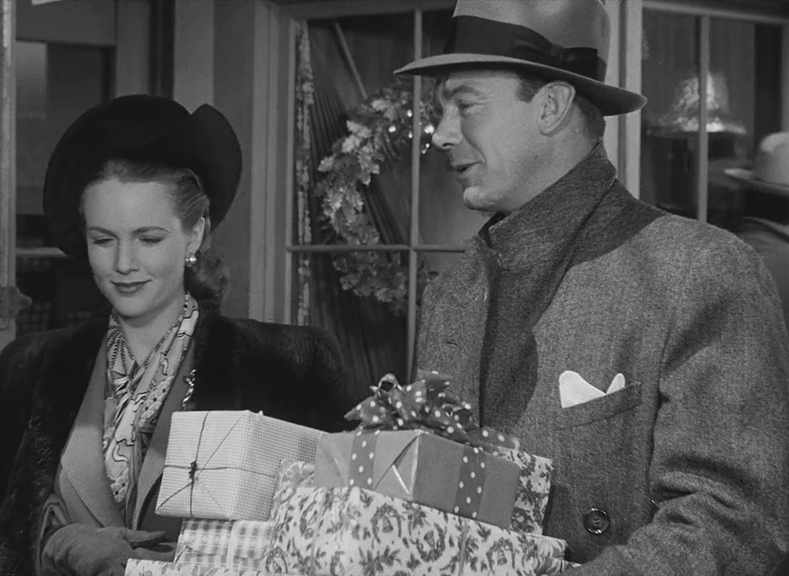

The leads are heading to a small mid-western town where everyone knows who's who. Britton is coming home for the holiday. She lights up the screen with every smile and may never have looked more appealing. Her teenage sister may be the film's cliched annoyance. She is all ga-ga over O'Keefe, an insurance investigator. He is arriving to confirm an apparent suicide but all clues lead to an obvious murder. He should feel right at home in a role he often played. He certainly knew his strengths. Much to O’Keefe’s disappointment, clues are pointing to Britton's father—
the likable Art Baker. His Luger is the assumed murder weapon with his vintage beaver coat figuring into the evidence. However illogical, the small town wants to ignore the past incident.


O’Keefe gets little cooperation from William Bendix, the county sheriff, who also owns a Luger. Falsely depicted in the poster above, he is about as violent as Jed Clampett. The two pros have witty chemistry from their first meeting. The sheriff’s cryptic behavior does not endear him to the investigator initially. Bendix tries to change the suicide subject more than once, suggesting twice he abandon cigarettes and switch to a pipe, his preferred habitual mode. O’Keefe says it is okay—
he owns stock in a cigarette company. The sheriff knows the truth will eventually unravel, but he is not keen on helping the investigator.


It is a rapid climax as the incident is revealed by a single witness. The man killed was not liked by anyone. He was bent on destroying the town, the people, and their future, with hate and gossip. So whether suicide or murder, the locals considered it good fortune. Children will long remember the murder that brought new joy to Christmas.

Notes: There are three characters with amusing scenes. First up is Bendix’s deputy, Dan White, who has no dialogue, finding it more convenient to simply shrug or point. But we first see him hanging up the phone at the end of a conversation! O’Keefe tells him to tone down his chatter on one visit.

Then there is the theater scene with an inquisitive and savvy youngster, George McDonald. He turns around and stares at O’Keefe and Britton for a while before giving opinions about the lame movie playing and some romantic advice. By then, O’Keefe is trying to buy him off with money for another theater across the street. Except the kid has seen that movie. He finally gets what he wanted all along: money for bowling. He and his buddy duck out of the theater.

But by far the most amusing performance is by Baker’s maid to end all maids, Doro Merande (above right). She is a walking encyclopedia of everything that goes on in the family and in town. Her unique delivery suggests she is completely daffy, yet her astute, cutting opinions are delivered like compliments. Her exchanges with O’Keefe are highlights. In their final greeting at the door, he jokingly grabs her at the shoulders, lifts her off her feet, and feigns an attempt to kiss her madly. She is aloof yet not completely against his advances. Later, to help cover for Baker during the investigation, she deliberately sets fire to his old college coat, destroying any evidence of it. She nonchalantly confesses to him before abruptly leaving the scene, "I had a little accident with your beaver coat. I was cleaning it, and it caught fire...burned up completely."

November 23, 2020

CRASHOUT (1955)

This eighty-nine-minute film—about ten minutes too long—is an unnecessary offering about a commonplace Hollywood theme, a clichéd prison break's aftermath. Perhaps six convicts are too many characters involved to be a legit noir. Three is manageable, and the film does center around the three main leads. Regardless of the number, convicts rarely escape successfully in a standard formula like this. I might have enjoyed this more if the cast were mostly unknown actors. These six are well-known, respected actors, all of whom had their turn as crooks or murderers with their membership in the “Criminal Actors Union.” Their polished performances seem a waste for such a routine B-movie. The film has a couple of gritty moments, but even those are tame when compared to some scenes from Armored Car Robbery from five years earlier.

The film was directed by Lewis Foster, who also helped pen the screenplay with his writing partner, Hal Chester. It was produced by Chester for Standard Productions. I think any blame falls directly on these two. The dialogue is not scintillating or original. One example is when the tough leader commands diner patrons, “Everybody stay where you are and keep quiet.” An anonymous jazz score with blaring trumpets is by Leith Stevens. What follows are my essential points in the movie, lacking any spoiler alerts.


William Bendix plays the self-centered, heartless leader at odds with life. If the others want their share of the loot he has hidden in the mountains, everyone will do it his way. Though a versatile actor, with his gnome-like stature, tiny mouth, and definitive nose, he seems better suited for a film’s levity. Nevertheless, the film gravitates around his capable performance as one unhappy individual. The balance of the cast follows his lead. 

William Talman may have been expected as the ruthless leader, speaking of Armored Car Robbery. Close. He is a mentally unbalanced reverend. A convict with knife-throwing expertise and the ability to use a Mercury as a lethal weapon. See my note below. The third main character is Arthur Kennedy. Unlike the other two, he was sent to prison for non-lethal embezzlement. He is an astute judge of character, and his least favorite person is Bendix. Rounding out the cast is Marshall Thompson, the youngest convict with redeemable qualities. Gene Evans, with several loathsome character roles under his belt, is always hungry, and Luther Adler is a scoundrel, moocher, and deviant. 

Throughout the film, the gang takes over a roadside diner, hides when motorcycle cops arrive by swapping clothes with the male patrons, steals a car, abandons it, hides out in a fridged mountain cave, and argues a lot. Only Kennedy is able to wrap up the film during a highly "corn flake" snowstorm, walking past the camera for an interpretative ending.


A favorite scene for me is when the convicts invade Beverly Michaels' country home. Coupled with Michaels is Adam Williams' singular performance (above). He nearly steals the film as a naive young man—a friend of the family. One could imagine his late appearance in the film to be accompanied by canned laughter. Polite to a fault, he is an all-around nice guy arriving to help Michaels in any way he can—perhaps with chores or saving her from preparing dinner. He is not leaving anytime soon. He would like to say hello to her mother. Unavailable. Kennedy, being the good judge of character he is, provides her protection from a couple of "crash outs." In an attempt to have him move on, Michaels tells him Kennedy is her visiting cousin. He immediately spots the family resemblance. He offers him chewing gum, even suggesting all three "take in a picture show." Not able to take a hint, the hidden convicts have had enough of his persistence and come downstairs to make things perfectly clear. A light bulb ignites for Williams.

Note: I will never understand how gullible Hollywood thinks the average moviegoer must be when someone just stands in one place like a possum caught in headlights while a vehicle accelerates toward them. Most times, it can be improved with better film editing. Having a trained police officer with good hearing and common sense, just staring at the approaching car rather than jumping out of the way, is not believable. No amount of suspended disbelief could improve this scene.

April 10, 2020

MACAO (1952)


You are not alone if you think this might be a follow-up to His Kind of Woman, released the previous year, or perhaps its backstory from The Las Vegas Story, released the same year. The film opens with a voice-over introduction about Macao being its own Las Vegas. Coincidence? Of the three RKO Radio Pictures, “Woman” was superior to this box office failure. Jane Russell seemingly uses a slightly altered script and wardrobe of a nightclub singer looking for a gig while snarling a few lame comebacks to any advancing male. Despite its star power, this eighty-one-minute film plays out slower than a one-person rickshaw. That responsibility falls heavily on director Josef von Sternberg, who had few fans among the cast. The screenplay by Bernard Schoenfeld and Stanley Rubin did not make this a memorable experience, either. Everyone’s low-key performance is sleep-inducing, and it takes nearly sixty minutes to get enough energy to overcome narcolepsy. Producer Alex Gottlieb hired the uncredited Nicholas Ray to step in and revitalize the climactic fight scene between Robert Mitchum and Brad Dexter. The result is not noteworthy, so I can only imagine how Sternberg originally planned it.


Memorable is Mitchum's chemistry opposite Russell, his kind of woman. He always earns his salary but glides through this film to ensure his house payment is on time. His trademark walking, as if his knees bend fore and aft, skims across floors with a manikin's upper body. He plays a laid-back drifter avoiding authorities in America. Russell is the only detail that he and Dexter have in common.

Painted into a familiar white strapless dress, Russell could never be called diminutive at 5’ 7” plus heels. Once again, a fabulous necklace fills the vast trapezoid below her neck. Despite a limited vocal and acting range, Russell was blessed with a fine alto voice. Though she appears to be belting out some notes, there is not an equal amount of sound coming out. The curse of early lip-syncing. Also limited is her vocal dynamic, never rising past mezzo-forte for these easy-going numbers. True enough, she was popular just standing still. Russell’s role is not precisely defined, yet she is good enough to pickpocket Mitchum’s wallet in the early going without him immediately noticing. The script subjects both to clichéd misunderstandings, making waves even in port.


Also from that “Vegas” movie is Dexter, again in his stereotypical, mid-century role. He plays the conniving casino owner and underworld boss who hires Russell to sing at his club. He appears to lack sleep for most of the film, perhaps thinking of her night and day. Though wanted by the authorities, he remains safe inside the three-mile limit of international waters. On his leash, doing his dirty work is a knife-throwing Philip Ahn and a slimy police lieutenant, Thomas Gomez, who informs him that Mitchum is an undercover cop. Jealousy over Russell, Dexter tries to bribe Mitchum into leaving Macao with the additional intention of ridding himself of the assumed detective.


William Bendix is introduced as a salesman. Not completely legit, he offers Mitchum a commission if he helps sell a stolen diamond from a necklace to Dexter, who is not interested because it is the same necklace he recently tried selling in Hong Kong. Later, mistaking Bendix for Mitchum from behind, Ahn sends a knife into an obvious protective “corkboard” under his suit coat. The knife wobbles a bit, nearly dropping from his back—Bendix has to hold it in place—before he falls. Ahn is disabled—possibly killed—improbably fast, quicker than a Vulcan nerve pinch by Mitchum’s arm around his throat. Bendix shares his final “sales pitch” with Mitchum.

Note: The three leads all have a turn at potentially funny quips. Rarely do they work all that well. However, there are a couple of noteworthy instances best suited for Mitchum. He asks Bendix what the “C” in his middle name stands for. He sheepishly replies, “Cicero. But keep it under your hat.” Understanding the obvious, Mitchum says matter-of-factly upon leaving the room, “What else would I do with it?” Mitchum is given another zinger after he delivers Dexter to the authorities in international waters. Drenched from going overboard, Mitchum climbs aboard where Russell awaits. They start to embrace, but she cautions him, “You’re all wet!” to which he replies, “You had better start getting used to me fresh out of the shower.” Their future is anchored with a kiss.

July 1, 2017

DANGEROUS MISSION (1954)


There is no faulting the cast of this colorful B-movie with A-list actors produced by RKO Radio Pictures. Outside of these stars, its main claim to fame might be an early effort by disaster film giant, Irwin Allen. The other fame claim is its use of 3D processing which may have elicited a few oohs and ahhs. In whatever dimension it is not hard to recognize the early Fifties RKO touches. Back-projected scenes and less than realistic special effects. It would appear most of the money was doled out for the cast. Which was a wise move. At the peak of his career, Victor Mature gets top billing, followed by Piper Laurie, William Bendix and RKO's go-to man, Vincent Price.

While working in New York City, Laurie stumbles upon the murder of a mobster. She hits the rails to Chicago, and I assume transfers onto the Great Northern Railway's “Empire Builder” and gets a job at the Glacier National Park gift shop. Who could possibly find her there? Mature, for one, who descends rather quickly after her arrival. His suave demeanor, pants with no rear pockets, and those wonderful eyebrows are attractive to Laurie. She is also fond of Price, who is doing his best impression of a sincere amateur photographer. He arrived before Mature and has already established a budding relationship with Laurie. Both are gentlemen as each trade date nights with fairness and civility. Her dangerous mission is to stay alive until the end of the film as the authorities want her to testify. Never mind the silly subplot involving Price's ever-fawning Indian maiden, Betta St. John, who is evidently from the local "naive tribe."


The title is broad in meaning. Though there is really only one character who fits the title best, the dangerous moments do present some interruptions. All of which have more to do with the producer's plan than the plot. Like so many current movies or television dramas, Irwin Allen assumes the viewer has the attention span of a gnat. There is an avalanche during a party in the mountains. A party essentially intended to further introduce characters to square dancing. The crushing avalanche brings down a power line. Mature does not hesitate to climb one utility pole to curtail a dangerous live wire in the likes of Angus MacGyver. He did this frequently as a Marine. Apparently. Then there is a forest fire in which untrained civilians, Mature and Price, are forced into fighting by a stuffed uniformed ranger, Bendix. Though not particularly dangerous, there is a frame-eating Indian ceremony to perhaps capture Montana's heritage or bump up tourism for the coming summer.

Note: The opening and early scenes set the viewer up for a potential crowd-pleaser. The cast is entirely responsible for this potential, though I found Laurie rather one-dimensional and bland. Overall, the movie's pacing is good at holding your attention thanks to the "hair-raising" sequences. Outside of these scenes, it is a routine adventure/drama. The ending, amid sets with glacier paint and studio lighting, brings few surprises though it is fairly exciting with hidden, snow-covered, crevasses. By this point most viewers had already chosen the cast member they hoped would not survive a fall into an icy abyss.