Showing posts with label don castle. Show all posts

July 4, 2022

LIPPERT PICTURES SERIES

Robert L. Lippert controlled a successful low-budget American film production and distribution company from 1948 to 1956, producing short, fast-paced westerns and crime films with a penchant for obligatory humor and the occasional jarring edits. This is my final review of seven Lippert films.


MOTOR PATROL (1950)

This hour-long film opens in an obviously low-budget fashion, yet as an honorable tribute to the motorcycle patrol officers of Los Angeles. I felt like standing to salute during the opening score by Ozzie Caswell—reminiscent of a college marching band or a football newsreel—as motorcycles leave the station in parade fashion. This main theme returns to close out the film. Later, during overlapping scenes of night patrols, he uses a couple of bars of situational comedy music. Certainly worthy of issuing a ticket. There is some location shooting, but expect a lot of back-screen projected scenery during the studio motorcycle “chase” segments. The speedy, climactic cycle chase is especially funny as the hero's fedora is surely stapled to his forehead. Motor Patrol is produced by Robert L. Lippert and Barney A. Sarecky and directed again by Sam Newfield. Fast pacing was a Lippert signature, yet this movie definitely played better in the mid-twentieth century. Other signatures are the occasional abrupt editing.

As each motorcycle peels off from the "parade" to its intended patrol area, the film quickly shifts to the Los Angeles Police Academy's firing range. First up are the female traffic cops aiming at parking meter silhouettes. You can believe that if you want. The male officers only get a tiny dot on a board. The location provides the perfect opportunity to introduce the main cast, Officers William Henry and Don Castle, plus Detective Reed Hadley. Richard Travis innocuously appears later as another detective. Yes, Lippert regular, Sid Melton, does his shtick as a bar owner where everyone knows his name: Omar. The leads work well enough in this dialogue-heavy screenplay by Maurice Tombragel and Orville Hampton, but expect some amateurs in the supporting cast.

Once Officer Henry's character is established, one gets the distinct feeling his days on the force are numbered. The apparent hit-and-run accident he was investigating was simply a cover for an automobile theft racket. Henry pays the price for getting too well-informed. Castle, engaged to Henry's sister, is asked to infiltrate the gang of pre-owned vehicles. The gang employs a tow truck driver—a familiar face from his Warner Bros. days—Frank Jenks, who is suspicious of the new guy. Things really heat up during the final aforementioned motorcycle pursuit. 

February 7, 2020

MADONNA OF THE DESERT (1948)


This sixty-minute Republic Pictures release will go by harmlessly. Directed by George Blair of Republic's Western fame, the film is a modern tale of the West. Do not expect riveting suspense. Screenwriter Albert DeMond included a few clichés for those expecting them in a story that centers around a mobster and an ivory Madonna statue. Though inanimate objects do not possess any power, man-made creations have become symbols of hope for many. Such is the case for the lead character in the desert of Southern California. Rarely has ivory been so beneficial.

Sheldon “Nick” Leonard learns about a priceless statue from his inside man working as an antique swindler...er...dealer, who is also a master at creating exact replica statues. Leonard is pretty much the bookends of this film, hardly seen in the sentimental middle section. Speaking of clichés, it is pretty funny when Leonard calmly chastises his female operative, Lynne “Legs” Roberts, about the importance of doing a caper well. Standing over her, with quintessential gangster mannerisms, he grabs his shirt sleeve cuffs with his forefinger and thumb under his suit coat and tugs on each sleeve as his shoulders rise up on every poignant word.


Don “Joe” Castle, half Rory Calhoun, half Robert Taylor, is the owner of a Renaissance Madonna statue that has been handed down for generations. He believes it has the power to protect anyone who believes in it. Indeed, the power to heal. It also brings good fortune, sort of like Buddha without the belly rubbing. Helping out on the plantation farm is Paul Hurst, a skeptical, experienced farmhand who quickly sizes up any visitor. He has some of the best lines in the film, usually with spot-on character assessments with humorous results.

Leonard makes the drive up in his Lincoln convertible in hopes of buying the Madonna. Apparently, with no one home, he discovers an unlocked door, so he decides to make off with the statue. Castle and Hurst return to find Leonard standing in the back doorway. The shifty mobster instantly becomes an interested “art collector” who is checking its sparkling jewels in the daylight. Hurst does not believe that one, either. Leonard admires Castle’s faith in the statue. Hurst acerbically fires back at Leonard, 'Joe has the faith. I have a club!' Accepting that the statue is not for sale, Leonard graciously leaves. Castle tells his farmhand that he seems like a nice guy. Hurst responds, 'Eh, that guy could give lessons to an eel.'

If the statue cannot be bought, then Leonard is not above stealing it. After meeting mild-mannered Castle, he thinks it should be an easy operation for Roberts, whose assignment will be to befriend Castle and exchange the real statue with a fake one. Leonard tells her that he is one of those 'corny golden rule guys' who probably have never met a real woman in his life. She arrives at the farm on foot after prearranged car trouble, dressed down compared to her first scene. If she is not successful, Leonard will not let her 'play in his yard anymore.' Which is a lot more menacing than it reads, verbally coming from him.


The Madonna has been loaned to an Italian wedding couple for good luck. Castle takes Roberts there to see the statue and for him to honor the family. When she attempts to make the switch, the candles surrounding the altar to the Madonna catch her sleeve on fire. Despite her screams, she shows no after-effects of being even slightly burned. Those in attendance thank Madonna. Roberts thanks her flame-retardant dress. Yet she wonders about that statue. Castle astutely notices a conflict in Roberts’ behavior after her burn notice. She is, in fact, having second thoughts about stealing the statue. In a bit of misguided script logic, Castle tells her, 'Only good people have conflicts. The bad ones aren’t bothered by anything.' He tells her not to worry, he has a dress back at the farmhouse. Never mind your Twenty-First Century thinking. It was his mother’s dress. So it gets worse for Roberts.


Donald Barry, a recent ex-con who used to work for Leonard, also finds out about the statue. He figures Leonard is responsible for his five-year vacation at San Quentin. Stealing the statue under his nose would be sweet revenge. After a brief script disappearance, he returns as the newly hired hand on Castle’s farm. Roberts, wanting to continue playing in Leonard’s yard, digs a hole in Castle’s yard in about seven seconds—with her bare hands—and buries the Madonna. There is no dirt under her nails. Another miracle. The switch is made, and once inside the house, Barry absconds with the fake. As script luck would have it, Leonard passes him on the road and then forces Barry to stop, demanding the statue. Leonard recognizes the fake, then the Madonna “flies” toward Barry’s head, knocking him down an embankment. Not finding the car keys that Leonard threw over the cliff, Barry grabs his gun and walks back to the farm. It is dark by the time he arrives to witness a fight between Castle and Leonard's stunt doubles. Barry wounds Leonard, then shoots him twice, 'where it hurts.' Amazingly, Leonard gets off one final shot in retaliation. For all its protective powers, Madonna did not help Leonard or Barry. Help thou my unbelief.

Note: Castle mentions returning from the war as a cripple with mental turmoil. He chose to believe the statue healed him. The cross that Christ died on was simply a wooden device of punishment and death. It has no power in and of itself, despite what Hollywood and Bram Stoker would want you to believe. Likewise, in the 1953 movie, “The Robe,” it was Caligula, among many others, who thought Jesus’ robe explained the miracles He performed. Human logic habitually wants to overrule simple truths.

August 12, 2017

ROSES ARE RED (1947)


Twentieth Century Fox agreed to distribute this tidy sixty-seven-minute noir with a lead cast of temporary popularity. Giving the viewer some common ground is a supporting cast of more familiar faces whose careers were gaining momentum, Jeff Chandler, James Aurness (Arness), Joe Sawyer, and Charles McGraw. The title refers to a murder case where the victim is found with a single rose in her hand. It does not make up the crux of the film, however. Sawyer is first seen smelling the rose at the crime scene. He sniffs up the aroma with great nostalgia as he recalls, as a child, his mother's rose garden. Lovely. 

The ridiculous premise of identical twins from different mothers is the most confusing element. I am spending more time on the storyline to perhaps help with this. Don Castle, at times looking like a cross between Rory Calhoun and Robert Taylor, plays the dual role of the latest D.A. and a criminal with the exact same appearance. Establishing both characters with matching mustaches, hair color, and style makes for one gullible audience. If that is not confusing enough, pretty Peggy Knudsen and Patricia Knight play, respectively, the good guy's fiance and the bad guy's wife. Of similar height, hairstyle, clothes, and hooked up—in reality—with the same guy, it may take a few minutes to sort things out. Knudsen, a crack newspaper reporter, appears to be wearing wax lips when not talking. The ladies have no trouble identifying their man, however, as each has a kiss that is more distinct than fingerprints.


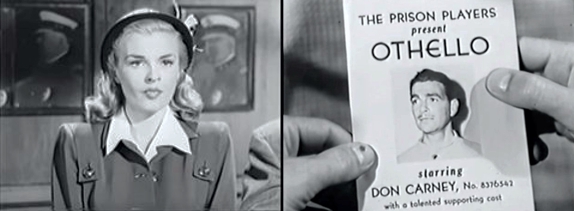
A wheelchair-bound mob boss is filled in about the new D.A. by the crooked cop and rose-smeller, Sawyer. He informs him that the new D.A. will not “cooperate” like the last D.A., who was apparently voted out for that very reason. After bad Castle is released from prison, he spots a photo of the new D.A. in the newspaper and recognizes himself. Posing as the real D.A., he visits the mob boss in the hope of convincing him he could play the new D.A. since he is the same person. However, the boss is not fooled. He recognizes bad Castle from a program cover for his performance in Othello by The Prison Players with a talented supporting cast! Obviously, bad Castle has the acting chops to pull it off. They initiate a prison revolving door plan and manipulate the judicial system.

A mob goon, Chandler, abducts the real D.A., taking him to a secluded location for a few days until the fake D.A. is ready to roll. Good and bad Castle finally meet, typically with a blank wall or door jamb between them in the background. When the opportunity arises, good Castle jumps corrupt Castle, knocks him out, and places him in an upright position as Chandler's automobile pulls into the drive. The D.A. exchanges clothes with the unconscious twin. How timely. How ridiculous, dressing a limp body in less than a minute. It is called "Suspension of Disbelief." Through his own initiative and maybe just for fun, the goon unknowingly shoots the corrupt Castle. After pushing the real D.A.'s car over a roadside embankment, Chandler knocks good Castle down the embankment to make it all appear as though he was thrown clear of his car. While recovering in the hospital the real D.A. keeps his kidnapping and bad driving skills vague to the authorities and his girl while a smug Sawyer looks on.

Knudsen, however, smells something rotten in this Castle. Later at gunpoint, he reminds her of their first kiss. As they kiss again, she knows he is the real deal. Well, he is at least alive. The real D.A. assumes the persona of the dead D.A. for Sawyer's sake. Oh, brother! Knight unexpectedly drops by his office and expects a familiar kiss from her husband. Upon leaving, she lets Sawyer in on what a kiss means to her as they motor away. A little too personal for Sawyer. His face turns red as a rose. I imagine. The real D.A. is now her fake husband. Or something. She disappears from the film for a while. The audience is not too concerned since they are way ahead of the script.

The jailbird accused of the murder agrees to turn state’s evidence on his crime family. Meanwhile, the mob boss will pay Sawyer to get out of the country but he turns the table and threatens the boss at gunpoint in his own plan to come out smelling like a rose. With an armed wheelchair Ernst Blofeld would envy, the mob boss mortally wounds Sawyer. Police arrive to haul off the dead and charge one with the illegal use of a wheelchair. Knight is called in to sign papers and divest herself from her dead husband. As she goes out the door, she reminds Knudsen that Castle's kissing needs some practice. Well, of all the nerve!