Showing posts with label impersonation. Show all posts

April 24, 2020

ACROSS THE BRIDGE (1957)


This slightly longer-than-necessary, one-hundred-three-minute British film is notable for Rod Steiger's gravitating performance, along with some interesting camera positions and closeups in the film's early stages. His propensity for offbeat, often volatile characters is legendary, though his range seemed to have few boundaries. All other characters fade by comparison. Yet for this film, he is almost an absurd figure of illogical attitudes and intents while channeling fellow method actor Brando. His German accent is no better than Artie Johnson from Laugh-In television fame with his “Vely Intelesting” signature comment. What might have been another signature role, the film's believability factor takes a hit as he flees the UK's prosecution. Still, it is an unusual, yet forgotten Steiger film.

Based on a short story of the same name by Graham Greene, the film was produced by The Rank Organisation and directed by Ken Annakin and filmed at Shepperton Studios, Middlesex, England, UK, and in Spain. The set-up is quite engaging as Scotland Yard arrives with embezzlement charges at Steiger's British office. The grand doors are opened, providing visual evidence that they have the right man as they witness a self-aggrandizing floor-to-ceiling “Stalinesque” self-portrait of himself. But Steiger gets the warning while at his New York headquarters. With inevitable escape procedures always planned ahead, he makes his immediate departure to Mexico for a planned three-month hideout. Scotland Yard sends an inspector across “the pond” to apprehend the condescending egoist.
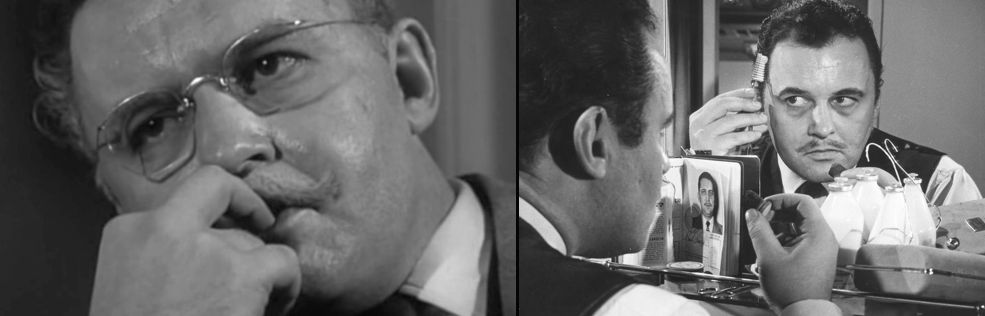

The panicked Steiger is placed in some forced, compromising suspense sequences as he begins his cowardly escape from justice. He assumes the identity of a rail passenger by matching the duped man's passport picture, allowing him to cross the Mexican border. In a heinous act, he shoves the drugged passenger from the speeding train. Embezzlement is one thing. Murder is another. Steiger retains the passenger's suitcase for identity purposes with a plan to dispose of it alongside the road. It snaps open, revealing that the man is wanted in Mexico for the assassination of a Mexican governor. An unfortunate twist. But Steiger's sweaty fingers have apparently lost the man's passport. But it gets worse. The man survived his abrupt train departure. Rescued and secretly treated by his “personal” doctor, the assassin is recovering in a singular motel along a Texas thoroughfare. Bandaged and in traction from head to toe—similar to the hilarious final scene in It's a Mad, Mad, Mad, Mad World—the man is threatened by Steiger at gunpoint for his passport.


There is a fair amount of assuming throughout the film. Steiger gets apprehended at the Mexican border, and the authorities assume he is their wanted man. But the smug thief tells them who he really is. They could not care less. Steiger is further stunned. The assassin's wife confesses that he is her husband! Hard to believe there was no initial question about why he was assuming that particular man's identity. Finally, Steiger's angry demands assume he is above the law, even offering a bribe to the Mexican police chief to get “his” passport back.

The police chief and the British inspector conspire to keep Steiger trapped in the Mexican border town to pressure him into escaping across the bridge back to America for prosecution. But the agreement is a one-sided affair in Mexico’s favor. He is never getting out of Mexico. Steiger is content to settle in the town for as long as it takes. His wealth buys him whatever he desires until the political assassin’s body is returned home, killed in a Mexican raid at the motel. I am not sure why the townspeople feel Steiger is responsible for leaving behind a widow and child, but they band together, refusing his money or his existence.

Note: After assuming that unfortunate identity, Steiger is unaware that he is now the owner of an adorable spaniel. Rather risky when the baggage car handler has to remind him not to leave his previously fawned-over pet behind. The dog seems to recognize the impersonated face and follows him around town. When Steiger disposes of the assassin's suitcase, he also tries to leave the dog behind. Weary and exhausted from escaping, his life is spared by the whimpering dog alerting him to a scorpion on his trousers. Steiger has a change of heart toward the dog, and it eventually becomes his only friend. Yet the catalyst for his death.

August 12, 2017

ROSES ARE RED (1947)


Twentieth Century Fox agreed to distribute this tidy sixty-seven-minute noir with a lead cast of temporary popularity. Giving the viewer some common ground is a supporting cast of more familiar faces whose careers were gaining momentum, Jeff Chandler, James Aurness (Arness), Joe Sawyer, and Charles McGraw. The title refers to a murder case where the victim is found with a single rose in her hand. It does not make up the crux of the film, however. Sawyer is first seen smelling the rose at the crime scene. He sniffs up the aroma with great nostalgia as he recalls, as a child, his mother's rose garden. Lovely. 

The ridiculous premise of identical twins from different mothers is the most confusing element. I am spending more time on the storyline to perhaps help with this. Don Castle, at times looking like a cross between Rory Calhoun and Robert Taylor, plays the dual role of the latest D.A. and a criminal with the exact same appearance. Establishing both characters with matching mustaches, hair color, and style makes for one gullible audience. If that is not confusing enough, pretty Peggy Knudsen and Patricia Knight play, respectively, the good guy's fiance and the bad guy's wife. Of similar height, hairstyle, clothes, and hooked up—in reality—with the same guy, it may take a few minutes to sort things out. Knudsen, a crack newspaper reporter, appears to be wearing wax lips when not talking. The ladies have no trouble identifying their man, however, as each has a kiss that is more distinct than fingerprints.


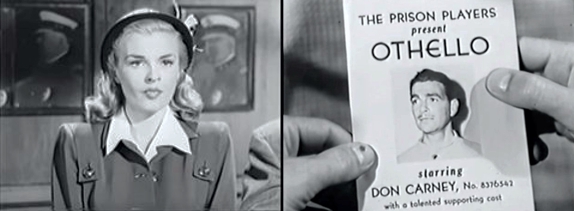
A wheelchair-bound mob boss is filled in about the new D.A. by the crooked cop and rose-smeller, Sawyer. He informs him that the new D.A. will not “cooperate” like the last D.A., who was apparently voted out for that very reason. After bad Castle is released from prison, he spots a photo of the new D.A. in the newspaper and recognizes himself. Posing as the real D.A., he visits the mob boss in the hope of convincing him he could play the new D.A. since he is the same person. However, the boss is not fooled. He recognizes bad Castle from a program cover for his performance in Othello by The Prison Players with a talented supporting cast! Obviously, bad Castle has the acting chops to pull it off. They initiate a prison revolving door plan and manipulate the judicial system.

A mob goon, Chandler, abducts the real D.A., taking him to a secluded location for a few days until the fake D.A. is ready to roll. Good and bad Castle finally meet, typically with a blank wall or door jamb between them in the background. When the opportunity arises, good Castle jumps corrupt Castle, knocks him out, and places him in an upright position as Chandler's automobile pulls into the drive. The D.A. exchanges clothes with the unconscious twin. How timely. How ridiculous, dressing a limp body in less than a minute. It is called "Suspension of Disbelief." Through his own initiative and maybe just for fun, the goon unknowingly shoots the corrupt Castle. After pushing the real D.A.'s car over a roadside embankment, Chandler knocks good Castle down the embankment to make it all appear as though he was thrown clear of his car. While recovering in the hospital the real D.A. keeps his kidnapping and bad driving skills vague to the authorities and his girl while a smug Sawyer looks on.

Knudsen, however, smells something rotten in this Castle. Later at gunpoint, he reminds her of their first kiss. As they kiss again, she knows he is the real deal. Well, he is at least alive. The real D.A. assumes the persona of the dead D.A. for Sawyer's sake. Oh, brother! Knight unexpectedly drops by his office and expects a familiar kiss from her husband. Upon leaving, she lets Sawyer in on what a kiss means to her as they motor away. A little too personal for Sawyer. His face turns red as a rose. I imagine. The real D.A. is now her fake husband. Or something. She disappears from the film for a while. The audience is not too concerned since they are way ahead of the script.

The jailbird accused of the murder agrees to turn state’s evidence on his crime family. Meanwhile, the mob boss will pay Sawyer to get out of the country but he turns the table and threatens the boss at gunpoint in his own plan to come out smelling like a rose. With an armed wheelchair Ernst Blofeld would envy, the mob boss mortally wounds Sawyer. Police arrive to haul off the dead and charge one with the illegal use of a wheelchair. Knight is called in to sign papers and divest herself from her dead husband. As she goes out the door, she reminds Knudsen that Castle's kissing needs some practice. Well, of all the nerve!