Showing posts with label 1947. Show all posts

March 29, 2021

EXPOSED (1947)


This film attests to the low-budget efforts of director George Blair for Republic Pictures. Royal Cole and Charles Moran wrote the tedious, confusing screenplay with an innocuous score by the future’s more important Ernest Gold. There is little need to share details about the plot that concerns an heir to the family fortune, a deceased wealthy businessman, and—no one anticipated this—a possible cure for alcoholism. Drinking in moderation was just too obvious. This routine fifty-nine-minute film involves several intertwined characters, where an extra ten minutes might have helped clarify them better. The deflated ending makes a stab at doing so. Still, one may need to rewind. The film might give the sense that this is just one in a string of entries about a father-daughter crime team. Except this film was one and done.


The spirited twenty-three-year-old Adele Mara brightens up the screen and is about the only reason to make the film. The captivating opening is a good start. She appears to be in jeopardy right from the start while seated in her favorite restaurant. Bob “Chicago” Steele approaches her table, removes his hat, and sits down. Not in the least bit intimidated, she coolly asks him to take his hat off the table because she is allergic to dandruff. The hat hides a gun. He escorts her from the restaurant only to be met by the extra-large William Haade, Mara’s bodyguard. The duo shuts down Steele’s plan, and they motor off. The self-confident beauty is a sassy private investigator in a man’s world. The early scenes establish her character as a savvy woman in total control of all things crime. There are humorous quips written for Mara.

You have seen these father-daughter battles before. Robert Armstrong tries to rein in his daughter for her own safety and lack of experience handling danger. She thinks Dad is old-fashioned. Still, they provide the only energy in this film, as faint as it is. Well, there is a rousing, choreographed fistfight between tall Haade and short Steele of Western stunt fame. Ironically, the distant shots use stunt doubles. Mara is an adept pickpocket as well. While hugging dear old dad, she lifts his badge from the side pocket of his suit, which gives her access to places off-limits to ordinary citizens. Armstrong castigates her for impersonating an officer, with serious jail time being a possible outcome. Recognizing it is his own badge, he hits the proverbial ceiling. Yet the two pool their resources and round up the rest of the cast like so many Agatha Christie films. Everyone gathers—minus the deceased—in one room for the finalĂ© and to expose each one’s motive during the mystery.

Note: Adele Mara, born Adelaide Delgado, churned out film after forgettable film in the Forties. In a Hollywood full of petite, pretty blondes cast in low-budget films, Mara’s career simply ran out of steam. She turned to television in the mid-fifties. She is the older sister of television’s Luis Delgado, a regular on The Rockford Files and Garner’s on-set personal aide for many years. Fortuitously, Mara would marry Roy Huggins in 1952, the man responsible for the Rockford character. 

July 24, 2020

SHOOT TO KILL (1947)


Produced and directed by William Berke with a screenplay by Edwin Westrate, this sixty-four-minute, fast-paced crime noir does have an ending that is anything but routine. The alternate title, “Police Reporter,” best defines the film, however. It was produced for Robert L. Lippert Productions and distributed by Screen Guild Productions. The whiplashing script—thanks to the numerous flashbacks—begins at the end of the movie with a cliff-side car crash that sends a female to the hospital. The myriad of flashbacks can make it a complicated affair, with the viewer feeling they may have “parachuted in.” Character development is nearly nonexistent for these unknown actors. Past the halfway point, the action finally kicks in but the contrived twist at the end is borderline science fiction.


A common practice of the era to condense a film was to have select scenes replaced by the next sequence sliding across the screen (above) or superimposed over another. An example is the whirlwind courtroom scene—dialogue edited down to essentials—to simply introduce local gangster, Robert Kent, accused of a murder he did not commit. The assistant district attorney (ADA) railroaded him, and Kent (below left) vows revenge even if it takes the full twenty-year sentence. One can imagine a number of things that could change in that time span. Besides, a twenty-year “flash-forward” would not be tolerated by the audience.


Russell Wade, in his next-to-last film, plays a crack newspaper reporter also trying to figure out what the characters are doing in this movie. Without the flashbacks, he might never find his purpose in the film. The script makes it a point to mention he has the ability to read—newspapers upside down—to subtly gain information. He is very polite with a laid-back, yet upbeat personality with the pulse of the city in his hip pocket. It would be remiss if I did not mention his flat dialogue delivery. Still in flashback mode outside the office of that ADA, the mustachioed Edmund MacDonald, Wade bumps into Luan Walters for their initial encounter. They become a fixture at many popular nightspots as their relationship blossoms. I expected a marriage proposal from Wade at any second. Walters becomes MacDonald's secretary, as Wade predicted. What he could not predict was MacDonald replacing him at said nightspots. MacDonald—a face combining a young Orson Welles and Robert Preston—is tied in with mobster, Nestor Paiva (above right in hat), who runs his career. 


Paiva senses that Walters is not trustworthy and demands that he, now in what is called a quandary, fire her. He attempts to write a letter dismissing her services, but has an epiphany instead. Walters is asked to transcribe a verbal message which—even in shorthand—becomes his clever marriage proposal. A wife cannot testify against her husband. She surmises his underhanded charade, and we begin to sense she is a driving force to be reckoned with. At this point, one realizes top-billed Wade has disappeared from the film, and after only six months in the slammer, Kent escapes prison.


About the forty-minute point, the film offers its first real action. Wade returns to the screen to track Kent and convince him that the confessions of two witnesses can clear him of the murder conviction. Kent is not convinced. While exiting a darkened stairway, an intense fistfight breaks out between the two stuntmen, with Kent escaping. It is quite an impressive action sequence for any era, sped up for your enjoyment. Another flashback—make that two—takes the viewer back to the hospital where Walters, still suffering from "multi-flashback syndrome," wraps up her revealing story to Wade. The most memorable segment—the science fiction part—is the double-crossing twist-upon-twist ending. The “clergyman” who performed the MacDonald-Walters “wedding ceremony” sends believability off the charts when he reappears. We are finally back to the beginning, but the movie has reached the end of its reel of celluloid.

Note: One will always know when something dramatic is about to happen as the music score by Darrell Calker crescendos to a fever pitch. An amusing example is after the ADA's office is bugged by a very nervous janitor under the fist of Pavia. A lot of film frames were eaten up for the janitor's scenes, though his screen presence is short-lived by an involuntary free-fall down an elevator shaft. MacDonald notices a wire under his office bookshelf. What the?! He starts pulling on it uprooting one floor rug after the other, before moving into the adjoining room, moving file cabinets, chairs and generally destroying the office before moving into a closet as the music gets louder and the tempo increases.

December 28, 2019

THE PRETENDER (1947)


Billy’s slightly older brother, W. Lee Wilder, directed this sixty-nine-minute B-movie noir for Republic Pictures, which may be best remembered as one of the earliest Hollywood films to use a theremin, by Dr. Samuel J. Hoffman, to good effect, and for John Alton's wonderfully dark, moody cinematography. The screenplay was written by Don Martin and Doris Miller, who also provided additional dialogue. I found the script lacking clarity, with some characters confusingly intertwined. It is quite possible I dozed off. Somewhat cleverly adding to the confusion, a key character changes his name after the halfway point. Quite perplexing for the leading man, Albert Dekker. For the era, I imagine this was a good, suspenseful drama. Had it been released years later, it would have been more efficient—and free—as an episode of The Alfred Hitchcock Hour.

Dekker had an inherent vocal ability to softly signify an unstable mind. At first, suggesting a reserved man, his real character here eventually comes to a breaking point. This role works for him. He plays a crooked investor, desperately embezzling money from a large estate bequeathed to the young Catherine Craig after her father’s death. Dekker is losing his shirt in the stock market, and acting as a Robin Hood broker has been stealing from the rich and giving to himself. He is fortunate to have a secretary with zero scruples. She witnesses all his dishonest fund transfers without so much as a blink.


Typical of Hollywood's Golden Era, Dekker is old enough to be Craig’s uncle, but he pours on the charm in his effort to woo her into marriage, giving him the ability to cover his debts with her inheritance. He even peels off his studio mustache, believing he looks younger. He has been a faithful and trusted friend regarding the estate, but she loves another in her age group. Dekker is not sure who that is, but wants him killed, paying a nightclub owner/mobster, Alan Carney, to arrange an “accident” after their engagement picture appears in the newspaper. The lucky guy is Charles Drake, a neurosurgeon and doctor of psychology, whose responsibilities have left little time for Craig. They mutually call off their engagement. To Dekker’s surprise and queasiness, she decides to accept “Uncle Albert’s” earlier proposal and wants to elope. And the local paper knows about it.


In the meantime, Carney is killed, and his right-hand man, Tom “Fingers” Kennedy, takes over the boss’s chair and decides to go upscale and use, I assume, his given character name. A name Dekker does not recognize, but his paranoia tells him that anyone named “Fingers” could carry out the prepaid deed on him. Carney, for anonymity, had bestowed upon Dekker’s character an alias, unknown to Kennedy. Throughout the balance of the film, the doomed groom is trying to make connections with Kennedy to cancel his prearranged funeral.


Dekker’s mental state is personified by the theremin. As the camera closes in on his face, now with a full mustache, he audibly shares his inner thoughts. Until the science fiction community confiscated the instrument, it was the perfect instrument to signify someone with psychological issues. His constant excuses and lies only go so far. He is afraid to eat for fear of poisoning. He does not trust their butler. Nor their second one. His paranoia increases to a ridiculous level while Craig becomes the most understanding woman on the planet. She gets Drake's free analysis and finds Dekker riddled with guilt and fear. They also find he has been dining alone in his room, eating canned food all along. Pretty creepy in the Dekker tradition. He dons sunglasses, even at night, for fear of being recognized. All his paranoia may be hard to sit through. Turns out, Carney left a note for Kennedy about canceling the groom’s elimination. One doubts that Dekker’s secretary will ever come forward about Craig’s monetary shortfall.

August 12, 2017

ROSES ARE RED (1947)


Twentieth Century Fox agreed to distribute this tidy sixty-seven-minute noir with a lead cast of temporary popularity. Giving the viewer some common ground is a supporting cast of more familiar faces whose careers were gaining momentum, Jeff Chandler, James Aurness (Arness), Joe Sawyer, and Charles McGraw. The title refers to a murder case where the victim is found with a single rose in her hand. It does not make up the crux of the film, however. Sawyer is first seen smelling the rose at the crime scene. He sniffs up the aroma with great nostalgia as he recalls, as a child, his mother's rose garden. Lovely. 

The ridiculous premise of identical twins from different mothers is the most confusing element. I am spending more time on the storyline to perhaps help with this. Don Castle, at times looking like a cross between Rory Calhoun and Robert Taylor, plays the dual role of the latest D.A. and a criminal with the exact same appearance. Establishing both characters with matching mustaches, hair color, and style makes for one gullible audience. If that is not confusing enough, pretty Peggy Knudsen and Patricia Knight play, respectively, the good guy's fiance and the bad guy's wife. Of similar height, hairstyle, clothes, and hooked up—in reality—with the same guy, it may take a few minutes to sort things out. Knudsen, a crack newspaper reporter, appears to be wearing wax lips when not talking. The ladies have no trouble identifying their man, however, as each has a kiss that is more distinct than fingerprints.


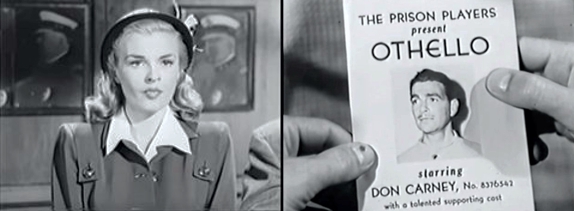
A wheelchair-bound mob boss is filled in about the new D.A. by the crooked cop and rose-smeller, Sawyer. He informs him that the new D.A. will not “cooperate” like the last D.A., who was apparently voted out for that very reason. After bad Castle is released from prison, he spots a photo of the new D.A. in the newspaper and recognizes himself. Posing as the real D.A., he visits the mob boss in the hope of convincing him he could play the new D.A. since he is the same person. However, the boss is not fooled. He recognizes bad Castle from a program cover for his performance in Othello by The Prison Players with a talented supporting cast! Obviously, bad Castle has the acting chops to pull it off. They initiate a prison revolving door plan and manipulate the judicial system.

A mob goon, Chandler, abducts the real D.A., taking him to a secluded location for a few days until the fake D.A. is ready to roll. Good and bad Castle finally meet, typically with a blank wall or door jamb between them in the background. When the opportunity arises, good Castle jumps corrupt Castle, knocks him out, and places him in an upright position as Chandler's automobile pulls into the drive. The D.A. exchanges clothes with the unconscious twin. How timely. How ridiculous, dressing a limp body in less than a minute. It is called "Suspension of Disbelief." Through his own initiative and maybe just for fun, the goon unknowingly shoots the corrupt Castle. After pushing the real D.A.'s car over a roadside embankment, Chandler knocks good Castle down the embankment to make it all appear as though he was thrown clear of his car. While recovering in the hospital the real D.A. keeps his kidnapping and bad driving skills vague to the authorities and his girl while a smug Sawyer looks on.

Knudsen, however, smells something rotten in this Castle. Later at gunpoint, he reminds her of their first kiss. As they kiss again, she knows he is the real deal. Well, he is at least alive. The real D.A. assumes the persona of the dead D.A. for Sawyer's sake. Oh, brother! Knight unexpectedly drops by his office and expects a familiar kiss from her husband. Upon leaving, she lets Sawyer in on what a kiss means to her as they motor away. A little too personal for Sawyer. His face turns red as a rose. I imagine. The real D.A. is now her fake husband. Or something. She disappears from the film for a while. The audience is not too concerned since they are way ahead of the script.

The jailbird accused of the murder agrees to turn state’s evidence on his crime family. Meanwhile, the mob boss will pay Sawyer to get out of the country but he turns the table and threatens the boss at gunpoint in his own plan to come out smelling like a rose. With an armed wheelchair Ernst Blofeld would envy, the mob boss mortally wounds Sawyer. Police arrive to haul off the dead and charge one with the illegal use of a wheelchair. Knight is called in to sign papers and divest herself from her dead husband. As she goes out the door, she reminds Knudsen that Castle's kissing needs some practice. Well, of all the nerve!

December 12, 2015

THE GANGSTER (1947)


This eighty-four-minute film was directed by Gordon Wiles with production handled by King Brothers Production (Frank and Maurice). It is from a screenplay by Daniel Fuchs and Dalton Trumbo. Distributed by Allied Artists Pictures, it is one of the most stylish noir films thanks to Paul Ivano's cinematography. Just one of the many standouts in this classic film. The limited-budget film might remind you of a Playhouse 90 with a singular gigantic set.

The title role of Shubunka (an original name if there ever was one) is played by Barry Sullivan in his breakout leading role. He is excellent as a small-time numbers racketeer who arrogantly thinks he is unstoppable. His front for the racket is an ice cream shop owned by his partner, Akim Tamiroff. In hock up to his eyeballs is John Ireland, who frequents the shop pleading with Tamiroff to give him an advance. He eventually comes to blows (literally) with Tamiroff. Ireland’s wife is played by Virginia Christine who is always pleading with him to come home for the mountain-grown coffee she just percolated.

Sullivan’s infatuation with a nightclub singer, played by Belita (the real-life ballerina and ice skater) takes a toll on his finances, buying her everything. Unknown to Sullivan, a rival, Sheldon Leonard, is planning to muscle him out of business. But Sullivan refuses to believe what a frightened Tamiroff tells him. Or that Belita is in on the takeover.


Sullivan’s riveting, rapid monologue in the last half is memorable. Truly 'told with bullet force' as the poster suggests. The low camera angle pointed toward the checkerboard ceiling makes him appear bigger than he is. It is a reality check for the viewer. Angrily he comes down on the shop cashier, Joan Lorring, in an effort to justify his lifestyle to all beneath him. Viewers soon realize that this cynical character is rather insecure and all his “accomplishments” are the result of tough talk and limited resources with no lasting impact.

Notes: Perhaps strange how many European figure skaters were groomed as actresses in the first half of the twentieth century. By far the most successful was Sonja Henie, but there was Vera Ralston, and here, Belita. They apparently had Foreign appeal on ice that Hollywood moguls wanted. Tamiroff's soda jerk, Harry Morgan, offers the only light moments in the film as a man of the world who wants anyone within earshot to know how he treats a real lady. An expert on the subject with little evidence as proof.

November 21, 2015

DESPERATE (1947)


This strong film is another Anthony Mann early noir effort that includes great camera angles and lighting by cinematographer George E. Diskant. It arises from a story by Mann and Dorothy Atlas. It is a dandy display of characters with an intelligent screenplay by Harry Essex. This seventy-three-minute RKO Radio Pictures release was produced by Michael Kraike with the ever-present Paul Sawtell composing the score.


Steve “B-movie” Brodie, not his usual bad guy here, and Audrey Long play newlyweds, expecting their first child after four months of marriage. Brodie is an independent trucker who unexpectedly reconnects with a svelte Raymond Burr. He puts the "hood" in childhood friend. Burr is now a mobster with plans to smuggle illegal merchandise using Brodie and his truck but he wants no part of it even after taking a beating. The swinging overhead lamp, back and forth over Burr’s face will be memorable. Believable makeup for Brodie’s beating and swollen cheek should also be noted. Burr threatens the wife if he does not go through with it. This hardly ever happens in films. Burr’s kid brother was captured during the film's opening heist and is set to be executed for killing a cop. Burr turns a bit psycho because of it and wants Brodie to confess to the shooting. His life for his brother’s. Brodie manages to escape on his second attempt. The only thing on his mind is his wife’s safety.


Perhaps because of the film’s fast pace, script logic takes a back seat. The elusive couple quickly takes the next train out of town. Switches to a bus then steal a car. They are not sure where they are going nor does the audience have any idea where they are coming from. I could not figure where the story opens but guess Chicago. Maybe I missed something. Never mind the couple’s increasing back rent and their inability to stop mail delivery. The couple decides to head for Long’s aunt & uncle's Minnesota farm.

Meanwhile, the police attempt to apprehend Burr and his gang. Burr escapes with a gunshot wound that puts him out of circulation for two months. However, the hole in Burr’s stomach is smaller than any hole in this script. The trail seems impossibly cold then Burr’s cop-on-the-take checks Brodie’s unopened apartment mail. Specifically the one with a Minnesota return address. Burr is roughly a twelve-hour drive away, perhaps confirming his Chicago location. The farm no longer a safe haven, Brodie puts his wife on a bus for California while he deals with Burr. Guessing the climax time frame, Long may have only made it as far as Kansas City before being sent back to Chicago.

Note: The brief performance by Jason Robards, Sr. should not go unnoticed. He plays the laid-back, wise detective who is more often than not filing his nails nonchalantly when in conversation. His unflappable performance is fun to watch. When Brodie attempts to turn himself in, Robards sees his confession as just convenient lies. But he lets him go simply to track him and capture the entire gang. I would think it not an easy task judging by Brodie’s earlier elusive transportation behavior. But Robards pops up at every turn. He soon discovers Brodie is on the level and both want to end Burr's criminal career.

October 3, 2015

RAILROADED (1947)


Anthony Mann kept busy directing in the late forties. Distributed by Eagle-Lion Films, this seventy-two-minute film is based on a real-life case, forming the basis of a more famous film, Call Northside 777, the following year. This shoe-string budgeted film adds an extra dose of noir, so dark at times it is hard to see what’s going on. In the climactic scene, Hugh Beaumont and John Ireland aim guns in cave darkness better than most. With this very predictable, loaded script, one wonders how the police could accuse someone on hearsay and speculation and be such a bad judge of character. Obviously, things have not changed that much since. There is the usual suspense with questions and answers. Sheila Ryan is not a good judge of character either, as she assumes John Ireland is just having a bad day. Again. He was usually typecast as a bad guy or down and out loser. Hugh Beaumont, on the other hand, typically played a person in authority and is solid here as a thorough, cool and collected investigator. Just the opposite, Ireland loses his cool often with no sanctity for life.

Note: You may enjoy this one. The strangulated budget hurts the worse. Enjoy watching Beaumont's competent acting before "retiring" as an investigator and using his skills to figure out what Wally and Theodore are up to.

September 19, 2015

T-MEN (1947)


Never a dull moment as Anthony Mann directs this story about U.S. Treasury men attempting to break up a counterfeiting ring. It plays out in a pseudo-documentary style, as do many films of the era. An excellent film noir with outstanding cinematography by John Alton and an appropriate score by Paul Sawtell. Big bucks were spent on this film. Well over five million in 2015 dollars, the equivalent of 500 grand in 1947. Within the same year and budget, Railroaded is nearly forgotten. Mann certainly redeemed himself for that earlier effort. Distributed by Eagle-Lion Films, this production cleaned up at the box office. The film is not flawless, but close. One script fumble is when a federal agent comes down hard on a shop owner for not recognizing counterfeit bills. This, after the film established that it takes an expert, under a magnifying glass, to know the difference between real bills. Another takes place during the climax. After establishing a hitman's cold, vicious behavior, he becomes a spineless weasel in the end, scared of being shot at. But I digress.
Navigating through background details throughout most of the film is the narrator, the definitive and commanding Reed Hadley. After an informer is murdered, the Treasury Department chooses Dennis O’Keefe and Alfred Ryder to go deep undercover. Each has a myriad of details to memorize so they can blend into the crime underbelly without suspicion. O’Keefe is first-rate in a standout role, leaving his earlier music or comedy films behind. Both are vouched for, and all goes according to plan, for a while. The steam room scenes with a bloated, sweating Wallace Ford under a waist towel are creepy in their own right. O'Keefe visits several in a row after a tip suggests Ford frequents steam baths. In the end, he is so zapped of strength he can barely stand, noting he lost several pounds before finding the health hypochondriac. Ford is known as the "Schemer" for getting things done in secrecy and keeping evidence that could bring down a lot of the counterfeiters if he is threatened. O'Keefe and Ryder give him a hard time, spreading the rumor that the boss is on to him.

There are edge-of-your-seat moments: in transit with Ford, Ryder is spotted by a friend who uses his real name. To make matters more intense, she is with Ryder's wife. The two meet face to face. Covering for his undercover work, she says, "You are mistaken. My husband is taller and more handsome." Ryder is saved, but Ford is suspicious. But none more intense than when O’Keefe witnesses his partner's murder and cannot do anything about it without blowing his own cover. Few were as heartless in film noirs as hitman Charles McGraw. Always on the edge of volatile behavior with a voice that could, if one got close enough, leave abrasions on your face. The "Schemer" learns too late about undermining his superiors. McGraw locks Ford in the steam bath under maximum heat.

Leading up to the climax, O'Keefe is highly suspicious that everyone knows he is a Fed. The sweating agent is pitted against a savvy counterfeit expert, Jane Randolph, whose boss okays the phony plates. But the real expert is called in to confirm it. He becomes sort of a double agent and lets O'Keefe live, lying that the plates are good. Numerous federal agents arrive and scatter the thieves, chief among them, the cowardly McGraw, running for his life from O'Keefe's bullets. Funerals are scheduled.

Note: This is one of ten films for the unknown Mary Meade, four of which are uncredited. She plays the nightclub photographer/counterfeit contact, Evangeline, during this peak period of her career. Much more success came to June Lockhart, here in her sixth post-World War II film as the wife. Finally, Alfred Ryder had a prolific career in television.

August 2, 2015

THEY WON'T BELIEVE ME (1947)


This RKO Radio Pictures' release is too long, but the first-rate cast helps the moviegoer survive the ninety-five minutes. Most audiences today may find the movie hard to believe as well. The film was directed by the notable Irving Pichel, with John Latimer doing the rickety screenplay. Long-time Alfred Hitchcock associate Joan Harrison produced the film. The British writer would later produce the American television series Alfred Hitchcock Presents.

Robert Young is surprisingly believable as a spineless, philandering scoundrel, equally tender and pathetic. Young’s wife is not as attractive as the other female costars. He realizes this rather quickly. He and Jane Greer have plans, but Young cannot leave his wife’s money. They go their separate ways. Enter Susan Hayward, his second fling, who has a manipulative mind of her own. After sending his wife divorce papers, Young plans to run away with Hayward, but their late-night automobile accident kills her beyond identification. Apparently, they could not find her teeth. Everyone assumes the auto victim was his wife, and Young has the bright idea to play along. This could actually work out. He could kill his wife, and no one would know the difference. But unknown to Young, during the same period, his wife falls to her death at her (former) favorite spot near their vacation ranch. After discovering his wife’s body, he stupidly dumps her in the nearby pond. No one will ever find her floating on the surface. Believe me, the ending may elicit more than a few groans.


The movie is told through flashbacks as Young testifies under oath that he did not kill his wife. True. But his story seems so convoluted and unbelievable, even he finds it hard to believe, and is convinced the jury of his fears will convict him. As the verdict starts to be read, there is a close-up of a screaming courtroom witness. The camera fixes on Young, about to roll (not jump) out the window to certain death. The courtroom police officer pulls his gun and kills him. Nobody is going to commit suicide on his watch! With no brief shot of Young dashing out of his chair, immediately followed by the screaming lady, it is unfortunate editing. Suspended disbelief in full display. By then, every moviegoer knows the ironic verdict.

Note: Many give this film high marks. It would rate higher with me if it were not for the aforementioned implausibilities and its length. A well-acted drama, nonetheless, and worth a viewing. Or a laugh. This film did not work in its era, either. It was a box office disappointment, and I believe Robert Young was not that surprised, considering his one-time-only nasty role.