April 4, 2022

LIPPERT PICTURES SERIES

Robert L. Lippert controlled a successful low-budget American film production and distribution company from 1948 to 1956, producing short, fast-paced westerns and crime films with a penchant for obligatory humor and the occasional jarring edits. This is my third of seven Lippert films.


UNKNOWN WORLD (1951)

This seventy-four-minute science fiction weakling was directed by Terrell Morse and written by Millard Kaufman. The latter carries the brunt of the blame. The film was produced by Irving Block and Jack Rabin, both involved in the special effects side of movie-making. Supporting all the endless technical jargon and suspense-like developments is a forgotten music score by Ernest Gold, generating fame nine years later for his score for the film Exodus. Arguably, Otto Waldis and Victor Kilian are the most recognized faces in the project.

Sounding more like a Wild West sheriff than a doctoral scientist, loony Kilian is so panicked by an imminent nuclear war that he suggests everyone cram into the center of the Earth to survive the inevitable holocaust. Never mind the small molten core, which had been confirmed centuries before. He thinks that is fake news. Facts are merely opinions. I am not sure many 1950 adults bought into this wacky premise: science and fiction in their most preposterous form. Jules Verne might have given it one star for the fairly believable filming of the rock-boring scale model tank, appearing to be designed by Raymond Loewy. It is not the only boring thing in the film.


To give the basement-budgeted film a sense of journalistic gravitas, a narrator walks the audience through the "logical" steps leading up to an expedition of scientists. The only expedition member without a doctoral degree is played by Jim Bannon. This makes his character quite expendable. After government funding falls through, the team is bailed out by a private kook, newspaper heir Bruce Kellogg, who would be tickled to go along. Part-time narrator and scientist, Marilyn Nash, is the film's ardent feminist—so says the opening narration. They will enter the Earth through a volcano in Alaska, then follow the “Earth Core” historical markers. With no time allowed for research and development, someone constructs an enormous atomic-powered tank, the Cyclotram, capable of drilling deep enough to get where they are headed.

The team's endless philosophizing and doubts about their success make the viewer stop and think: surely I have better things to do. They finally reach a utopia where every element needed for survival is present, except for sunshine, and testing reveals that any life form is born sterile. [descending music cue: Dah-dah-dah-dah!] The dangerous journey ultimately claims the lives of two expedition members. They are soon forgotten once the eruption of the underground lake pushes the Cyclotram and its three survivors back to Earth's surface near a small tropical island named Gilligan

March 21, 2022

HOT SUMMER NIGHT (1957)


There is some intrigue at the beginning of this film as bank robbers coerce a bank executive from his home at night to open the vault. Overall, it is a decent film, helped enormously by veteran actors. The film stumbles during a slow-motion, dimly-lit getaway through a most obvious studio set with "studio dirt" heavily applied to a station wagon. There is zero realism in the scene that is sprinkled with extras as obvious as shadows on a sunny day. In his small, fading hometown, Robert Wilke has become somewhat of a local hero, giving his illegal gains to support the town where he sees fit. The townsfolk are very protective of him—out of fear.

The recently fired newspaper reporter, Leslie Nielson, sees the news article about a local robbery and develops a planput his honeymoon on hold while he gets a scoop on Wilke's former girlfriend. Nielson's past article helped free her from his dominance, but everyone in town is tight-lipped about her whereabouts. Never mind about his wife, Colleen Miller, for marrying a guy without a job or mindlessly accepting her husband's decision for this dangerous career booster. He is vague about his plan, only telling her that a honeymoon is forthcoming. Probably.

Wilke's ego is stroked with anticipation of a grand story about himself. He is eerily cordial to the reporter as his skeptical gang is not sure whether he might order Nielson shot from across the table. In a powerfully tense scene, before the interview starts, Wilke sets the table by verbally flattening his skittish partner, Paul Richards, like a placematinsulting his panic attack that ruined a previous robbery. Richards is seething with rage but has not yet decided how to retaliate. Their friendship has run its course. Nielson ultimately gets a story, but not the one he intended.


Most will note the familiar television lead actors in this unknown crime film, a film suggesting it has noir roots. A volunteer gang member, James Best, opens the film with his usual good old country boy flavor. He praises Wilke for his morale boost to the town. Nielson is adequate as a one-dimensional character. He was much “bigger” on the small screen during his dramatic era. Miller's career was sparse, as is her emotional range here. She is the weak link in the cast. The standout in the film, the aforementioned Richards, is the mentally unpredictable polar opposite of venerable film actor Jay C. Flippen, the level-headed veteran of the gang. Filming never attempts to capture Richards' menacing, aloof stare that was somewhat of his trademark in sinister roles. But what he does in wide-eyed pleasure about halfway into the film gets everyone's attention. It is the only shocking moment in this dialogue-heavy film. The genuine article is Edward Andrews, inhabiting his character as a sweaty sheriff.

This is probably the only film with two actors of the opposite sex named Leslie. For her uncredited role, Leslie Parrish plays an undefined character sitting on the floor, oddly clinging to Richards' leg in total devotion. IMBD dot com, for one, incorrectly identifies Parrish, giving her two different actresses' names.

Note: Directed by David Friedkin, this eighty-six-minute film 
did not return a profit. It would appear to be a television production with its low budget, flat camera work by Harold J. Marzorati, and highly visible actors of the period. The music is by AndrĂ© Previn, but the score remains, for the most part, anonymous. Metro-Goldwyn-Mayer distributed the film. Today, it might be considered a lost treasure by younger viewers, not realizing Nielson did anything else but Lt. Frank Drebin.

March 7, 2022

LIPPERT PICTURES SERIES

Robert L. Lippert controlled a successful low-budget American film production and distribution company from 1948 to 1956, producing short, fast-paced westerns and crime films with a penchant for obligatory humor and the occasional jarring edits. This is my second of seven Lippert films.


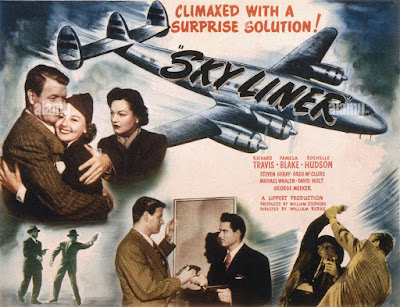
SKY LINER (1949)

Sky Liner is a sixty-one-minute espionage film that takes its time getting airborne. As a double-billed, lower-bunk-bed offering, it lacks all the excitement expected in a crime film. Had it been released today, it would have gone directly to subscription streaming. It is Cold War mania as a handsome FBI agent gets caught up tracking down pesky Communists on a westbound flight. The storyline is a bit hard to follow with an opening set-up leaving the viewer wanting explanations, mostly about who signed off on the haphazard music score. Lippert Pictures produced a boring yet fast-paced film. Quite a feat. On a positive note, the second half of this film is more interesting. Perhaps the only recognizable actor in this “air-noir” is Richard Travis, yet he is mostly known for one film, the 1942 comedy, The Man Who Came to Dinner. His laid-back, slightly naive supporting role worked well for him there. For this film, the FBI agent is laid back from the opening nearly to the halfway point before establishing his identity. The movie starts to gel with his involvement, yet he is unable to ignite a single spark plug.

A sharp-shadowed silhouette with a revolver in hand enters the office of an American State Department official. A bit of visual trickery as viewers expect a gunshot to ring out. But the attacker simply uses the well-placed butt of his gun to the skull, resulting in manslaughter. Assuming the identity of the late official, he boards the plane with Rochelle Hudson, secretary to the official. Unfortunately, it will not be necessary for the imposter to fasten his seat belt before landing. With the help of a stewardess, Travis sets a trap for the murderer on board, intercepting Hudson before she defects to the Soviet Union. When confronted, the traitor reveals information helpful to the moviegoers.

Travis quickly wraps up the plot essentials with Blake in case there are still those puzzled before leaving the theater. What is truly puzzling is why two elderly ladiesin early twentieth-century apparel—close out the film amusingly. It is totally without precedent and not as useful as Sid Melton's obligatory appearances could be in Lippert's films. Caught up in their own fantasy, they watch with hearts aflutter as Travis and Blake kiss before entering the terminal. The duo decides then and there to apply for an exciting position as stewardesses.

Note: There are many low-budget films where airliner continuity is of no concern to the director. Obtaining stock footage could be expensive or difficult to come by. The worst examples have a plane taking off as one type and then "transforming" in flight into a different type or airline. The triple-tailed TWA Lockheed Constellation in this film remains intact throughout, even if subtle markings do not. No doubt, the aerial footage may have come from TWA or Lockheed for promotional purposes. Perhaps a case in point, that final landing in the film—at the recently named Los Angeles International Airport—is just opposite the Lockheed factory.

February 14, 2022

FILM BRAKE : ZIV TELEVISION


Ziv Television Programs was founded in 1948. By 1955, Frederick Ziv churned out more than 250 half-hour shows until first-run syndicated programming dwindled in the early1960s. Despite starring some noted actors, the majority only ran for one season. Ziv's longer-running shows of three seasons were Tombstone Territory,  Sea Hunt, and the four-season Highway Patrol, which I have elected to profile.

HIGHWAY PATROL (1955-1959)

This 156-episode crime drama action series famously stars Broderick Crawford as the dedicated Dan Matthews, a gruff yet empathetic head of a police force. Clad in a suit and fedora, Crawford's signature rapid-fire delivery served him well as he barked into a patrol car's microphone any number of police codes while leaning against the open door of his Buick patrol car. The show was created in response to the California Highway Patrol wanting to be featured in a series. However, Ziv thought the show needed a broader police scope, so the state name was dropped. In its early run, the show received technical assistance from the California Highway Patrol, using actual patrol vehicles. Apparently unhappy with the show's direction, they dropped their support, and the producers had to use unofficial vehicles with their own subdued markings. The show opened with aerials from a helicopter as it buzzed over a highway roadblock. David Rose's military march theme song then set a noble tone. Interestingly, Tombstone Territory also utilized helicopter filming of the show's star on horseback while voice-over narration explained his journey. 

Ziv has stated that the small budget show moved at a fast pace to match Crawford's rapid delivery. He claimed the show introduced "quick cutting" to television, starting a new trend. The opening narration by the unmistakable voice-over artist, Art Glimore, gave the sense that the story unfolding was pulled from actual police files. Not exactly, but the show was noted for realism and its famous location shooting around the formerly rural San Fernando Valley and Simi Valley. Common pursuit locations included the curb-sided Griffith Park Drive and nearby Bronson Canyon. The show centered on crime-fighting rather than issuing traffic tickets, though during its formative years, the episodes ended with Crawford himself delivering pithy traffic safety advice—sometimes humorous—aimed at the television viewer.

Note: The show featured many actors who went on to become successful stars in their own right, among them was Stuart Whitman as Sgt. Walters, Guy Williams appeared occasionally as Matthew's partner, Clint Eastwood, Robert Conrad, Larry Hagman, Barbara Eden, Paul Burke, and Leonard Nimoy. 

February 7, 2022

LIPPERT PICTURES SERIES

Robert L. Lippert controlled a successful low-budget American film production and distribution company from 1948 to 1956, producing short, fast-paced westerns and crime films with a penchant for obligatory humor and the occasional jarring edits. This is my first of seven Lippert films.


RADAR SECRET SERVICE (1950)

Suppressing counterfeit currency was the Secret Service's primary objective in 1865. In future decades, its service expanded to other areas. But few anticipated—nor actually considered—radar. So forget G-men. The R-men are really on to something, cracking down on California crime one telemeter at a time. The opening voice-over excitedly points out that radar's potential is “beyond belief.” For this film, I have to agree. As confirmation, the radar operator back at headquarters tells his boss they located a school of fish by radar that resulted in an unbelievable catch of the day. This potential I could believe, though it has no relevance in this movie. But there were those who could imagine all sorts of useful things it could do in true science fiction fashion—live images in the fashion of a highway webcam. The relayed picture quality is undeniably excellent, as if the movie studio provided the footage. Similarly, how their stationary telemeters could possibly keep pace with a passing vehicle is a total mystery. Merely a minor issue to work out.

One could not be blamed if this sixty-one-minute film was thought to be originally a four-part serial from the Thirties. It possesses a cast of “who knew” B-movie actors, including John Howard as an agent of the Secret Radar Service (RSS) lobbying for more funds to expand the use of telemeters across the United States. That knee-jerk action is similar to suggesting that enough charging stations will make electric vehicles viable for the masses in three years. Tom Neal and Tristram Coffin—known to law enforcement as the mustachioed Mickey & Michael—star as uneasy partners trying to intercept a shipment of Uranium-238 they hope to transport across the Pacific Ocean. Coffin never reveals his master plan, but one can assume he will sell it to the highest bidder and probably double-cross Neal.


Robert “B-movie” Kent is the gang's enforcer. Too bad, he looked like such a nice young man. Returning famously in another devious typecast role is the soft Adele Jergens, girlfriend to Neal or Coffin, whichever works best into her future. Myrna dull—er, Dell—plays a waitress involved with a member of the “U-Gang.” Her boyfriend is recovering in a hospital from a gunshot wound from an earlier RSS raid. Angry because the gang leaders are not willing to help him, she eventually goes under the radar to help the RSS. Adding wacky levity to the gang is Lippert's own Sid Melton with the moniker “Pill Box.” He is convinced his perpetual illness results from blood pressure “at a 140 net” and his “blow pressure is with a hypertension” and his “temperature is by the arrow Fahrenheit.” One wonders who vouched for the hypochondriac.

The headquarters use their radar to find the car carrying the radioactive material. To their dismay, Coffin had the incomprehensible idea of sending out a decoy car. Drat! Their horizontal radar beam has its limitations. A fragile-looking Hiller 360 helicopter is employed to track fleeing criminals from above during a yawning chase with cars “rocketing” down the highway at nearly twenty miles per hour. The helicopter was a marvel during this period, but it would not be long before it would mock radar's usefulness as a crime-fighting resource. The two gangs meet in the California countryside just as the radar patrol arrives. It becomes a trilogy of gunfire. A wounded Neal manages to make it to Coffin's hideout for a final confrontation. More mayhem ensues as the armed waitress also arrives. The film ends with preparations being made for two additional coffins. 

Note: This is probably one of the silliest premises from Lippert Pictures, again directed by Sam Newfield. The “1940” worn-out screenplay was written by Beryl Sachs—his last of five films—but I appreciated his take on Melton's character, though misplaced it may be in this “action-packed thriller.” 

January 17, 2022

FILM BRAKE: IRWIN ALLEN AT SEA


This science fiction television series is based on the 1961 film of the same name created by Irwin Allen. Fortuitously, the film's sets, costumes, props, special effects, models, and occasional footage, were available for the series. Launched in 1964, the show had a popular four-season run when compared to Allen's other science fiction series of the period, Lost in Space, The Time Tunnel, and Land of the Giants. The first season was seen in black and white and seemed to fit the show's occasional scripts about Cold War tensions or averting a third-world government coup. Not even close to the bottom of the sea. Yet the series never left its science fiction roots, attested to by a first season episode about an off-course flying saucer that submerges into the sea and prehistoric "monsters" discovered under Antarctica's "warm spot." Most networks hopped on the new trend of color broadcasting by 1965. Viewers were thrilled to watch their favorite gray actors in color.

THE MAIN CAST


Most of the action took place on a futuristic, nuclear-powered submarine, the Seaview. True to the series title, the Seaview was on the bottom of the sea quite often due to sabotage or an unknown force controlling the ship's operating systems. The Seaview was the brainchild of Admiral Nelsonplayed by respected actor Richard Basehartthe director of the super-secret Nelson Institute of Marine Research. It co-starred David Hedison as the ship's Captain and featured Robert Dowdell as the Lieutenant Commander, Del Monroe, reprising a similar role in the film version, and joining the cast after season one was Emmy-winning director and producer, Terry Becker.


For many young viewers, the Seaview was the star, with its far-reaching technology. Yet the series took place only about a decade into the future. The final two seasons were set during the eighties yet technology apparently never advanced further. In keeping with all the 007 gadgetry of the era, the crew gained the seldom-seen Sea Crab, a self-propelled explorer, a two-person mini-sub in the first season, and the yellow Flying Sub (FS-1), a three-person Manta Ray-shaped craft capable of underwater navigation or supersonic flight. It was launched underneath the Seaview's bow through a sliding paneleven when the ship was flat on the ocean floor due to an “editing mishap.” The Seaview went through early design modifications, most notably reducing the number of front horizontal windows in the bow to four. The view from the interior, however, the windows were decidedly vertical.

                                     THE SINKING SCRIPTS

In the first half of the series, there were many decently written espionage or Communist takeover plots in true spy fashion. The ABC Network wanted a lighter, less serious approach, and what developed was quite outlandish at times. It is doubtful the show could have sustained a four-year run without transitioning into the fantasy world of science fiction of a humanoid sea creature, an invisible alien, or an ordinary-looking house plant that controlled a crew member's mind. It never seemed to matter. Certainly not to the average nine-year-old. The "alien-of-the-week" was well underway during the final two seasons. One of the more silly devices had a villain or creature routinely destroying the Circuitry Room's wall of wires, disabling the ship. The amount of stockpiled wiring must have been astounding. The crew would predictably tossed left and right multiple times from an explosion on board, setting off fires and miniature fireworks. All helped by a studio camera that rocked back and forth in the opposite direction to the actors. As lead officers, Basehart and Hedison were the least vaccinated against alien mind control, who then threatened the ship or crew. Despite lowering the bar during its run, it was likely those episodes that made the series an Irwin Allen cult classic.

Note: Upon returning from the catastrophic climax scene, the final thirty seconds allowed Basehart to predictably give a rapid summation of what just transpired with everything miraculously back to normal. He might end the episode with a reserved smile or quip. I would speculate the two experienced film actors thought four seasons was plenty.

January 3, 2022

THE BIG CAPER (1957)


With film camera secured, the viewer rides along with Rory Calhoun's 1956 Chrysler convertible as he motors his way to convince crime kingpin James Gregory, to help organize another heist. Lounging poolside at his estate, appearing a legit businessman, Gregory angrily tells his former operative—in no uncertain terms—he is not interested and to take a hike. Calhoun reemphasizes it involves a bank that regularly holds a million dollars before distribution to nearby Camp Pendleton. In the very next scene, Gregory and his girl, Mary Costa, are passengers in the convertible to case the bank. A salivating Gregory has Calhoun abandon his fancy New Yorker for a mid-forties beater, sets him up as a gas station owner, and buys a large house where he and Costa can establish themselves as a married couple. The big house simply to hide the heist team. However, after four months, Costa starts liking her domestic role and the fact that Calhoun knows how to make pancakes without them sticking to the griddle. Their neighbors establish Scrabble night, and their young son now refers to Calhoun as "uncle." With every vacuuming, Costa thinks less and less of dirtbag Gregory.

This eighty-five-minute American film noir crime film was directed by Robert Stevens from a screenplay by Martin Berkeley based on the novel of the same name by Lionel White. United Artists released a dandy, yet oft-told story about another well-financed and planned robbery. Filmed beneath opening titles and an Albert Glasser score, that automotive opening is a good setup for a heist film, and it is worth going into some detail about it.


Everyone is first-rate in this crime film. Calhoun is his cool self in one of his better crime films of the Fifties. Costa is also quite good in only her second film, possessing an intelligent vocal delivery and on-screen composure—not playing to the camera. Gregory is excellent in a role familiar to him. He mentions serving five years for a robbery as a young kid. He may not have been incarcerated since, but he has been slippery enough to avoid any more downtime. The guy has deep pockets. Gregory's booming, foghorn voice—his trademarked mumbling through some lines as if it is an aside—and sarcastic comments toward the suspected “happy couple” clearly reveal his ruthless side.

Making the film much more memorable, however, are two psychopaths (above). Robert Harris' entrance at the Calhoun house—squinting, sweating, with an untidy appearance—is the first standout. Harris had a knack for convincing performances as an overheated, demented, near-sighted weasel. An expert in explosives—his “bang juice”—he also has a gin problem. His thought processing is seemingly incoherent; he settles into his room, and Calhoun tells him the gin is off-limits until after the robbery. Approaching another meltdown, he lights a match to calm himself. He is mesmerized by the flame. The normally dark-haired Corey Allen is also hard to forget as a short-cropped, bleached blonde in glistening dark suntan makeup. Cold-blooded murder seems to be his most enjoyable pastime. That, and listening to Glasser's jazz score via a record player prop. Hollywood thought there was some sort of connection between a jazz freak and a white-haired murderer with a bow tie. To say he is on edge is an understatement. His role seems to follow up on his previous 1957 film, The Shadow on the Window.

The customary review of the caper's details is to be expected. Gregory is pretty ecstatic to go over the crude map and everyone's role to play. Filming of the successful robbery is effectively not drawn out with a redundant set of visuals. A tense moment occurs when the neighbor pays a visit to the house. Tagging along is his son with an armful of lost dog. The dog bolts up the stairway where the gang is hiding, nearly going to dog heaven by an Allen knife. Glasser's score ramps up the intensity.

Harris's two diversionary explosions will create chaos—one at a high school on Saturday night, assuming no one will be there. He nearly soils himself talking about his assignment. There will be a power outage, thanks to another Paul Picerni criminal role with Allen elected as the wheelman. The exciting, rapid climax includes a believable, choreographed fight scene between Calhoun and Gregory when the latter tries to escape with the loot. Wisely, it was all shot in shadows. Now a genuine couple, the last seconds of the film have “The Calhouns” making a decision that will more than likely reduce their jail time.

Notes: A couple of amusing bits come after Calhoun signs the papers for the gas station. The elderly gas station owner quickly calls his wife about the sale, "Get the trailer fixed. The suckers fell for it!" Another chuckling scene is when Harris, angered over his gin restrictions, knocks Calhoun out and dumps his body from the car on the night of the heist. The camera then has a distant shot of the car parked behind a “No Dumping” sign.