Showing posts with label 1951. Show all posts

June 6, 2022

LIPPERT PICTURES SERIES

Robert L. Lippert controlled a successful low-budget American film production and distribution company from 1948 to 1956, producing short, fast-paced westerns and crime films with a penchant for obligatory humor and the occasional jarring edits. This is my fifth of seven Lippert films.


ROARING CITY (1951)

This oddly titled low-budget crime film was surely forgotten a week after leaving the theater. As noted elsewhere online, this movie has two distinct halves unrelated to one another except for the three main stars. 
This film and two others from the same year, Danger Zone and Pier 23, were meant to become part of a thirty-minute television series, but wisely, the Networks saw no future for them. Each plot has slightly confusing twists, but both stories are wrapped up by the male leads to explain what transpired. As a film, it does eliminate commercial breaks. It is directed by William Berke, produced by Jack Leewood, and distributed by Lippert Pictures. Not helping on the excitement level is an innocuous score with its travelogue opening by Bert Shefter. I could not assess what all the roaring is about in this film.

At just under sixty minutes, this is an ordinary murder mystery on one hand, yet it stars Hugh Beaumont on the other. He played Dennis O'Brien in the two aforementioned films as an unlicensed private investigator eking out a living along the San Francisco pier, renting boats and hoping the next phone call gets him a paying client. Vintage radio fans would remember this premise from a previous series, Pat Novak, For Hire, starring Jack Webb. Both characters narrate the story, rent boats, and deliver hard-boiled pulp fiction dialogue and one-liner quips. Beaumont does not corner that market. Most of the actors provide quips to the point of overkill. Beaumont remains cool and collected, but he is not an acerbic Novak, who was always on the cusp of decking someone. Beaumont is more Jim Rockford and would seem to avoid violence except in self-defense. Like Rockford, there are enough knocks to his head to follow concussion protocol.


Beaumont opens the film with a drowsy—slightly inebriated—voice-over about San Francisco being a "conservative town." How times have changed—I digress. There is the ever-present dialogue bringing the viewer up to speed. Here is the gist: a crook wants Beaumont to place some bets in his name on a boxing match that has been rigged. But when the “losing” boxer wins, things start to unravel, especially for Beaumont, who is suspected of being part of the fixed match. He gets tangled up with a brunette for the boxing story, then accepts an assignment from a two-timing blonde in the second half, which opens in a diner. Upon her departure, Beaumont's voice-over says, “She left a trail of perfume that was two parts garden and one part chloroform.” Richard Travis plays the licensed detective who always thinks Beaumont is guilty of something, like Jim Rockford.

Note: It is a delight to see Ed Brophy as Beaumont's roommate, not playing a well-meaning buffoon or sidekick. Like Pat Novak's legman, Brophy has a fetish for strong drinks. With a convincing British accent and multi-syllable dialogue seeming lifted from Shakespearean theater, he amusingly plays "ex-Professor" Frederick Simpson Schicker in a low-key fashion.

April 4, 2022

LIPPERT PICTURES SERIES

Robert L. Lippert controlled a successful low-budget American film production and distribution company from 1948 to 1956, producing short, fast-paced westerns and crime films with a penchant for obligatory humor and the occasional jarring edits. This is my third of seven Lippert films.


UNKNOWN WORLD (1951)

This seventy-four-minute science fiction weakling was directed by Terrell Morse and written by Millard Kaufman. The latter carries the brunt of the blame. The film was produced by Irving Block and Jack Rabin, both involved in the special effects side of movie-making. Supporting all the endless technical jargon and suspense-like developments is a forgotten music score by Ernest Gold, generating fame nine years later for his score for the film Exodus. Arguably, Otto Waldis and Victor Kilian are the most recognized faces in the project.

Sounding more like a Wild West sheriff than a doctoral scientist, loony Kilian is so panicked by an imminent nuclear war that he suggests everyone cram into the center of the Earth to survive the inevitable holocaust. Never mind the small molten core, which had been confirmed centuries before. He thinks that is fake news. Facts are merely opinions. I am not sure many 1950 adults bought into this wacky premise: science and fiction in their most preposterous form. Jules Verne might have given it one star for the fairly believable filming of the rock-boring scale model tank, appearing to be designed by Raymond Loewy. It is not the only boring thing in the film.


To give the basement-budgeted film a sense of journalistic gravitas, a narrator walks the audience through the "logical" steps leading up to an expedition of scientists. The only expedition member without a doctoral degree is played by Jim Bannon. This makes his character quite expendable. After government funding falls through, the team is bailed out by a private kook, newspaper heir Bruce Kellogg, who would be tickled to go along. Part-time narrator and scientist, Marilyn Nash, is the film's ardent feminist—so says the opening narration. They will enter the Earth through a volcano in Alaska, then follow the “Earth Core” historical markers. With no time allowed for research and development, someone constructs an enormous atomic-powered tank, the Cyclotram, capable of drilling deep enough to get where they are headed.

The team's endless philosophizing and doubts about their success make the viewer stop and think: surely I have better things to do. They finally reach a utopia where every element needed for survival is present, except for sunshine, and testing reveals that any life form is born sterile. [descending music cue: Dah-dah-dah-dah!] The dangerous journey ultimately claims the lives of two expedition members. They are soon forgotten once the eruption of the underground lake pushes the Cyclotram and its three survivors back to Earth's surface near a small tropical island named Gilligan

June 12, 2020

NEVER TRUST A GAMBLER (1951)


NEVER TRUST AN EX-HUSBAND

Known mostly for being unknown, directing forgettable films in the Thirties and Forties, the name of Ralph Murphy might ring a bell for directing three costume adventure films teaming Louis Hayward and Patricia Medina in Lady in the Iron Mask, The Lady and the Bandit, and Captain Pirate. All in an effort to revitalize the swashbuckler. Months before these films, he directed this very predictable crime drama released by Columbia Pictures. The film was produced by Louis B. Appleton Jr. and Monty Shaff. It was developed from a routine screenplay by Jesse Lasky Jr. and Jerome Odlum with zero surprises. The adequate music score is by Arthur Morton. Clocking in at seventy-nine minutes, it is typical of the period but the commendable second-tier performers steady the film.

The film stars Bernard Zanville, aka Dane Clark, as a small-time gambler refusing to testify to supposedly protect his innocent friend accused of murder. The edgy Clark is always hiding behind curtains, peering between Venetian blinds when not packing a suitcase. His co-star is Cathy O’Donnell, playing the ex-wife. As a reserved school teacher, she is well cast as her apparent weak acting fits the role. Her eyes are lifeless, at times as if she were playing a blind character. Her acting resume was thin. She reluctantly agrees to let him stay and tries to cover for him, but admits she is not good at lying like Clark. In her final scene after being manhandled as Clark's shield, I could not tell if she was crying or exhausted from laughing.

Rhys Williams makes an indelibly disgusting mark on the viewer with his short, pivotal screen time as an off-duty police sergeant full of himself. He collides with O’Donnell in a market. He dated O’Donnell’s roommate and recognizes her. In spite of his rather clownish appearance, he assumes he is irresistible and obliged to make advances. Among her food items, she purchases a bottle of whiskey for Clark. The store clerk is that handsome beach ball with legs, Percy Helton. Williams teases her so persistently about that whiskey and living alone, she just gives it to him to make him go away. But this guy is a leech. A sexual predator. He shows up at her home with the lame excuse of returning the whiskey. He gets physical, and she slaps him a few times and instinctively calls out Clark’s name. The pervert thinks she lied to him about being alone and confronts Clark, thusly:

A fight erupts, Williams fires his gun,
Only hitting the ceiling, he is done.
Hit by a footstool on his head,
He is not alive but very dead.
Moviegoers rise up and cheer,
A pleasant movie moment of the year.

Tip #1: if you want to fill in a bullet hole in your ceiling,
you can use ordinary “kitchen soap.” Preferably white.

Clark decides to mask the manslaughter by sending Williams and his car over a cliff. A plan that rarely works. It is quickly determined that Williams died well before the accident. In a silly bit, another officer spotted footprints and determined the shoes were in a hurry. The officer is amazing. Deserves a promotion. Yet the scenes with Clark leaving the scene have him walking, not running. Williams’ three-year partner is played by Jeff Corey. He confirms, whether on or off duty, Williams had only one thing on his mind: ‘a skirt.’ A character Hollywood salaciously included as expected male behavior, but now, with selective indignation, has created their own hashtags.

Tom Drake, the lead detective, is solid in this role. He and Corey are naturals. Drake’s vocal quality and delivery, along with his body language, add depth to his character. On his first visit with O’Donnell in her home, he senses she is hiding something, though he is there to ask about her former roommate, who had a past with Williams. The roommate is later questioned and, in no uncertain terms, tells the police what a scumbag Williams was. The moviegoers stand and cheer once more.

Drake could also be quite charming. He and O’Donnell have lunch together, and they enjoy each other's company. But a probing question unravels her suspected sheltering of her ex-husband. A lot of interviews later, Corey and Drake know they are after that Clark skunk. The detective duo returns to the O’Donnell house, but she is not there. The day’s heavy rain causes the roof to leak, conveniently revealing the bullet hole in the ceiling. Amusingly, on the floor is the plug of soap.

Tip #2: if you want to fill in a bullet hole in your ceiling,
have a leak-proof roof.

Clark, at his wits’ end, lies about supporting O’Donnell’s constant plea to turn himself in. Unknown to him, she witnesses him packing a revolver in his suitcase. He forces her along on his escape, getting more desperate by the mile. They stop for gas, and she offers to pay by credit card. While signing the receipt, she adds a note for the attendant to call Drake. Clark does stupid things during the climax of the film in typical B-movie fashion. The screenplay ends the film on a lighter note as Drake and O’Donnell cozy up in the rear of Corey’s vehicle. He looks through his rearview mirror, smirks, and adjusts the mirror downward. 

Note: There is a comical scene with Sid Tomack, a bus driver. Drake arrives to question him about passengers he picked up on the night of the Williams’ killing, but his nagging wife, “Ginger,” played by Ruth Warren, thinks the police are there to arrest her husband for stealing again. It is obvious she runs their home. When Drake introduces himself, Tomack tries to take a step backward out of fear, but his wife pushes him forward. Nervously, he tells the police he has not done anything wrong with his wife, instantly calling him a liar. Tomack, however, saves face by confirming Clark was a fare.

April 17, 2020

IRON MAN (1951)


This eighty-two-minute film noir, directed by Joseph Pevney, is helped by a strong cast starring Jeff Chandler, Evelyn Keyes, and Stephen McNally. Produced by Aaron Rosenberg and distributed by Universal Pictures, it is a few notches below the likes of the previously released The Set-up or Champion, and despite the title, it is not a marvel. It will help to have an affinity for boxing, Hollywood style. Even so, this is simply another one from an extremely long list. Just enjoy watching these professionals perform.


The film is told in flashback through the eyes of Keyes, who gets effectively watery by the end. Agonizingly watching her husband, Chandler, in the ring for perhaps the last time, the film transitions to a “romantic” Pennsylvania coal town where we are introduced to the main cast. Among the hearty group of coal miners is James Arness in a small role. He is always bad-mouthing Chandler in the hopes of picking a fight. He apparently hates him because he seems smarter than himself. Not surprisingly, a cave-in occurs, but Chandler recovers. The other men trapped have an unknown future, as we never see them again. Due to the speculative encouragement by the older brother, McNally, Chandler never returns to the "miner leagues." McNally has always envisioned a future boxing career for his kid brother.


McNally is a thick-headed deal-maker, gambler, and manipulator out to make a buck, ignoring any knowledgeable advice. He remembers Chandler's explosive temper as kids would laugh at him because of his towering height. That killer instinct signifies a champion to McNally. However, after a few practice matches, his face becomes quite intimate with the mat. Fans start laughing at him for a different reason. But Chandler goes into a rage, ripping into his opponent in a savage display of anger. A smiling McNally blurts out, “There it is!” Unfortunately, McNally knows no more about what makes a boxer than Jack Benny.

Winning his bouts with unsportsmanlike conduct has earned him a reputation as a lousy fighter, and sportswriter Jim Backus says as much in his columns. He has no business being in the ring, and the crowds agree. McNally still thinks his brother will eventually gain his undeserved respect. In somewhat of a surprise, Backus turns out to be an understanding mentor of sorts as he learns of Chandler’s backstory. Oddly, Keyes feels totally responsible for Chandler’s fighting fate, when it is clearly McNally's fault.


Rock Hudson, who desperately wants to be called “Speed” when his time comes to get into the ring, sounds as though he inhaled a slight dose of helium. He comes across well as a golly-gee-whiz naive kid who thinks Chandler is the epitome of a champion. It does not take long, however, before Chandler’s lousy attitude alienates everyone in his circle. At the badgering of McNally, Backus informs the trainer to let Chandler fight the young upstart, now “Mister Speed.” The title bout is pretty exciting with the best boxing choreography of the film, though it all looks familiar. To everyone’s surprise, Chandler fights legit and gets the tar beaten out of him near the end of the match. The crowd’s boos turn to cheers out of respect and to the delight of the facially dented, nearly blind Chandler. He has used his face as a metaphor for obliterating his past.

September 7, 2019

CAUSE FOR ALARM! (1951)


To Have And To Hold Until Paranoia Do Part

This seventy-four-minute MGM film, directed by Tay Garnett, suffered a six-figure loss at the box office. But then, it did not cost much to make. The screenplay is by Mel Dinelli and Tom Lewis, with the film being produced also by Lewis, Loretta Young’s second husband. Young periodically narrates the film, sharing inner thoughts about her frightening day of the week. The film quickly unfolds with a flashback to establish the friendship between Young, Barry Sullivan, and Hollywood newcomer Bruce Cowling during World War II. Cowling is pursuing Young, but it is Sullivan who makes the biggest impression on her.

I found it difficult to ignore Young's over-the-top performance at times. Maybe she was trying too hard, aware that the film was rolling. Young seems to be the wrong actress for this hysterical character. Perhaps a “stronger” actress in the mold of Anne Baxter or Patricia Neal might have dialed it back. Neither, of course, was married to the producer. Then again, here, Young is “married” to Barry Sullivan, who has a psychotic disorder. 


Sullivan has a limited role as a bedridden patient with a scripted bad heart. He is also a little touched in the head with irrational jealousy, convinced Young and his doctor, his old Navy buddy, Cowling, are having an affair and both plotting to kill him. Sullivan goes so far as to write a detailed letter to the district attorney suggesting so. His plan is to kill her before she gets to him. He tells her his whole warped plan. But before firing a shot, he collapses from a fatal heart attack. Young’s posture and expression, wedged between the door frame and dresser (lower right image above), are straight out of a Carol Burnett show skit. She is acting so hard that it is laughable. 


It is near this point that the film is cause for alarm as Young tries to get the letter back from the postman after he dropped it at the post office. He is played by the typically befuddled or opinionated Irving Bacon. A by-the-book postal carrier with the gift of gab about the extreme heat, his sore feet, and concerns about securing his pension. The exchanges between him and Young are good, though she is obviously rattled to the point of being ridiculous. She pleads with Bacon to give her the letter, but he cannot. It is Sullivan who wrote the letter, and he must sign for it to be retrieved. Bacon is more than happy to take it to him. Young bursts. He instructs her to pick up the letter at the post office. Postal Superintendent Art Baker is happy to return the letter to her. Her husband just needs to fill out a form and sign it. Her irrational behavior is a red flag to Baker, who cancels their conversation.

More bad news as Sullivan's snooty and arrogant aunt shows up at the house. Young returns from the post office to find her making herself at home. She nearly has a heart attack herself when the aunt heads upstairs to see her nephew. Young's perceived rudeness sends the aunt to her car. Young's only good news in the film is when Bacon returns to inform her that the letter could not be delivered anyway. Insufficient postage. My preferred title for the film. 

Note: There is a brief uncredited appearance by Robert Easton and his on-screen pal, Carl Switzer. Both are involved in their personal automotive maintenance program.

Adding some humor and cuteness to the film is nine-year-old Brad Marrow, as "Hoppy," a popular nickname for the Western hero Hopalong Cassidy. It is Hoppy's public service to protect the neighbors from outlaws while riding his tricycle "horse." The engaging boy is not shy about asking Young for a cookie, either.

July 27, 2019

ROADBLOCK (1951)


RKO Radio Pictures provided a promising opening to this film noir. Character actor, Peter Brocco, witnesses the late-night shooting of Louis Jean Heydt by Charles McGraw. He is abducted by McGraw at gunpoint but swears not to mention it to the police. He cannot. He is on the lame for theft. He makes a deal to split his one hundred grand, kept in his late uncle's cemetery vault. As Brocco removes the floor tile, he first grabs a gun from underneath. McGraw's fist is introduced to Brocco, and to his shock, in walks Heydt. The two insurance investigators have just wrapped up another case. Just like that. Do not expect a lot of action after this. The film is bookended by this intriguing opening and an exciting, though predictable, closing. But you will witness something McGraw rarely gets to do. Smile.


We find McGraw awaiting a plane back to Los Angeles. With an air of sophistication, petite Joan Dixon, unable to afford a full-price single ticket, requests a husband/wife discount ticket. She chooses McGraw as her husband. He does not understand but likes the idea. A lot. The flight has to land short of their destination due to bad weather and both assess each other during the delay. She bluntly tells him they have no future together. Never misquote the Bible: money is not the root of all evil. It is the love of money. Just ask Dixon. Her demeanor suggests a teenager as she dreamily envisions her future, “I’m on a rocket ship to the moon” or “I’m going for the World Series.” McGraw looks puzzled. He cannot afford tickets to the World Series on his salary! This greatly bothers him and we learn his left brain is packed full of stupid. Now settle in for a lot of conversation until well past the halfway point.

The good news is, Dixon now wants to marry McGraw. He needs a lot of money and fast. And so it goes. He proposes a railway mail car robbery to underworld figure and Dixon’s former sugar daddy, Lowell Gilmore. McGraw’s inside knowledge of over a million-dollar cash shipment is the target. He wants Gilmore to stash his take inside a commercial-sized fire extinguisher and mail it to their mountainside honeymoon cabin offered to them by Heydt. I think most have mailed fire extinguishers at some point. To liven up his alibi honeymoon, he confesses his deal with Gilmore. The bad news, money is not as important as her new husband. D'oh! Dixon is ashamed of herself for how low McGraw has descended for her.


The robbery goes well except a railroad employee later dies from the mail car explosion. This, according to a police detective, Milburn Stone. The department tracks down the pilot of the seaplane used for the robbers’ getaway. He identifies one of the robbers. Methodically, the noose gets tighter around McGraw, who arranges to meet Gilmore with a plan to solve their predicament. Gilmore attempts to draw his gun but square-jaw McGraw gets the upper hand. The unconscious Gilmore is placed in his car before it goes over an embankment in flames. Predicament solved.

In a restaurant meeting, Heydt disappointingly explains McGraw’s slip-up. It was the extra fire extinguisher. He had just bought a new one for the cabin. D'oh! A beer bottle on the head temporarily slows Heydt, but soon he and Stone are racing to apprehend husband and wife as they predictably flee to Mexico via the classically famous and frequently used, Los Angeles riverbed, hydro-foiling across the water. It never seems like anything good comes from driving down there, but the low traffic volume made it simpler for a few directors during this era, to say nothing about it being unique. These closing chase scenes are the most memorable moments. The seventy-three-minute film ends with mixed feelings among the remaining cast as Dixon walks away amidst the Los Angeles smog.

Note: For any film buff, this film hardly deserves to be in an unknown category. McGraw's career never skipped a beat because of this film and a jumpstart with RKO's previous dandy, “Armored Car Robbery” or the later “The Narrow Margin.” His co-stars in this film did not burn up the screen, however. Gilmore’s weak character is not memorable. Dixon is rather one-dimensional in this, the most famous role of her short career.

June 29, 2019

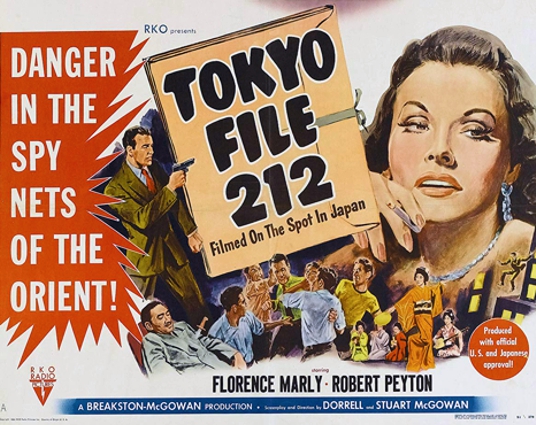
TOKYO FILE 212 (1951)


This American-Japanese double-billed film, distributed by RKO Radio Pictures, could not get any more “B.” From the start of filming to it being put "in the can" took about two months. The acting is okay, but any scintillating dialogue was left in a manila folder, perhaps File 207. The bland dialogue may be an effort to suggest the film was “shot as it happened” using the everyday people involved. I am being kind. Except for some actual military personnel, it is simply a cast of unknown actors in a speculative story filmed entirely in Tokyo, a Hollywood first. It is an innovative take on the Korean War, suggesting Communist spies were working from Japan to sabotage American operations. Certainly not a preposterous premise. Despite the film’s average packaging, the pacing is good, and the Tokyo settings add realism and mystery. Albert Glasser’s rousing opening score certainly gets your attention. The eighty-four-minute movie was not a success, with mixed reviews from critics and ticket buyers alike.

The story is told with voice-overs by a U.S. Government Agent, the sometimes billed, Robert Peyton. His voice and mannerisms seem too intimate for the big screen and better suited for television, where one can get small but perceived as big. The bulk of the movie is told in flashback after a briefcase bomb explodes near his chins. Since he is telling the story, we know he survives the blast, but we do not know what miracle befell him. The climax does have a logical, eye-opening resolution. Officially, he was not a body double for Fred MacMurray, but one might disagree, below.


After checking in at the front desk, Peyton finds Francis Marly, a mature Euro-tart making herself at home in his room. Perhaps the funniest thing in the movie is that she talks seductively in the third person. Being a debonair geek, he is attracted to her "fit of flirts." We are never sure if she can tell the truth. They become an odd team even though he suspects her of being a Communist sympathizer.

Peyton came to Japan to find an old college classmate, Katsuhiko Haida, who is suspected of joining the Communists. Haida’s father tells Peyton of his son’s backstory in a World War II Kamikaze 101 class, where they use scale models for practice. One student is slapped by the tough instructor for timidly and repeatedly not zooming his plane in the right area of a carrier model, thanks to an improper grip on the model. No successful Kamikaze 101 student gets a typical diploma. They get funeral rites. But the war comes to an end, and Haida is crushed that he will never be able to go on frequent Kamikaze missions. He is despondent and vulnerable to Communist propaganda.


The leader of the Communist ring, Tetsu Nakamura, is all very honorable when in Peyton’s presence. Just a sweetheart. Peyton’s informer, however, tells him to be wary of his secret ingredient when he dines with him. Poison. Peyton makes an attempt to add a bit of (awkward) suspenseful humor to this scene. 

The girlfriend of Haida is played by the exceptionally cute Reiko Otani. She is abducted by the Commies, then dumped on the road without so much as an apology. While in the critical care unit, Haida secretly visits, and they express their undying love for each other. Never use any form of the word “dying” in her presence at this point. Haida has an epiphany and is no longer on the dark red side, using all his kamikaze skills to defeat Nakamura. For Peyton, it is on to File 213.

Note: The film provides the moviegoer with good exposure to mid-century Japanese culture. If the film has any assets, it would be this. Many of these scenes carry no dialogue as we follow Peyton through the streets and bars of Tokyo. This in itself saved a ton of production money. There is a scene in a sleazy Japanese-only bar where rowdy, drunk, tattooed men are doing what they would not do unless in a crowd. There is a fully clothed female dancer, after a fashion, on a table. When Peyton and Marly enter in search of Haida, the place becomes dead silent. like two Jewish men entering a Nazi bar. The U.S. Military Police tell them that the bar is off limits and suggest, for their own safety, that they leave.

February 23, 2019

THE FAT MAN (1951)


Universal Pictures released this crime film noir based on the popular five-year radio drama created by Dashiell Hammett. Directed by William Castle, the pacing is slow and offers zero excitement, with a screenplay by Harry Essex and Leonard Lee bearing some responsibility. The script could not be fully clarified without multiple flashbacks. One is a flashback within a flashback. The supporting cast is awarded at least one. At any rate, the frequency disrupts the film's flow. The film eliminates the imagination that radio can generate. Theater attendance made this clear, signaling a follow-up movie was not in the planning stages. 

J. Scott Smart reprises and finishes his role as the well-known private detective with a commonality with Rex Stout's Nero Wolfeboth having a passion for food with waistlines as proof. Smart is not nearly as smart, however. Simple investigative logic is all he needs to solve crimes. He can “cut a rug” on the dance floor and habitually addresses a female or male as “sweetheart.” His assistant is the befuddled and persnickety Clinton Sundberg, responsible for shuttling him around and designing his meals. He is very fastidious concerning meal preparation. 


The "Fat Man" is about to partake in a sizable gourmet lunch. A most inopportune time for Jayne Meadows to seek his counsel. She initiates the first flashback to help him understand her backstory. They become somewhat of a team in tracking down the murder of her boss, a dentist, and a missing set of X-rays. Thus begins the usual questioning of intertwined characters. Smart meets with Julie London on more than one occasion. She provides flashbacks about her husband, Rock Hudson, and his prison stretch from a million-dollar robbery organized by John Russell. Hudson's cellmate, Emmitt Kelly, learns of Hudson's demise and wants his share of the loot. A minor detail: Meadows and Hudson use their real first names for their characters, Jane and Roy, as in Roy Scherer Jr.

The performances sway like a pendulum. Meadows seems near-comatose throughout. London is in the same coma ward, though her coma breaks early. Russell adds interest to his scenes with his menacing brow, which fits a gangster, unlike Hudson, who is miscast. Teddy Hart steals his two scenes with Sundberg as “Shifty,” a short, weaselly, high-voiced Brooklyn informer. He teases Sundberg because he knows it exasperates him. But without a doubt, Marvin Kaplan's brief scene as “Pinkie” swings the pendulum far into the hilarity region. His distinct Brooklyn accent and his melancholy delivery were legendary. He and his brother-in-law and trucking firm boss, Edwin Max, dislike each other immensely. Max thinks Kaplan is a dimwit and incapable of a solid day's work. Kaplan's sarcastic banter with Max is delightful. It is not just for laughs, either. They provide the final clue for Smart to pinpoint the murderer. 

Note: Screen Gems created a second potential television series starring Robert Middleton. The never-aired 1959 pilot movie was a lackluster fifty-eight minutes, despite Middleton's suave and commanding performance and a fine turn by his crackling assistant, Tony Travis. This private detective charged $200 a day, indicating Jim Rockford was not keeping pace with inflation.

September 22, 2018

THE MOB (1951)


This Columbia Pictures release, directed by Robert Parish with an adapted screenplay by William Bowers, is first-rate from beginning to end. A compelling film about corruption, mental delusions, and atonement. Bower’s script bounces humorous quips from one character to another, as one might expect from a film noir of this caliber. Nearly everyone has a turn at them. The cinematography by Joseph Walker is rich with wet streets and dark, danger-filled shadows. The well-versed George Duning provided an effective music score, as well.


Police detective Broderick Crawford is duped by a mob killer carrying an authentic police badge who appears to be coming to the aid of a shooting victim. Crawford discovers too late that the victim was a key witness in an upcoming hearing. The police commissioner is livid and would like to punish Crawford for his halfhearted effort to double-check the true identity of the impostor/gunman. For news headline purposes only, accompanied by a fake picture, he is “suspended.” His real punishment is a death-defying undercover assignment to infiltrate a rough New York waterfront crime organization and bring down its kingpin. 


Needing to redeem his career, Crawford's acting allows him to fit right in as a tough, sarcastic, and unflappable thug from New Orleans. His noir quips are expelled effortlessly through his legendary lightning delivery. Also on the waterfront payroll is Richard Kiley. He and Crawford become pals. It does not take Kiley long, however, to frequently question why Crawford is so interested in what goes on. Crawford drops a few key names that get the attention of a Union thug, Ernest Borgnine. Neville Brand, nearly approaching a typecast level in his career, is again playing a henchman. This time, not the psychotic “Chester” from D.O.A. but a gunman with the wherewithal to also deliver a few great quips of his own at Crawford's expense.

Local bartender Matt Crowley seems to know a lot about what goes on around the waterfront. For a fee. After frequent encounters, he feels Crawford can be trusted enough to set up a meeting with Blackie, the kingpin. The police put a tracking device under Crowley’s car, about the size of a carry-on suitcase. Also installed is an equally sized tank that cleverly drips fluorescent dye on the road so the police can tail the car at night using an infrared spotlight. Cool. Except they did not figure a city street sweeper would turn onto their street a few blocks ahead of them. Just one of the many clever twists in this film you will not expect.

Blackie wants Crawford to do him a favor. Kill the suspended police officer seen in the newspaper. In a twist to end all twists, Crawford is hired to do a hit on himself. Blackie has kidnapped Crawford’s girlfriend, Betty Buehler, to use as a pawn to flesh out her boyfriend, who stands before him. Twisted. When she and Crawford meet, their roles are played as effectively as possible. The detective kicks a lamp over, but in total darkness Blackie escapes with a minor gunshot wound. A hospital setting ends the film, where Buehler and Blackie are recovering. Blackie enters at gunpoint and closes the window curtain. A "nurse" enters to check on Buehler and to open the curtain for more light. From an adjacent building, the police have a clear shot through the window.

Note: From numerous twists, there is a humorous one when Kiley sets up a blind date with Crawford to find out what his game is by using his sister, Lynn Baggett, to pump him for information. Crawford immediately hooks up with Kiley’s wife, played by Jean Alexander, the more attractive of the two. It seems no one wants to be with the sister. Especially Kiley, who protests. He says there is nothing wrong with Doris. “Why can’t he like Doris?!” The sister quickly adds, “Why can’t somebody?” After numerous teasing lines between Baggett and Crawford, the sister turns to her brother, “Well, say something to me.” Kiley hesitates, then awkwardly replies, “Oh...uh..how ya’ been?”

July 14, 2018

HOMETOWN STORY (1951)


Here is a sixty-one-minute visual slice of Americana. Though well-acted and providing no lulls, the movie will never be on anyone’s bucket list. It makes a better television drama than an MGM movie. Yet it turned a small, six-figure profit from its minuscule budget. Some suggest this project is a General Motors self-promotion film. Perhaps. What is more important is Louis Forbes’ opening piano score, which sounds frighteningly like a depressing medical melodrama in which viewers are going to need absorbent facial tissues. Elsewhere, the score seems lifted from a typical Fifties or Sixties sitcom with dominating flutes.

It opens with views of an All-American city below, from a DC-3 airliner. The downtown is a wonderful snapshot of post-war America, and its quiet tree-lined neighborhoods with white picket fences. No gas-powered lawnmowers or leaf blowers disrupt the silence. Harley-Davidson motorcycles are mostly used by patrol officers, all equipped with standard exhaust and not today's personal, noise-polluting aftermarket units.

Jeffrey Lynn plays a sore loser. He is a two-year Senator who was not re-elected and is quite defensive about it. Lynn inherits the senior editor position of the town’s newspaper from his uncle and plans to use this platform for political gain. Shame. Shame. He attacks one industry’s dumping of pollutants in the local river system, though its controller, Harry Harvey, provides evidence that their process does nothing of the kind. The parallels to today are obvious as Lynn starts spreading fake news about the evils of big corporations and their profits. Apparently, not coming to terms with the fact that most people in a business set out to make a profit. The CEO, Donald Crisp, visits Lynn and graciously offers his thoughts on how many people actually benefit from big industry profits. He hopes it will quell the negative editorials. But Lynn remains selfishly skeptical. Lynn's buddy and news reporter, Alan Hale, Jr., looking particularly handsome and oozing charm with a big smile, comes to blows with Lynn’s attacks and personal edginess.


Lynn’s seven-year fiancĂ©—that is not a typo—Marjorie Reynolds, levels with him about why he lost the election. And maybe a wedding. Voters thought the celebrated war hero would make a difference, but they knew it was a mistake soon after pulling the lever. Ouch! Melinda Plowman's voice (Lynn’s baby sister) has been dubbed by sixteen fingernails across a blackboard. Judging by the vast age difference between brother and sister, she was probably a late “surprise.” While on a school field trip, her life is spared, ironically, by Crisp's big corporation’s heavy equipment, the rapid response of its workers, and the company's air transportation to the necessary hospital. Waiting for the results in the waiting room, Lynn humbly realizes he was born to run a newspaper and not people's lives, with no future political ambitions. Probably. We hope.

Notes: The humorous scenes centered around Hale's attraction to Marilyn Monroe's savvy character are delightful thanks to her trademark, deadpan delivery. Another funny scene of camera trickery comes up later. While gazing in Monroe’s direction, without looking, Hale throws his fedora like a Frisbee behind him, across the editing room, where it lands properly on a female colleague’s head. I suspect no viewer saw that coming.

It would seem every poster, then and today's DVDs, gives the false impression that the nearly unknown Monroe is a major characterOne might think she is the hometown story. Far from it, her scenes total about four minutes in this, her third film spot. Ray Teal had nearly as much screen time, but he was not even credited. Admittedly, Teal's sweaters do not fit quite the same. And there was something about his walk. Also uncredited is the familiar face of Hugh Beaumont, feeling quite at home in an idyllic town.