Showing posts with label embezzlement. Show all posts

April 19, 2021

LOOPHOLE (1954)


Distributed by Allied Artists Pictures, this eighty-minute film was produced by Lindsley Parsons and directed by Harold Schuster. The movie is a forgotten good one, though the premise by Warren Douglas offers few surprises. Paul Dunlap stepped away from his many westerns to score this movie. The second-tier studio production falls into the noir slot because an ordinary guy attempts to get himself out of a loophole. Once again, the poster is misleading—one could say dishonest—which suggests Barry Sullivan is the film's criminal.

You just want McGraw hit by an iron Buick while jaywalking. 
The kind with the big toothy chrome grille.

Nearly six minutes of voice-over sets up the opening premise and reminds the viewer that this is an ordinary Friday, and the incident that unfolds could happen to you. Assuming you are a bank teller. Sullivan heads up a competent cast with Dorothy Malone, looking quite vibrant and balanced in her natural hair color, Charles McGraw, and Don Haggerty. In another of his apprehensive, swindler roles, Don Beddoe is responsible for said loophole as the phony, second bank examiner, stealing fifty grand while his accomplice, Mary Beth Hughes, distracts Sullivan at his teller window. Sullivan makes a judgment error by not reporting the major shortfall until after the weekend. The bank’s bonding agent sends in their investigator, former police detective “McGruff McGraw,” who assumes everyone is a liar. A guy who hates life in general. He will not consider that Sullivan might be on the level. He tails him everywhere, hoping for a slip-up. Pretty excruciating to sit through his obstinate, condescending character.

Everyone at the Hollywood precinct has Sullivan guilty until proven innocent. They question Sullivan’s wife, Malone, in the hopes she will reveal any tidbit with which they can “hang” her husband. Their barrage of questions is designed to humiliate them, albeit in a private office and not leaked to the press. It is soon confirmed that there is never a second bank examiner during the annual review. A lie detector test provides a ray of hope, and Haggerty believes Sullivan. McGraw growls. He thinks the machine is faulty. A waste of time. Sullivan obviously had an accomplice, probably a girl. The suspect is sent home and then fired the next day at work. McGraw spreads lies about Sullivan’s “embezzlement” to his new bosses to keep him from being hired. Their house has to be put on the market. And this was in the mid-twentieth century. Many things never change. 

Really, you just want McGraw hit by a bus. 
Just a smaller city transit bus.

At about the forty-five-minute mark, things start to rev up for Sullivan, now a taxi driver. His next fare is an irate Hughes with sugar daddy Beddoe. How this age-disparate couple ever got together might be worth a sub-plot. While taking a call from dispatch outside the cab, they recognize Sullivan's photo ID and hightail it. Sullivan suddenly recalls the fare’s voice. It is the first of too many contrived close calls.


At a different bank, Malone approaches the teller window, and on the other side is none other than Beddoe. Returning to the car, she fails to grab her purse, which Sullivan volunteers to retrieve. He and Beddoe lock eyes. Dunlap’s score cranks up the excitement. Beddoe is forced to his apartment and abides by Sullivan's “deal.” The moviegoer is not clear what point Sullivan is trying to make. What is clear, Hughes is the mastermind of the duo. Her constant verbal abuse has beaten the courage out of Beddoe, and he cannot pull the trigger.

The film ends with a “travelogue-style” voice-over as we see Sullivan, now an assistant bank manager, welcoming Haggerty. Outside, peering in, stands granite-faced McGraw, still on “The Sullivan Case.” They both laugh, knowing he has lost all credibility.

Note: Burly Richard Reeves has a couple of good turns as the taxi business owner. The best is nearer the end at Beddoe's apartment. Sullivan asked for Reeves’s help and to meet him there. The ever-present McGraw arrives there first, however, after the “Hughes-Beddoe Gang” escapes. He finds Sullivan waking from a knock on the head. When Reeves and his taxi pal show up, they stop McGraw from pounding on Sullivan, not letting him leave the room to pursue him. Reeves insists. One solid punch and McGraw turns all limp. “Keep forgettin’ my own strength,” he confesses.

April 24, 2020

ACROSS THE BRIDGE (1957)


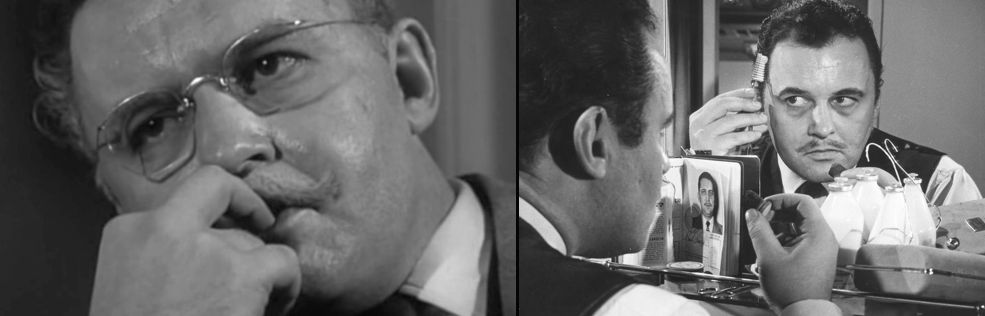
This slightly longer-than-necessary, one-hundred-three-minute British film is notable for Rod Steiger's gravitating performance, along with some interesting camera positions and closeups in the film's early stages. His propensity for offbeat, often volatile characters is legendary, though his range seemed to have few boundaries. All other characters fade by comparison. Yet for this film, he is almost an absurd figure of illogical attitudes and intents while channeling fellow method actor Brando. His German accent is no better than Artie Johnson from Laugh-In television fame with his “Vely Intelesting” signature comment. What might have been another signature role, the film's believability factor takes a hit as he flees the UK's prosecution. Still, it is an unusual, yet forgotten Steiger film.

Based on a short story of the same name by Graham Greene, the film was produced by The Rank Organisation and directed by Ken Annakin and filmed at Shepperton Studios, Middlesex, England, UK, and in Spain. The set-up is quite engaging as Scotland Yard arrives with embezzlement charges at Steiger's British office. The grand doors are opened, providing visual evidence that they have the right man as they witness a self-aggrandizing floor-to-ceiling “Stalinesque” self-portrait of himself. But Steiger gets the warning while at his New York headquarters. With inevitable escape procedures always planned ahead, he makes his immediate departure to Mexico for a planned three-month hideout. Scotland Yard sends an inspector across “the pond” to apprehend the condescending egoist.


The panicked Steiger is placed in some forced, compromising suspense sequences as he begins his cowardly escape from justice. He assumes the identity of a rail passenger by matching the duped man's passport picture, allowing him to cross the Mexican border. In a heinous act, he shoves the drugged passenger from the speeding train. Embezzlement is one thing. Murder is another. Steiger retains the passenger's suitcase for identity purposes with a plan to dispose of it alongside the road. It snaps open, revealing that the man is wanted in Mexico for the assassination of a Mexican governor. An unfortunate twist. But Steiger's sweaty fingers have apparently lost the man's passport. But it gets worse. The man survived his abrupt train departure. Rescued and secretly treated by his “personal” doctor, the assassin is recovering in a singular motel along a Texas thoroughfare. Bandaged and in traction from head to toe—similar to the hilarious final scene in It's a Mad, Mad, Mad, Mad Worldthe man is threatened by Steiger at gunpoint for his passport.


There is a fair amount of assuming throughout the film. Steiger gets apprehended at the Mexican border, and the authorities assume he is their wanted man. But the smug thief tells them who he really is. They could not care less. Steiger is further stunned. The assassin's wife confesses that he is her husband! Hard to believe there was no initial question about why he was assuming that particular man's identity. Finally, Steiger's angry demands assume he is above the law, even offering a bribe to the Mexican police chief to get “his” passport back.

The police chief and the British inspector conspire to keep Steiger trapped in the Mexican border town to pressure him into escaping across the bridge back to America for prosecution. But the agreement is a one-sided affair in Mexico’s favor. He is never getting out of Mexico. Steiger is content to settle in the town for as long as it takes. His wealth buys him whatever he desires until the political assassin’s body is returned home, killed in a Mexican raid at the motel. I am not sure why the townspeople feel Steiger is responsible for leaving behind a widow and child, but they band together, refusing his money or his existence.

Note: After assuming that unfortunate identity, Steiger is unaware that he is now the owner of an adorable spaniel. Rather risky when the baggage car handler has to remind him not to leave his previously fawned-over pet behind. The dog seems to recognize the impersonated face and follows him around town. When Steiger disposes of the assassin's suitcase, he also tries to leave the dog behind. Weary and exhausted from escaping, his life is spared by the whimpering dog alerting him to a scorpion on his trousers. Steiger has a change of heart toward the dog, and it eventually becomes his only friend. Yet the catalyst for his death.

December 28, 2019

THE PRETENDER (1947)


Billy’s slightly older brother, W. Lee Wilder, directed this sixty-nine-minute B-movie noir for Republic Pictures, which may be best remembered as one of the earliest Hollywood films to use a theremin, by Dr. Samuel J. Hoffman, to good effect, and for John Alton's wonderfully dark, moody cinematography. The screenplay was written by Don Martin and Doris Miller, who also provided additional dialogue. I found the script lacking clarity, with some characters confusingly intertwined. It is quite possible I dozed off. Somewhat cleverly adding to the confusion, a key character changes his name after the halfway point. Quite perplexing for the leading man, Albert Dekker. For the era, I imagine this was a good, suspenseful drama. Had it been released years later, it would have been more efficient—and free—as an episode of The Alfred Hitchcock Hour.

Dekker had an inherent vocal ability to softly signify an unstable mind. At first, suggesting a reserved man, his real character here eventually comes to a breaking point. This role works for him. He plays a crooked investor, desperately embezzling money from a large estate bequeathed to the young Catherine Craig after her father’s death. Dekker is losing his shirt in the stock market, and acting as a Robin Hood broker has been stealing from the rich and giving to himself. He is fortunate to have a secretary with zero scruples. She witnesses all his dishonest fund transfers without so much as a blink.


Typical of Hollywood's Golden Era, Dekker is old enough to be Craig’s uncle, but he pours on the charm in his effort to woo her into marriage, giving him the ability to cover his debts with her inheritance. He even peels off his studio mustache, believing he looks younger. He has been a faithful and trusted friend regarding the estate, but she loves another in her age group. Dekker is not sure who that is, but wants him killed, paying a nightclub owner/mobster, Alan Carney, to arrange an “accident” after their engagement picture appears in the newspaper. The lucky guy is Charles Drake, a neurosurgeon and doctor of psychology, whose responsibilities have left little time for Craig. They mutually call off their engagement. To Dekker’s surprise and queasiness, she decides to accept “Uncle Albert’s” earlier proposal and wants to elope. And the local paper knows about it.


In the meantime, Carney is killed, and his right-hand man, Tom “Fingers” Kennedy, takes over the boss’s chair and decides to go upscale and use, I assume, his given character name. A name Dekker does not recognize, but his paranoia tells him that anyone named “Fingers” could carry out the prepaid deed on him. Carney, for anonymity, had bestowed upon Dekker’s character an alias, unknown to Kennedy. Throughout the balance of the film, the doomed groom is trying to make connections with Kennedy to cancel his prearranged funeral.


Dekker’s mental state is personified by the theremin. As the camera closes in on his face, now with a full mustache, he audibly shares his inner thoughts. Until the science fiction community confiscated the instrument, it was the perfect instrument to signify someone with psychological issues. His constant excuses and lies only go so far. He is afraid to eat for fear of poisoning. He does not trust their butler. Nor their second one. His paranoia increases to a ridiculous level while Craig becomes the most understanding woman on the planet. She gets Drake's free analysis and finds Dekker riddled with guilt and fear. They also find he has been dining alone in his room, eating canned food all along. Pretty creepy in the Dekker tradition. He dons sunglasses, even at night, for fear of being recognized. All his paranoia may be hard to sit through. Turns out, Carney left a note for Kennedy about canceling the groom’s elimination. One doubts that Dekker’s secretary will ever come forward about Craig’s monetary shortfall.

October 14, 2017

THE LAS VEGAS STORY (1952)


Howard Hughes puts his trademarks on this eighty-eight-minute RKO Radio Pictures film, what with the flying sequences and microscopic closeups of his leading lady. A hardly unknown film, it lost money at the box office. However, with the pairing of Victor Mature and Jane Russell, it is hard to ignore. Despite some inferior projects, Mature never embarrassed himself. He is his usual flawless self, yet his co-star, Vincent Price, takes a back seat to no one. Throw in Hoagy Carmichael and you have the potential for fine entertainment. It was directed by Robert Stevenson and required the trio of Robert Sparks, Howard Hughes, and Samuel Bischoff to produce it.

With similar “dangerous” facial features, testy pout, and a noteworthy sneer, Russell may remind one of the female Elvis. She could hardly be called flat except for her adequate acting and one-dimensional delivery here. Her eyes are generally expressionless and her potentially witty comebacks are not as pointed as in the superior, His Kind of Woman, a year earlier, with Robert Mitchum. Nonetheless, she had one of the most beautiful smiles in Hollywood. But lately, those smiles only happen when she is around Happy, played by Carmichael, the casino pianist. Thanks to his delivery, he lightens the film considerably, if not frequently. His opening narration sets up the background for the film's stars. Hoagy's folksy tone of a “country cool cat” is endearing. He performs an early “rap” song, “The Monkey Song.” The difference with his rap is that he uses an actual melody. The 1938 song, “I Get Along Without You Very Well” is reused for this film. Russell is filmed only from the waist up while singing, providing another comparison to Elvis. But with Hughe's opposite intentions.


Russell's husband, Price, insists on vacationing in Las Vegas, determined to play the tables in hopes of winning enough to pay his debts. He is decidedly a character with selfish motives. Russell preferred a flight anywhere else from fears of running into her old flame, Mature, now a lieutenant with the Sheriff's Department. Throughout most of the film, he and Russell get along without each other very well due to their parting years before, the result of poor communication skills. Russell's 100 grand necklace becomes Price's gambling collateral with the casino owner attempting to secure it. Getting off the same flight as the newlyweds is "Mr. Smarmy" himself, Brad Dexter. He has been assigned by his insurance company to watch Price and Russell's neckli...uh...necklace. Dexter slimes into the dark side about halfway through the film.


The climax, filmed at the former Tonopah Army Airfield, was the first car and helicopter chase sequence in a movie. Flying twice through an open hanger was a groundbreaking sequence and I imagine amazed the audience. Dexter's useless driving around in circles in his attempt to evade the helicopter is pretty silly. The foot chase between him and Mature is a high-wind final confrontation yet typical of the era. Price is no longer a murder suspect but is found guilty of embezzlement to please the audience. An appropriate wrap to the film. But wait. It is not quite over. After two murders, theft, and an extended chase scene, one might not expect to have another song thrown in. Written for this film and Mature's character, “My Resistance Is Low” is an okay Carmichael song but hard to sit through because of Russell's syrupy delivery and slurred esses. I digress. There will be divorce papers to sign and assuming they can keep their personal blowups restrained, Russell and Mature may roll the dice one more time. Viva Las Vegas!