Showing posts with label spy. Show all posts

May 1, 2023

SHACK OUT ON 101 (1955)


This movie surely got lost on its opening weekend, but no need to apologize for their efforts. You will enjoy this rather unconventionally titled film. One might think this is a filmed stage play as ninety-five percent of the film takes place in a diner [set] along California's Highway 101. The viewer gets hooked in the first five minutes, and past this point, the plot slowly unfolds. A story not about the life of Pie, but centering around a common theme during this period: national security. This slow-burn film has an interesting mix of humor and mystery during the “who do you trust” era. Condense this down to under sixty minutes, and you would have one of the better
Alfred Hitchcock Hour episodes.


All the diner's patrons interact with numerous one-on-one conversations. There is Lee Marvin, a character who swings from lecherous slob to comical buddy. Everyone's cliched short-order cook. If Marvin seemed to be underappreciated mid-century, he did not go unnoticed. He is quite versatile here, handling a pivotal dual role. He has a lot cooking, but it is not chili. Keenan Wynn, the sarcastic eatery owner, does not like Marvin's attitude and apparently his cooking. Their verbal jabs is the daily routine. He and Marvin have the funniest scene during their weight-lifting challenge. It is full of sarcastic insults as each tries to "out man" the other. Lean and lanky, Marvin is hilarious.


Throw in smokey-voiced tenor, Frank Lovejoy, with a few secrets; throw in a naive waitress, Terry Moore, and you have a reason to show up at the diner. Despite her top billing, this is Marvin's film. If you are expecting Whit Bissell to show up, then you will not be disappointed. He plays the D-Day buddy of Wynn’s character. Len Lesser (Seinfeld’s Uncle Leo) and Marvin seem to have a long-standing relationship. Their odd mock "boxing match" at arm's length with opposite ends of a towel between their teeth would seem to have a childhood history.

Note: This eighty-minute suspense drama was directed by Edward Dein with a twisty screenplay by him and Mildred Dein. It was produced by William F. Broidy Productions and released by United Artists Pictures. The ever-present Paul Dunlap offered up the music score, starting off with a jazzy jukebox number.

May 16, 2022

THE FLYING SAUCER (1950)


This American, independently made Soviet spy drama was written, produced, directed, and starred the average-looking Mikel Conrad, not Comrade. So, most of the blame falls on his shoulders. In truth, he does a decent job of capturing his character, but he is never in Micky Spillane territory. Occasionally, one person in charge of all aspects of a film can make an impact. Allen Baron is a great example with his 1961 crime film, Blast of Silence. The result here is lackluster filmmaking. The film is not a thriller; it is science fiction, but not in the typical sense. Do not expect flying saucers to destroy totem poles in Juneau, Alaska. This is a mystery, and that is its strongest compliment. Denver Pyle, Roy “B-movie” Engel, and to a lesser degree, Russell Hicks, are the best-known faces, while much of the cast turns in solid collegiate performances.

Intelligence officials learn that Soviet spies have begun exploring a remote region of the Alaska Territory, concerning worldwide reports of flying saucers. Conrad, raised in that region, is recruited because his credentials as a wealthy American playboy are best suited to handle an undercover assignment to assist a Secret Service agency. He is not excited—too much work. Then he admires his reflection in a mirror and is introduced to the pretty female agent, Pat Garrison. Many frames are eaten up by bucolic Alaskan scenery, slow motorboat navigation across a vast lake, a seaplane flight, and a picnic, all of which include no dialogue. The crescendoing music score is better suited for an epic film. Yet the grandeur is lost in a wash of grays. 


Conrad is to pretend he is suffering from a nervous breakdown—trying to control this film, perhaps—with Garrison acting as his private nurse. “Mr. Terrific,” clad in plaid, is highly skeptical of flying saucer reports until he hears one slice over his Alaskan lodge. Probably a meteor, he thinks. The saucer is real, an invention of American scientist Roy Engel, whose mechanic, Denver Pyle, is a greedy communist spy with a plan: get in on the ground floor of the Soviet Frisbee cartel. Conrad has to deal with Soviet agents in Juneau, a conniving barmaid, and his own drunken stupor, an avalanche, and the rescue of his phony private nurse—all of which approach the mundane. Conrad, Garrison, and Engel see light at the end of a secret Soviet tunnel just in time to spot Pyle being "saucered." The Soviets would learn a lot from reverse engineering, so Engel installed an after-market accessory. At a certain altitude, the saucer explodes, resulting in small "Pyles" scattered about.

Note: This seventy-five-minute science fiction film was distributed in the United States by Film Classics Inc. It is the first feature film to deal with the era's hot topic of flying saucers. I imagine those who bought tickets for this international spy yarn were ticked off that it has nothing to do with the poster. The single saucer in this film is more akin to a reconnaissance drone. Flying disks were first given the film's title in 1947 by a private pilot who reported nine silvery, crescent-shaped objects flying in tight formation. Some chose to take him at his word.

January 18, 2021

NIGHT TRAIN TO PARIS (1964)


Ending in an appropriate sixty-five minutes, this film’s lackluster direction by actor Robert Douglas never becomes an exciting espionage yarn, hinting that he should stay in the television medium where he was best suited to direct. The repeated filming of the same sequences only lengthens the film. He uses a momentary rocking camera motion only for the train’s first interior filming to my annoyance. An opening jazz score by the modest British composer, Kenny Graham, assumes a treat ahead as if to mimic Henry Mancini. The underlying cartoon train graphic—I expected the Pink Panther as the engineer—shaves any dangerous edges off the film. So one might anticipate a little humor, and that is all one gets. Unlike a secure day train, only on a night train does one experience death. Filmed by Shepperton Studios in London, it was released by Twentieth Century Fox. It assumes a cool caper television pilot that the networks passed on.


The excitement begins and ends with two men exchanging wrapped deli sandwiches...er...a reel tape and cash at a phone booth. The guy with the cash never makes it home. The other guy retains a fake reel as a deception. The scene shifts to the office of an airline travel agency and its public relations man, Leslie Nielsen, a former intelligence officer in the OSS. He is charming and flippant, but not convincing, whether serious or comedic. Squeezing laughs out of an unfunny script by Harry Spalding is not easy. At this stage in his career, Nielsen is not a notable star, yet the average television viewer in America at the time would recognize his face if not his name. For any fan of Nielsen's comedic career crescendo, it may be difficult to entirely remove him from his Lt. Frank Drebin character. 

Arriving at his office in a modest tribute to the hairstyle of the bride of Frankenstein's creation is Alizia Gur in all her exotic allure. A frequent guest star on many American television shows during the period, her acting has not matured since her single Bond film appearance. She arranges a meeting between Nielson and Hugh Latimercredited as playing Jules Lemoine—a fellow OSS officer who wants his pal off to Paris for a secret mission to deliver the (real) tape containing defense information. But Latimer's fake reel becomes his fatal drawback. Upon discovering his body, Nielson gathers unknown material from his apartment for a tedious waste of film. Without any music score, it seems even longer.


Nielson poses as an assistant to a professional photographer, and to further the gambit, they take along two models, one of whom turns out to be an impostor. Gur fills in as a third model. But even before packing for the special New Year’s Eve Bear Ski Club train, the photographer is stabbed in the back by the short-spiked end of a ski pole. I might have believed his immediate demise had he been struck in a carotid artery. With Gur as his companion,
Nielson arrives at the costume party in a “Groucho Marx” propDrebin undercover. By midnight, the party is in full swing with era music and “ants in your pants” dancing.

On board is the large, high-cholesterol Eric Pohlmann, responsible for all the deaths in the film. The ski club has an inebriated bear mascot that interacts with Nielson for no apparent reason. The mascot gets a throttling as well, and after the boat docks, Pohlmann dons the bear costume to the unknowing travel agent. Their confrontation in Dunkirk is pretty silly, but it was not meant to be. He is able to beat the bear costume into submission with repeated blows to the stomach. Meanwhile, Gur’s been busy with her own plan for the tape, and her inept pursuit of Nielson is preposterously dull. Nielson ends the film with a lighthearted, freeze-framed expression in Police Squad fashion.

Notes: Hugh Latimer is credited with playing Jules Lemoine. Adding some confusion, he is introduced to Gur as Georges Freneau. She claimed to be a friend of Lemoine, yet, oddly, she never flinches when his undercover name is mentioned.

Finally, back in the day, a ferry shuttled specialty trains from Great Britain to France across the English Channel. Once docked in Dunkirk, the train would continue on to Paris and Switzerland’s slopes. Despite the film’s title, neither the audience nor the cast ever gets to Paris. Perhaps a more accurate, but less intriguing title, “The Dunkirk Night Ferry.”

September 4, 2020

FOREIGN INTRIGUE (1956)


Directed and produced by Sheldon Reynolds for Sheldon Reynolds Productions but not starring Sheldon Reynolds, this mystery was a box office success for United Artists in spite of an involved, twisty plot and some confusing characters. Reynolds’ one-sheet resumé includes producing the television show of the same name at the same time. He was quite repetitive. American audiences were familiar with the star of this seemingly long, one-hundred-minute film, but not so much the co-stars. Introduced are Geneviève Page as Dominique and the blonde Ingrid Thulin as Brita. An intriguing character of amusing danger is played by Frederick O'Brady as "Mr. Spring." Except for the lone American, Mitchum, I have referred to the cast members by their character names. The slow-burn plot is not short on intrigue. Enjoy the beautiful camera work with lavish interiors and cinematic outdoor locations. One should appreciate Bertil Palmgren for his excellent cinematography during the final climactic scenes. The dark shadows cast by village archways and rich colors add visual intrigue to this film. The tension mounts with Durand’s two tones from a woodblock percussion instrument—a similar effect of water dripping in a drain pipe. But an unresolved ending may make one throw the remains of the popcorn at the screen, however.


The classically-inspired piano solo composition, appropriately entitled “The Foreign Intrigue Concerto” by Charles Norman, opens the film as Victor Danemore returns to his mansion after surveying his enormous flower garden. At the same time, along the French Riviera, Mitchum enters the film to purchase Danemore’s airline tickets. His exit is in a sleek 1949 Delahaye 135 Cabriolet Chapron, accompanied by a frivolity of strings. Paul Durand’s music is never quite right as Mitchum traverses a beautiful high stone arch bridge in a distant shot—foreshadowing the likes of some early James Bond movies—the music here is a vivid mismatch of scene and score as soft flutes take over, setting entirely the wrong mood. The music is better suited for Mitchum net-hunting butterflies in a field. Visually, that would be intriguing.

Mitchum enters the mansionchest firstto find Danemore on the floor in a position that would be uncomfortable for someone alive. He informs Danemore’s young wife, Dominique, who is not exactly grief-stricken. All the viewer knows at this point is that Mitchum was hired a few years back to write a glowing account of Danemore’s past life. Glowing but fabricated. Not until near the halfway point does one learn that Mitchum is a reporter. But he cannot get any straight answers on how he obtained his wealth. The intrigue gets underway in a complicated intertwining of tales and characters. Mitchum is particularly perplexed by the shadowing of the bald-headed Spring. Throughout the movie, Mitchum seems so relaxed that he probably suspects what is around the next corner. On the contrary, he is flummoxed at every turn. His most frustrating mystery is why so many want to know if Danemore said anything before he died. Sometime after the funeral, in all her feigned sweetness, Dominique pays Danemore's estate representative a visit to request a sealed document. But she is permitted only to verify that it is sealed. He opens the safe, and the screen fades to black. For a second, I thought I passed out. Mitchum stumbles upon another dead body. 


In an effort to unravel the two recent deaths, Mitchum sets off for Stockholm to meet a man associated with Danemore. Unfortunately, the man is no longer living. His daughter, Brita, is there to greet him. Whenever these two are together, Durand’s score erupts with more strings in a bouncy, slightly baroque repetitious ditty. The American is quite smitten with her playfulness. Brita suggests her mother may be able to shed some light on her late husband's connection, yet Mitchum hits another brick wall.

Spring returns as the self-invited guest in Mitchum's hotel room. They share some sarcastic banter while Mitchum shaves. Nonchalantly, Spring informs him of his orders to kill him for that visit to Stockholm. He slowly lifts a small handgun, then Mitchum knocks the gun from his hand with a towel and an uppercut decks him. After he awakes, Spring rubs his jaw in total puzzlement as to why he was punched so hard since they are good friends. It is back to Vienna for Mitchum, where he is finally enlightened about Danemore’s past from four national representatives (below). They request that he proceed with his prearranged night meeting with Spring. Conveniently hidden from his view, Dominique (bottom) approaches Mitchum at gunpoint with a partnership proposal or else. Those foreign officials are nearby, and she is arrested. 


Note: When Dominique pays a condescending visit to Brita and her mother, it is an editing whiplash of sorts. As the mother appears to further elaborate on her husband, the scene abruptly changes to Mitchum looking through Spring’s suitcase. A few words with Spring, and we are suddenly back to the three ladies as Dominique blabs on about Mitchum romancing Brita, only to get the truth on Danemore and blackmail her with that truth. Then it is back to Mitchum and Spring. Then back to the ladies as Dominique leaves the premises with a threat. It all reminds me of many of today’s television crime dramas, where they incorporate the assumed attention span of a gnat into the story.

August 28, 2020

THE NAKED RUNNER (1967)


This British Cold War espionage film, directed by Sidney Furie, would have benefited from shaving about fifteen minutes from its one-hundred-minute length to help eliminate scripted micro-detailing. The weak character development adds to the confusion with a myriad of characters popping up throughout the film. Scene changes may be frustratingly abrupt as well. I was initially not sure what to make of Harry Sukman’s opening piano concerto. It seemed out of place or a bit too romantic. It is explained, however, with opening visual support, as only a suggested record album selection of one main character, Peter Vaughn. I was most impressed with the stylish cinematography and its tight, asymmetrical close-ups of actors or camera angles. A late Sixties trend. Also trendy were the simple, graphic posters, some with a high degree of white space around the creative illustrations. The high-angle shots of a modern London office interior suit the title character, an industrial designer played by Frank Sinatra. Just to clarify, he runs a bit, but at no time is he naked, and this film should not be confused with his superior, Some Came Running, nine years earlier. Though at times ponderous, this is a decent update of a typical B-movie and would fit nicely into a Sinatra movie vault. His friend, actor Brad Dexter, garnered support for the project and ended up producing it. Unfortunately, the film was a box office disappointment and severed the ties between Sinatra and Warner Bros. Little help from the cool poster as well.


Working in London, Sinatra and his young son are planning a holiday behind the Iron Curtain—another “Wheel of Fortune” getaway—and attend an international trade show. Meanwhile, a British Intelligence officer, the aforementioned Vaughn, who served with Sinatra in the Second World War, decides to use the opportunity to coerce him into carrying out a simple exchange. Sinatra is skeptical of its simplicity. Only Vaughn knows that a recent prison escapee plans to share highly sensitive scientific information with Moscow, and his assassination is imperative. With an integrated plan that involves half of Western Europe, Vaughn plays on Sinatra’s sympathies and his wartime experience as an expert marksman. However unethical, he will do anything to rattle Sinatra to the breaking point—perhaps make him so angry he will willingly carry out the deed.


The script seems to suggest that after twenty years a civilian, Sinatra is a bit rusty and naively assumes everyone is telling the truth. His anger increases, however, as the truth gets harder to find. He is at the mercy of Vaughn and his operatives. One operative is Derren Nesbitt, posing as an East German intelligence officer, who sweats him out in an abandoned warehouse in the middle of a forest. The agonizingly slow interrogation ends with Nesbitt’s apparent plan to execute Sinatra. After a short stroll in the woods, he takes the pistol’s safety off but “changes his mind” at the last second. This pushes ‘Ol Blues Eyes over the edge, expelling whatever meal he had eaten previously. Another operative is Edward Fox, intending to be from the British Embassy and graciously comes to Sinatra’s aid, yet provides no information of value to relieve his anxiety.


An abrupt, deflated ending may recall one of those old “backstory jokes” from your uncle, with a set-up that seemingly goes on forever and a punchline not worth the wait. The single most glaring element of the film. Kudos for saving disappointment until the end. As Vaughn’s pawn, Sinatra gets no apologies for his underhanded manipulation. Sinatra had become so confused with Vaughn’s cryptic behavior that he assumed he was the actual target. Vaughn does provide an extremely brief explanation with a compliment for completing the nerve-racking assignment as planned. No hard feelings, ‘ol chap?

Oddity: Shortly after the seven-minute point on my copy, there is a fuzzy red square covering the center of the screen, cropping into the hands of Vaughn and the Cabinet ministerfacing each other at opposite ends of the screenduring their conversation. What we see is actually the back of an out-of-focus red chair, set in the near foreground. My thanks go to the expert comment in the first paragraph below, which clarifies my mystery.

June 29, 2019

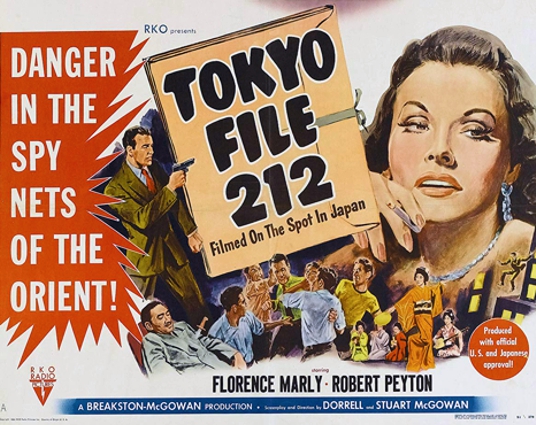
TOKYO FILE 212 (1951)


This American-Japanese double-billed film, distributed by RKO Radio Pictures, could not get any more “B.” From the start of filming to it being put "in the can" took about two months. The acting is okay, but any scintillating dialogue was left in a manila folder, perhaps File 207. The bland dialogue may be an effort to suggest the film was “shot as it happened” using the everyday people involved. I am being kind. Except for some actual military personnel, it is simply a cast of unknown actors in a speculative story filmed entirely in Tokyo, a Hollywood first. It is an innovative take on the Korean War, suggesting Communist spies were working from Japan to sabotage American operations. Certainly not a preposterous premise. Despite the film’s average packaging, the pacing is good, and the Tokyo settings add realism and mystery. Albert Glasser’s rousing opening score certainly gets your attention. The eighty-four-minute movie was not a success, with mixed reviews from critics and ticket buyers alike.

The story is told with voice-overs by a U.S. Government Agent, the sometimes billed, Robert Peyton. His voice and mannerisms seem too intimate for the big screen and better suited for television, where one can get small but perceived as big. The bulk of the movie is told in flashback after a briefcase bomb explodes near his chins. Since he is telling the story, we know he survives the blast, but we do not know what miracle befell him. The climax does have a logical, eye-opening resolution. Officially, he was not a body double for Fred MacMurray, but one might disagree, below.


After checking in at the front desk, Peyton finds Francis Marly, a mature Euro-tart making herself at home in his room. Perhaps the funniest thing in the movie is that she talks seductively in the third person. Being a debonair geek, he is attracted to her "fit of flirts." We are never sure if she can tell the truth. They become an odd team even though he suspects her of being a Communist sympathizer.

Peyton came to Japan to find an old college classmate, Katsuhiko Haida, who is suspected of joining the Communists. Haida’s father tells Peyton of his son’s backstory in a World War II Kamikaze 101 class, where they use scale models for practice. One student is slapped by the tough instructor for timidly and repeatedly not zooming his plane in the right area of a carrier model, thanks to an improper grip on the model. No successful Kamikaze 101 student gets a typical diploma. They get funeral rites. But the war comes to an end, and Haida is crushed that he will never be able to go on frequent Kamikaze missions. He is despondent and vulnerable to Communist propaganda.


The leader of the Communist ring, Tetsu Nakamura, is all very honorable when in Peyton’s presence. Just a sweetheart. Peyton’s informer, however, tells him to be wary of his secret ingredient when he dines with him. Poison. Peyton makes an attempt to add a bit of (awkward) suspenseful humor to this scene. 

The girlfriend of Haida is played by the exceptionally cute Reiko Otani. She is abducted by the Commies, then dumped on the road without so much as an apology. While in the critical care unit, Haida secretly visits, and they express their undying love for each other. Never use any form of the word “dying” in her presence at this point. Haida has an epiphany and is no longer on the dark red side, using all his kamikaze skills to defeat Nakamura. For Peyton, it is on to File 213.

Note: The film provides the moviegoer with good exposure to mid-century Japanese culture. If the film has any assets, it would be this. Many of these scenes carry no dialogue as we follow Peyton through the streets and bars of Tokyo. This in itself saved a ton of production money. There is a scene in a sleazy Japanese-only bar where rowdy, drunk, tattooed men are doing what they would not do unless in a crowd. There is a fully clothed female dancer, after a fashion, on a table. When Peyton and Marly enter in search of Haida, the place becomes dead silent. like two Jewish men entering a Nazi bar. The U.S. Military Police tell them that the bar is off limits and suggest, for their own safety, that they leave.

March 12, 2016

WHERE THE SPIES ARE (1966)


This lighthearted, yet underwhelming film was to initiate a Dr. Love spy series. Released fifty years ago this month, the decision not to pursue a sequel had to be fairly obvious. David Niven plays said doctor, a reluctant recruit to carry out an undercover Cold War assignment. A charming, debonair man, the baggy-eyed Niven has left behind his youthful days with Errol Flynn. He rekindles his charm by wearing a jolly good smile or saying anything in his British accent, however. This dialogue-heavy film starts off with an intriguing, yet confused, list of characters that have not yet been established. Filmed in Metrocolor, it uses dated backscreen projection for numerous driving sequences familiar to Connery fans. This was still common for large-budget films until the end of the decade with films like Vanishing Point and Bullitt. The action goes from interesting to dangerous in rapid order. Picturesque location shoots add to the worldwide flavor established in the popular Bond series.

How Niven is duped into the spy game is pretty good fun. British intelligence needs some unknown to discover what happened to one of their agents in Beirut, Lebanon. Since Niven did some intelligence work during WW2, he could also attend a medical convention there without attracting suspicion. That is their guess. Niven never makes it to any convention. He is met by the boss, John Le Mesurier, who finds it hard to keep Niven focused on his proposal. Niven is obsessed with his 1937 Cord automobile which he brags about constantly. In reality, the car has awful brakes, sputters, and breaks down on a regular basis. Le Mesurier feeds him plenty of untruths about how simple the mission will be...nearly a vacation. This scene is the most (only) amusing one in the film.

Francoise Dorleac instant romance with Niven is hard to fathom. The double agent is young enough to be his niece. Having her fall so quickly for the old codger says something about her lack of judicious discernment, typical of the era. Just as peculiar is Niven instinctively adapting to the spy gadgets like a pro. The last thirty minutes live up to the spy genre as the good doctor finds himself a target by Communist spies. He is briefly "tortured" on board an Aeroflot "peace" flight to gain knowledge of his part in the mission in stereotypical Soviet fashion. Niven suddenly comes off as clever and a bit daringlike any adapting physician. Painfully laughable are scenes concerning a Comet airliner scale model and miniature set, destroying an otherwise acceptable ending. Obvious budget constraints took their toll, none worse than when Niven “jumps” from the taxiing plane. What hits the ground appears to be a close-up of dryer lint blurred by a high-speed hair dryer. Whatever that is, it certainly is not humanoid. A burst out laughing moment.

Yet a most glaring faux pas is a mixed-bag music score by the Italian composer, Mario Nascimbene. It jumps from a bongo, and percussion coolness to sappy full orchestra elevator music, neither of which is in no way appropriate for the scene it is used to support. That latter score might have gone over better had Niven co-starred with Doris Day in another family film. Niven does better himself the following year with, Casino Royale, possessing a much better screenplay, music score, and intelligent production. Tuxedo included.

Note: This poster speaks for itselfnot believable. The film plays off the recent 007 successes at the height of the international spy craze. If you like this early spy genre or you are a huge Niven fan you may enjoy this. Well, except for those creepy romance scenes with his “niece.”