Showing posts with label korean war. Show all posts

July 19, 2026

The Hunters (1958)


This film is an adaptation of The Hunters, the first novel by Air Force veteran James Salter in 1957. The film strays from the original story most notably by incorporating a self-destructive fighter pilot. Mr. Salter was not pleased and not consulted. It was directed and produced competently by Dick Powell, with a 
screenplay by Wendell Mayes. The 108-minute film was distributed by Twentieth Century FoxPaul Sawtell's powerful music score during the escape of three downed American pilots in Communist occupied territory is worth noting. Without a doubt, the CinemaScope aerial sequences by cinematographer Charles G. Clarke, A.S.C. are the highlight of the movie. Because the well-acted drama is another "war picture" with personal conflicts, studio cockpit "flying", and hitting the speed brake switch during a love tryst going nowhere. A film that might have stood the test of time instead lost money. Not too surprising after viewing the first quarter of the film.

The film stars Robert Mitchum, Robert Wagner, Lee Philips, May Britt, and Richard Egan. Hard to argue with this line-up, though Britt seems a bit anemic. Yet it probably is written into the script, "your character is supposed to be anemic." You can believe that if you want. Mitchum plays an experienced WWII combat ace. On the opposite end of the spectrum is a young lieutenant, a hep-talking, ego-centric new recruit, Wagner. He is quite good in the role and improves the film from his very first scene with his legendary exuberant delivery and good looks. The two do not see eye-to-eye on taking orders. Mitchum wants him out of his flight unit, but the Colonel, Egan, overrides his desire. It turns out to be fortuitous.


Philips is worth singling out with a difficult emotional role as the invented character outside the novel. He plays a promising combat pilot who has only found frustration with his inability to make a mark for himself. His escape is to drown his fears and self-loathing in alcohol consumption. Aware of Mitchum's legendary status, Philips is quite defensive about his lack of confidence (above). But Mitchum has little sympathy for the thirty-year-old and, upon meeting his wife, Britt, senses that she is on the proverbial fence over her husband's evasive maneuvers. Mitch and Britt are joined at the lips on several occasions. Philips suspects as much.


On one hunting mission, Philips is caught trying to outmaneuver a top Communist pilot when his plane is hit. He ejects, landing in a tree badly injured. Mitchum takes out the enemy plane, spots Philips' chute after a few passes, then finds a clearing to do a risky belly landing. His duty is to rescue his fellow pilot. Wagner was given an order to return to the base, but disobeying is second nature. He spots Chinese military vehicles approaching and hits the deck to strafe the convoy. But his plane is hit by anti-aircraft fire while climbing away. He has to bail. The three make a valiant effort to stay alive in Powell's action-filled climax, making good use of the term. A passing UN convoy saves their lives. Mitchum actually had enough fuel to get back to base. By deliberately destroying his aircraft, a court-martial is a likely outcome. Common sense wins, and after a light reprimand, Egan dismisses the incident.

The trio is transferred to a military hospital stateside, where Mitchum recovers from a wounded arm, and Philips improves daily. The latter indicates sincere remorse to Britt and vows to be the husband he had intended to be. She seems skeptical. The unscathed Wagner finishes his scenes humorously and with a genuine respect for "his elders."

Notes: The air combat scenes are exciting as North American F-86 Sabre Jets (above) encounter Chinese/North Korean Mig 15s. Except the Migs are gray Republic F-84 Thunderstreaks with the red Chinese stars appropriately placed. The sequence of a one-on-one dogfight is exciting, as are the beautiful rows of contrails from a multi-ship formation of Sabres at altitude. 

As is so often the case in films where relationships take precedence over aircraft continuity, famous stock footage of a North American F-100 Super Sabre crashing substitutes for a pilot's F-86. Rather than editing in this obvious out-of-place clip, let the onlooking cast convey the inevitable crash in facial horror with the provided script. Not sure Powell saw the rushes.

April 3, 2026

BATTLE TAXI (1955)


Directed by Herbert Strock, with a screenplay by Malvin Wald, this black-and-white aviation film was distributed by United Artists. The production company was Ivan Tors Productions. Between footage of slow-moving helicopters, interspersed with some cliched human interaction on the ground, this is not an edge-of-your-seat combat film. Blurry, stock Korean War footage is inserted, signaling a low-budget, spliced-together effort. It is well-acted, and that saves it from being a total loss of eighty-two minutes. That, and filming the aircraft of the era. Historical aviation buffs will get their blood flowing with the high-speed flyovers of the North American F-86 Sabre Jets and F-51s, plus stock footage of F-80s, SA-16A Albatross, an RB-45 Tornado, and the Boeing SB-29 air-sea rescue aircraft. The Sikorsky H-19 Chickasaw helicopters are the lifeblood of the film. All of which gives authenticity to a film lacking any thrilling action. Perhaps determining which would sell more tickets, a fighter jet or a helicopter, the art director chose the former for the above poster. Once again, misleading a potential audience.


The film's most famous actor is Sterling Hayden, followed by the competent Arthur Franz and Marshall Thompson. The script allows for the occasional subtle humor between these three, and that helps. Hayden is the no-nonsense commander of an Air Rescue helicopter team during the Far East conflict. He is a thorn in the side of Franz, a hot-shot fighter pilot who has been thrust into piloting a cumbersome "air taxi" due to a shortage of rescue pilots. Ignoring direct orders, he takes it upon himself to delay a North Korean tank from pounding soldiers on his first mission. His co-pilot, Thompson, is not comfortable with the surprises that await him. Franz circles the tank twice as Thompson drops smoke bombs to hinder the enemy's visibility. Though the unauthorized maneuver does help the situation, distancing the soldiers from the tank, sparks fly when Hayden comes down hard on Franz for multiple reasons.


Angry with Hayden's by-the-book approach, Franz begs to be transferred to a fighter squadron where he can better use his skills. Instead, with everything he can muster, Hayden will drive home the importance of air rescue until he champions its cause. Not yet willing to accept his “whirlybird” limitations on a subsequent mission, Franz dangerously goes after a pilot stranded in enemy territory with low fuel reserves. The rescue is aborted after the downed pilot is gunned down while being hoisted up. He risks everything, confidently announcing they will find fuel along the way. A disabled military truck provides some extra fuel. But Franz is seriously wounded as they depart, leaving Thompson to fly back to base. Burning gasoline damages the engine, and his H-19 will take extra hours to fix.

Rather than pinning Franz to the wall verbally, Hayden volunteers him to speak to the fighter jockeys if or when they might need rescuing. The H-19 is at their service and the rescue team's top priority. Though awkward for him, it is a turning point in Franz's perspective.

There is a rather nifty sequence to divert a small band of North Korean troops away from the Americans. Piloting his "battle taxi," Hayden's co-pilot sets off a smoke flare that suggests the Korean's have struck the aircraft's engine. A bit of authentically faked maneuvering, he sets down the H-19 in an open field and opens the engine compartment. Aware that the enemy is running in his direction, he closes the engine compartment once shots ring out. The helicopter quickly rises and disappears, moving the enemy further away for safety.

Note: There was stiff war movie competition during the same year as this B-movie. It was arguably Raoul Walsh's Battle Cry that gained the most attention. Other combat films of note were To Hell and Back, Blood Alley, Mister Roberts, and the British production of The Dam Busters. Battle Taxi has therefore become a film to chronicle Hayden's career. The film is a pretty good effort as an “also-ran.”

June 29, 2019

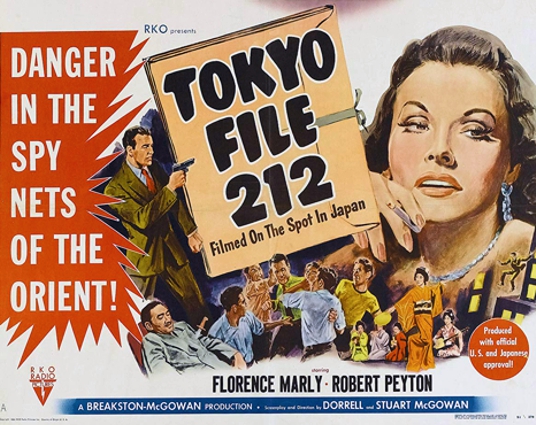
TOKYO FILE 212 (1951)


This American-Japanese double-billed film, distributed by RKO Radio Pictures, could not get any more “B.” From the start of filming to it being put "in the can" took about two months. The acting is okay, but any scintillating dialogue was left in a manila folder, perhaps File 207. The bland dialogue may be an effort to suggest the film was “shot as it happened” using the everyday people involved. I am being kind. Except for some actual military personnel, it is simply a cast of unknown actors in a speculative story filmed entirely in Tokyo, a Hollywood first. It is an innovative take on the Korean War, suggesting Communist spies were working from Japan to sabotage American operations. Certainly not a preposterous premise. Despite the film’s average packaging, the pacing is good, and the Tokyo settings add realism and mystery. Albert Glasser’s rousing opening score certainly gets your attention. The eighty-four-minute movie was not a success, with mixed reviews from critics and ticket buyers alike.

The story is told with voice-overs by a U.S. Government Agent, the sometimes billed, Robert Peyton. His voice and mannerisms seem too intimate for the big screen and better suited for television, where one can get small but perceived as big. The bulk of the movie is told in flashback after a briefcase bomb explodes near his chins. Since he is telling the story, we know he survives the blast, but we do not know what miracle befell him. The climax does have a logical, eye-opening resolution. Officially, he was not a body double for Fred MacMurray, but one might disagree, below.


After checking in at the front desk, Peyton finds Francis Marly, a mature Euro-tart making herself at home in his room. Perhaps the funniest thing in the movie is that she talks seductively in the third person. Being a debonair geek, he is attracted to her "fit of flirts." We are never sure if she can tell the truth. They become an odd team even though he suspects her of being a Communist sympathizer.

Peyton came to Japan to find an old college classmate, Katsuhiko Haida, who is suspected of joining the Communists. Haida’s father tells Peyton of his son’s backstory in a World War II Kamikaze 101 class, where they use scale models for practice. One student is slapped by the tough instructor for timidly and repeatedly not zooming his plane in the right area of a carrier model, thanks to an improper grip on the model. No successful Kamikaze 101 student gets a typical diploma. They get funeral rites. But the war comes to an end, and Haida is crushed that he will never be able to go on frequent Kamikaze missions. He is despondent and vulnerable to Communist propaganda.


The leader of the Communist ring, Tetsu Nakamura, is all very honorable when in Peyton’s presence. Just a sweetheart. Peyton’s informer, however, tells him to be wary of his secret ingredient when he dines with him. Poison. Peyton makes an attempt to add a bit of (awkward) suspenseful humor to this scene. 

The girlfriend of Haida is played by the exceptionally cute Reiko Otani. She is abducted by the Commies, then dumped on the road without so much as an apology. While in the critical care unit, Haida secretly visits, and they express their undying love for each other. Never use any form of the word “dying” in her presence at this point. Haida has an epiphany and is no longer on the dark red side, using all his kamikaze skills to defeat Nakamura. For Peyton, it is on to File 213.

Note: The film provides the moviegoer with good exposure to mid-century Japanese culture. If the film has any assets, it would be this. Many of these scenes carry no dialogue as we follow Peyton through the streets and bars of Tokyo. This in itself saved a ton of production money. There is a scene in a sleazy Japanese-only bar where rowdy, drunk, tattooed men are doing what they would not do unless in a crowd. There is a fully clothed female dancer, after a fashion, on a table. When Peyton and Marly enter in search of Haida, the place becomes dead silent. like two Jewish men entering a Nazi bar. The U.S. Military Police tell them that the bar is off limits and suggest, for their own safety, that they leave.