Showing posts with label mexico. Show all posts

April 24, 2020

ACROSS THE BRIDGE (1957)


This slightly longer-than-necessary, one-hundred-three-minute British film is notable for Rod Steiger's gravitating performance, along with some interesting camera positions and closeups in the film's early stages. His propensity for offbeat, often volatile characters is legendary, though his range seemed to have few boundaries. All other characters fade by comparison. Yet for this film, he is almost an absurd figure of illogical attitudes and intents while channeling fellow method actor Brando. His German accent is no better than Artie Johnson from Laugh-In television fame with his “Vely Intelesting” signature comment. What might have been another signature role, the film's believability factor takes a hit as he flees the UK's prosecution. Still, it is an unusual, yet forgotten Steiger film.

Based on a short story of the same name by Graham Greene, the film was produced by The Rank Organisation and directed by Ken Annakin and filmed at Shepperton Studios, Middlesex, England, UK, and in Spain. The set-up is quite engaging as Scotland Yard arrives with embezzlement charges at Steiger's British office. The grand doors are opened, providing visual evidence that they have the right man as they witness a self-aggrandizing floor-to-ceiling “Stalinesque” self-portrait of himself. But Steiger gets the warning while at his New York headquarters. With inevitable escape procedures always planned ahead, he makes his immediate departure to Mexico for a planned three-month hideout. Scotland Yard sends an inspector across “the pond” to apprehend the condescending egoist.
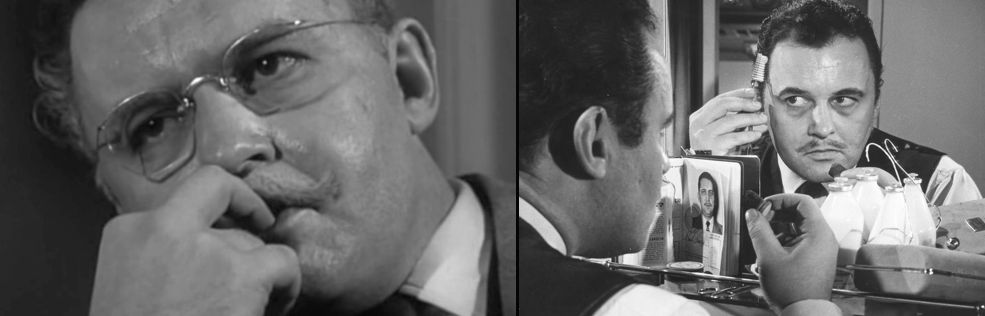

The panicked Steiger is placed in some forced, compromising suspense sequences as he begins his cowardly escape from justice. He assumes the identity of a rail passenger by matching the duped man's passport picture, allowing him to cross the Mexican border. In a heinous act, he shoves the drugged passenger from the speeding train. Embezzlement is one thing. Murder is another. Steiger retains the passenger's suitcase for identity purposes with a plan to dispose of it alongside the road. It snaps open, revealing that the man is wanted in Mexico for the assassination of a Mexican governor. An unfortunate twist. But Steiger's sweaty fingers have apparently lost the man's passport. But it gets worse. The man survived his abrupt train departure. Rescued and secretly treated by his “personal” doctor, the assassin is recovering in a singular motel along a Texas thoroughfare. Bandaged and in traction from head to toe—similar to the hilarious final scene in It's a Mad, Mad, Mad, Mad Worldthe man is threatened by Steiger at gunpoint for his passport.


There is a fair amount of assuming throughout the film. Steiger gets apprehended at the Mexican border, and the authorities assume he is their wanted man. But the smug thief tells them who he really is. They could not care less. Steiger is further stunned. The assassin's wife confesses that he is her husband! Hard to believe there was no initial question about why he was assuming that particular man's identity. Finally, Steiger's angry demands assume he is above the law, even offering a bribe to the Mexican police chief to get “his” passport back.

The police chief and the British inspector conspire to keep Steiger trapped in the Mexican border town to pressure him into escaping across the bridge back to America for prosecution. But the agreement is a one-sided affair in Mexico’s favor. He is never getting out of Mexico. Steiger is content to settle in the town for as long as it takes. His wealth buys him whatever he desires until the political assassin’s body is returned home, killed in a Mexican raid at the motel. I am not sure why the townspeople feel Steiger is responsible for leaving behind a widow and child, but they band together, refusing his money or his existence.

Note: After assuming that unfortunate identity, Steiger is unaware that he is now the owner of an adorable spaniel. Rather risky when the baggage car handler has to remind him not to leave his previously fawned-over pet behind. The dog seems to recognize the impersonated face and follows him around town. When Steiger disposes of the assassin's suitcase, he also tries to leave the dog behind. Weary and exhausted from escaping, his life is spared by the whimpering dog alerting him to a scorpion on his trousers. Steiger has a change of heart toward the dog, and it eventually becomes his only friend. Yet the catalyst for his death.

May 18, 2019

BORDERLINE (1950)


There is not much of anything hard-hitting in this eighty-eight-minute crime noir-ette about narcotics smuggling. Directed by William Seiter with a decent screenplay by Devery Freeman, this Universal International-released B-movie eventually slipped between theater seats rather quickly. Fans of Claire Trevor or Fred MacMurray may be pleased, however. Fans of Raymond Burr, not so much, as his screen time carries less weight than he appears, playing a ruthless drug dealer in a widescreen suit. A music score by Hans Salter supports the film.


The opening establishes this extra-light comedy with Trevor slightly daft, as per Madeline Kahn some twenty years later. Trevor’s character is “Madeleine” by the way. Policewoman Trevor is being ignored as the right undercover officer to infiltrate the drug-dealing gang. With her face framed in a “V” between two male sleeves, their superior thinks she is not tawdry enough. Glancing her direction, one guy thinks she would probably pass. Two seconds later, Trevor's expression reacts to the remark. Another makes it a point to mention she was in the OSS during the war and speaks “Mexican,” training she never uses throughout the film.

The film cuts to Mexico as Salter’s score decidedly adds a theme seemingly pulled from a music library shelf labeled, “Mexican.” Trevor arrives by dusty bus, walks into a cantina, and in the very next frame, she is dancing in a chorus line! Their second assumed purposely humorous number has all six girls displaying their training from the Lucy Ricardo School of Music and Dance. A number that could have used at least one run-through backstage. None are in sync with the melody nor the difficult lyrics of 'la-la-la, la-la-la, la-la-la.' Sounding uncomfortably like barnyard chickens. Trevor seems especially out of her element. It is a funny scene. She tries, in a not-so-subtle fashion, to get Burr to make eye contact. After making several passes, at one point she kicks her left, then her right leg high on both sides of him. I imagine the breeze felt good in the stuffy nightclub.


Trevor is making inroads into Burr’s circle of noir-do-wells, but all is interrupted when MacMurray enters the film with gun in hand, confronting Burr about a shipment of narcotics. He wants credit for the sale. There is a tussle, some gunpowder, and MacMurray absconds with Trevor, assuming she is part of Burr’s inner circle. Narcotics boss, Roy Roberts, arranges for them to pose as husband and wife as they head toward the borderline of a studio set. 


I could not accept Fred MacMurray as a hardened criminal, as his first screen appearance might suggest. He does wear a frown most of the way, but I expected dry quips at any moment. The script lightens up, and not surprisingly, so does MacMurray. No real secret, owing to the comedic music score. Avoiding the Mexican authorities, they ditch their strategically muddied car. Now on foot, there are shades of It Happened One Night, or It's A Wonderful World, as both share their phony background to hide their true identity. There are a lot of assumptions between them. The last ten minutes are worth the wait as big surprises await the leads. Other than the early tussle with the big Burr, the only real excitement comes in the last two minutes.

Note: This is purely an innocuous drama/comedy movie that happens to have respected leads. A film that starts promising and ends pleasantly enough. Trevor had a flair for subtle comedy. MacMurray was no stranger to comedy, either. But as a memorable film noir crime saga, it is borderline at best. 

August 6, 2016

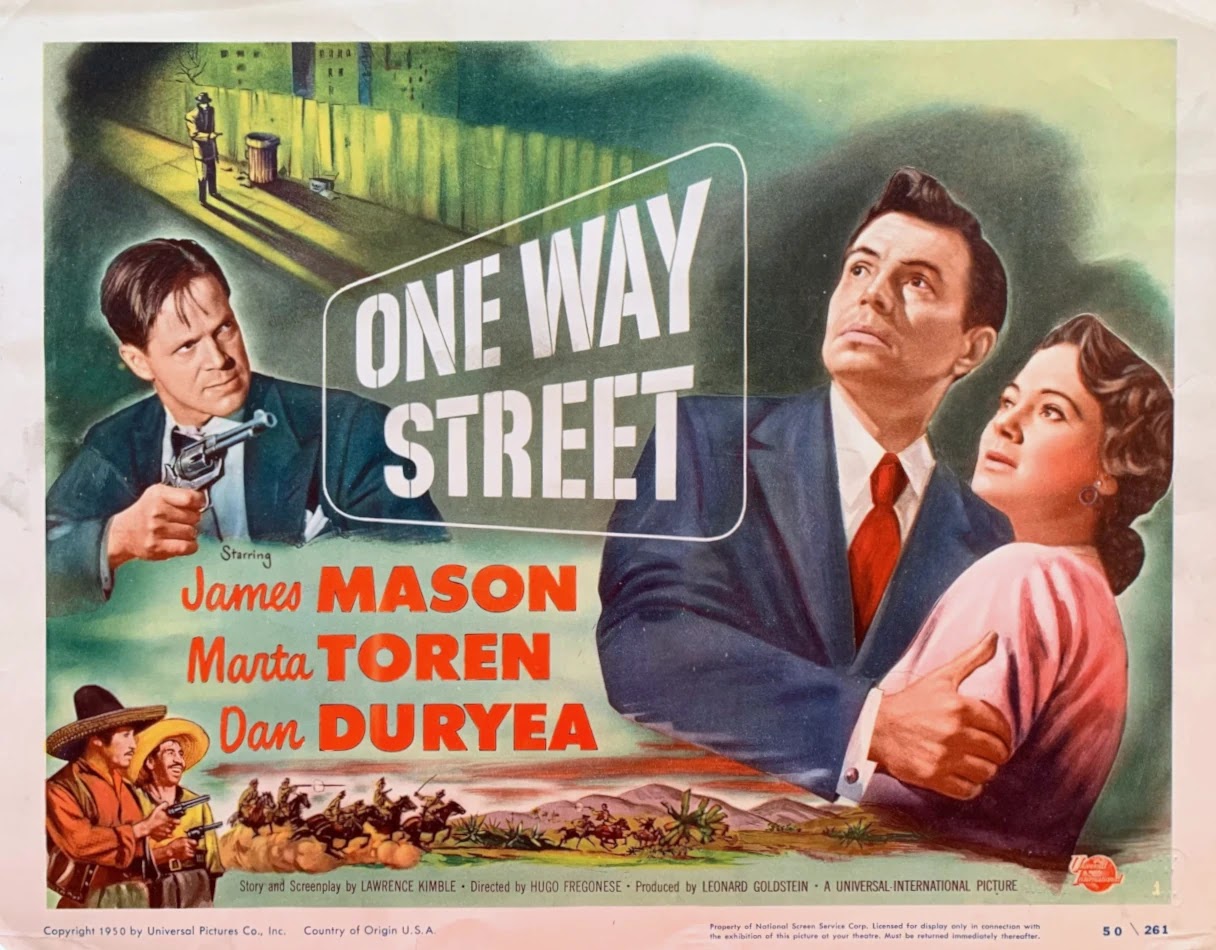
ONE WAY STREET (1950)


For the first twenty-five minutes, this film would appear to have potential as a noir with its dark shadows and moody, waiting game atmosphere of poker. The film starts strong with a wounded criminal, a girl who belongs somewhere, and the whine of Dan Duryea’s voice. But it all falls short during the vast middle, becoming a predictable romantic melodrama. As if you changed channels and stopped on another movie before returning for the final ten minutes of noir. Even with a couple of A-list actors, this disappointing film goes nowhere but south. The opening music theme is befitting a soap opera which should have been my clue.


Perennial double-crosser, Duryea, plays the gangster mastermind of a recent bank job. His partners are William Conrad, King Donovan, and Jack Elam. The latter's brief role is irrelevant, though momentarily (stay with me here) resembles David Letterman after a horrible face plant and botched plastic surgery. Not many mobsters travel with their own doctor, James Mason, who immediately attends to Conrad’s flesh wound. In the mix is Marta Toren, who is supposed to be Duryea’s girl but she has a fondness for medical males. He does not trust the group. Toren in general. Duryea specifically. The slickest setup in the film has Mason giving Duryea something for his headache. A standard procedure after an intense heist. Mason
is not exactly a model citizen, either. He closes his medical bag but also the matching bag with the 200 grand. He intends to walk out with both. Guns are drawn on Mason, but with his calm, understated delivery, he tells Duryea the “aspirin” he took will actually put him into convulsions in under two hours. Without the antidote, he will die. All three watch Mason and Toren leave. Donovan is particularly out of sorts over his disappearing share of the loot and in a rage attempts to shoot Mason from their second-story apartment. Duryea, literally, calls the shots in the gang and a bullet releases Donovan’s share. The King is dead. Sweating, Duryea hopes Mason’s long-distance call with the antidote will come true.

The nervous couple is off to Mexico as quickly as possible because the pill Mason gave Duryea was a placebo. The next forty-five minutes is a completely different film. Oddly, it stars both leads from that earlier film. You will have plenty of time to fix that sandwich or wash your car. To be fair, it is not a poorly executed segment and Mason reluctantly uses his medical practice for the locals and livestock. Warming to Toren’s advances, both appear to be living happily ever after. A highlight during the Mexico bits is a priest, played by Basil Ruysdael. He is loved by the locals and becomes a trusted friend to the assumed married couple. His rich bass voice, rye sense of humor and wisdom are endearing. One wonders if Duryea and Conrad have already started work on their next picture because it does not appear as though we will see them again in this one. Thankfully, Mason and Toren want to be free of their past and both think it best to return the money and end this film "noir-like." Many tears are shed by the locals. Understandably, they preferred being part of this film over the bookended parts.

Mason arrives on "a dark and stormy night" to find that Conrad has double-crossed Duryea, mortally wounding him. Conrad demands Mason take the stack of bills out of the leather bag. Stack after stack, Mason complies. But a surprise awaits Conrad with a bullet through the bottom of the bag. Toren rushes to meet Mason in the pouring rain and they embrace. With great relief, he confesses, “I really thought my number was up today.” Never say that at the end of a film noir. Let us just say he should have looked in both directions when crossing that one-way street.

December 19, 2015

NAKED ALIBI (1954)


This Universal International Pictures release may give you the impression it is a sequel to either Crime Wave or The Big Heat. Two of its main stars play similar roles here. In short, we have seen this one numerous times. You will need to overlook the typical sets, a dubbed vocal and an erratic plot. The eighty-six-minute film was directed by Jerry Hopper and produced by Ross Hunter, both of whom had numerous television projects to their credit. Sterling Hayden is once again a wooden police lieutenant. Unsympathetic. Strictly business. He is bent on pinning a policeman’s murder on Gene Barry. Sympathizers of Barry believe it is nothing more than police harassment. But “Dirty Hayden” has issues. He is caught on camera roughing up Barry. The photo is published. He is fired. But he is convinced Barry is no good. He sets out to find him on a dark and grimy Mexico studio set.
Barry, the debonair owner of a local bakery, also frequents Mexico on “business trips” to reconnect with bad girl and nightclub singer, Gloria Grahame—the actress with a permanent fever-blistered upper lip appearance because of her towering Philtrum ridges and pronounced Cupid's Bow—to say nothing of her slight overbite with noticeable, tiny "Esses." Barry is not the innocent flour thrower we were led to believe. She gets roughed up by Barry, depending on his temperament, but nothing like her devastating scene in the aforementioned The Big Heat. Given Grahame’s earlier roles she should have seen this coming.

As the mundane script plays out, you get the distinct feeling Hayden has got a hold of something besides Grahame. You may actually end up liking him. As for the title, Barry's alibi is the bakery. Once he is apprehended he reveals himself, so to speak, to be a gangster. Naked to the underworld. I suppose.