Showing posts with label assassination. Show all posts

August 9, 2021

YOU HAVE TO RUN FAST (1961)

The hunting season is about to start in the sleepy mountain town of Summit City, and a gangster has the perfect wall for the head of Craig Hill. The actor plays a doctor during an era when their door was always open. In the middle of the night, two mobsters, judging by their attitude and vocal tone, bring in a fellow they “found” on the side of the road. They are rather murky about their background and quickly leave Hill with the badly beaten victim, who does not survive the dawn. The police arrive, and Hill is informed that the dead man is a detective and the no-good Samaritans were bogus.

So begins a rather nifty—what should have been—television episode. But this suspenseful crime drama was never edited down from its seventy-three-minute run time. It is well-acted with a "blistering pace" for a routine premise of someone assuming a new identity in another town for his own survival. Dr. Richard Kimball may have had his own ideas after seeing this film. Expect the makeup department's budget to include the obligatory black-rimmed glasses, powdered gray wig, and mustache to facilitate Hill's transformation.

Hill wants no part in being confined under police protection, and their eyewitness gets out of town fast. It is one year later, and he is hardly recognizable without the makeup department's help. Now managing a sporting goods store in Summit City, Hill has taken a room at a lodge run by Willis Bouchey and his daughter, Elaine Edwards. A wheelchair-bound World War II veteran, Bouchey is his usual film character, barreling out wisdom to Hill about making something of himself rather than just running a seasonal hunting store. Awkward. Bouchey is also an expert marksman and is quite pumped about the hunting season when the public floods the small town in the likes of Fairmount, Indiana, during James Dean weekend. This is a rare film for the small-screen Edwards, who is on the verge of getting serious with Hill. But his “survival secret” offers setbacks. Yet, like Kimble, it becomes impossible to hide his Hippocratic oath for long. 


How the gangsters get a bead on his remote location is a near miracle. Hill's old “passport” photo does throw them a few curves, but the townsfolk unwittingly provided the thugs with needed information. Unlikely the two guys in suits, wingtips, and fedoras are avid game hunters, it soon becomes apparent to Hill that there are bullets with his namesake on them. Hill departs fast into the wilderness to dodge mob bullets. Wanting to hunt anything moving, Bouchey grabs a high-powered rifle with a scope and wheels himself to a window conveniently located directly opposite all the filmed action. He kills a five-point buck. No. He kills one of the gangsters about to fire on Hill. In an amazing bit of time-saving editing, the boss is actually captured in his car by the doctor who has been crouching in the back seat for who knows how long. It was the day the running stopped.

Note: The film was directed by Edward L. Cahn and produced by Robert E. Kent. They were frequent collaborators for films of this nature. Decent but forgettable. United Artists distributed it for the "renowned" production company, Harvard Film Corporation. The bits of location shooting will reveal that the Ford Motor Company volunteered its wallowing automobiles for the film.

August 28, 2020

THE NAKED RUNNER (1967)


This British Cold War espionage film, directed by Sidney Furie, would have benefited from shaving about fifteen minutes from its one-hundred-minute length to help eliminate scripted micro-detailing. The weak character development adds to the confusion with a myriad of characters popping up throughout the film. Scene changes may be frustratingly abrupt as well. I was initially not sure what to make of Harry Sukman’s opening piano concerto. It seemed out of place or a bit too romantic. It is explained, however, with opening visual support, as only a suggested record album selection of one main character, Peter Vaughn. I was most impressed with the stylish cinematography and its tight, asymmetrical close-ups of actors or camera angles. A late Sixties trend. Also trendy were the simple, graphic posters, some with a high degree of white space around the creative illustrations. The high-angle shots of a modern London office interior suit the title character, an industrial designer played by Frank Sinatra. Just to clarify, he runs a bit, but at no time is he naked, and this film should not be confused with his superior, Some Came Running, nine years earlier. Though at times ponderous, this is a decent update of a typical B-movie and would fit nicely into a Sinatra movie vault. His friend, actor Brad Dexter, garnered support for the project and ended up producing it. Unfortunately, the film was a box office disappointment and severed the ties between Sinatra and Warner Bros. Little help from the cool poster as well.


Working in London, Sinatra and his young son are planning a holiday behind the Iron Curtain—another “Wheel of Fortune” getaway—and attend an international trade show. Meanwhile, a British Intelligence officer, the aforementioned Vaughn, who served with Sinatra in the Second World War, decides to use the opportunity to coerce him into carrying out a simple exchange. Sinatra is skeptical of its simplicity. Only Vaughn knows that a recent prison escapee plans to share highly sensitive scientific information with Moscow, and his assassination is imperative. With an integrated plan that involves half of Western Europe, Vaughn plays on Sinatra’s sympathies and his wartime experience as an expert marksman. However unethical, he will do anything to rattle Sinatra to the breaking point—perhaps make him so angry he will willingly carry out the deed.


The script seems to suggest that after twenty years a civilian, Sinatra is a bit rusty and naively assumes everyone is telling the truth. His anger increases, however, as the truth gets harder to find. He is at the mercy of Vaughn and his operatives. One operative is Derren Nesbitt, posing as an East German intelligence officer, who sweats him out in an abandoned warehouse in the middle of a forest. The agonizingly slow interrogation ends with Nesbitt’s apparent plan to execute Sinatra. After a short stroll in the woods, he takes the pistol’s safety off but “changes his mind” at the last second. This pushes ‘Ol Blues Eyes over the edge, expelling whatever meal he had eaten previously. Another operative is Edward Fox, intending to be from the British Embassy and graciously comes to Sinatra’s aid, yet provides no information of value to relieve his anxiety.


An abrupt, deflated ending may recall one of those old “backstory jokes” from your uncle, with a set-up that seemingly goes on forever and a punchline not worth the wait. The single most glaring element of the film. Kudos for saving disappointment until the end. As Vaughn’s pawn, Sinatra gets no apologies for his underhanded manipulation. Sinatra had become so confused with Vaughn’s cryptic behavior that he assumed he was the actual target. Vaughn does provide an extremely brief explanation with a compliment for completing the nerve-racking assignment as planned. No hard feelings, ‘ol chap?

Oddity: Shortly after the seven-minute point on my copy, there is a fuzzy red square covering the center of the screen, cropping into the hands of Vaughn and the Cabinet minister—facing each other at opposite ends of the screen—during their conversation. What we see is actually the back of an out-of-focus red chair, set in the near foreground. My thanks go to the expert comment in the first paragraph below, which clarifies my mystery.

July 3, 2020

HAIL! MAFIA (1965)


This low-budget, French-Italian film with its quirky title—delivered during mafia club meetings—is a "prototype" leading up to the subject’s peak in The Godfather. The more creatively designed European poster is on the left. It took no less than three production companies to put this eighty-eight-minute film in the can. The dominant element is not acting, but its period-specific jazz score that was apparently recorded in a parking garage. Without Hubert Rostaing’s score, however, this would be a dull movie. Yet it almost intrudes on some scenes as if playing in the same room you are watching television, and you wish someone would turn it down a bit. Expect some abrupt film edits. One, in particular, has the camera jumping from a train to a city street to an arcade in a mere two seconds. Superimposed sporadically are titles to identify the location or the time of day. This film has been rightfully forgotten since its premiere. For your approval, here is the trio of restrained characters, each with a competent performance.

It is a rare occasion when two left-handed actors are in the same mafia film. Eddie Constantine, at the peak of European popularity, provides the cryptic opening voice-over narration describing his lot in life as the viewer watches him outwit an assassin in a Paris parking garage...er...recording studio. His single voice-over is rather meaningless, only acting as a device to introduce his persona. There are no additional voice-overs to help carry his character or the story. The other lefty, Henry Silva, found his niche in gangster films. His facial structure may give the impression of possible reconstructive surgery. Anyone familiar with him at this stage in his career knows he was essentially a supporting B-movie or television actor. Celebrating him in recent years does not make him one of the greats because he is still alive, as of this writing. Thankfully, he is always interesting to watch. He and fellow mafia club member, the right-handed Jack Klugman, have never been on an “assassination run” before. Klugman was adept at displaying pessimistic or disgruntled characters. So he makes a believable hitman with a lot of angst. Ever so cool, Silva tells him to relax and do what he tells him to do. Their road trip is a psychological study of how paid assassins' friendships can be so fleeting. Both are off to Paris to assassinate Constantine before he can testify against a mob boss indicted in America.


Minor characters are confusingly introduced, initially without a name. Elsa Martinelli has an insignificant role as a secretary or love assistant to Constantine. Micheline Presle is a French informer for Silva, who drives a 1965 Plymouth Fury through the streets of Paris. It becomes Silva’s loaner as he travels “invisibly” among Citroens and Volkswagens. Do not expect much suspense until the very end, which extends too long. Expect a twist or two as the truth is revealed about Constantine.

Note: There is a poorly edited sequence as the duo heads toward Constantine’s hideout, providing a bit of confusion. It is irrelevant to the plot, but I am compelled to mention its subtlety. Silva navigates the “SS Plymouth” into a service station for petrol. As Silva walks to the (apparently) self-service pump, Klugman gets out and says he will be right back. With seemingly no time elapsing, Silva gets behind the wheel and drives away. There is no definitive evidence that Klugman ever returned. What might be missed in the two-second snippet is the slight bounce of the car as Klugman gets seated, and his split-second silhouette is visible at the extreme right of the screen. Once on the highway, however, Klugman is now driving!

April 24, 2020

ACROSS THE BRIDGE (1957)


This slightly longer-than-necessary, one-hundred-three-minute British film is notable for Rod Steiger's gravitating performance, along with some interesting camera positions and closeups in the film's early stages. His propensity for offbeat, often volatile characters is legendary, though his range seemed to have few boundaries. All other characters fade by comparison. Yet for this film, he is almost an absurd figure of illogical attitudes and intents while channeling fellow method actor Brando. His German accent is no better than Artie Johnson from Laugh-In television fame with his “Vely Intelesting” signature comment. What might have been another signature role, the film's believability factor takes a hit as he flees the UK's prosecution. Still, it is an unusual, yet forgotten Steiger film.

Based on a short story of the same name by Graham Greene, the film was produced by The Rank Organisation and directed by Ken Annakin and filmed at Shepperton Studios, Middlesex, England, UK, and in Spain. The set-up is quite engaging as Scotland Yard arrives with embezzlement charges at Steiger's British office. The grand doors are opened, providing visual evidence that they have the right man as they witness a self-aggrandizing floor-to-ceiling “Stalinesque” self-portrait of himself. But Steiger gets the warning while at his New York headquarters. With inevitable escape procedures always planned ahead, he makes his immediate departure to Mexico for a planned three-month hideout. Scotland Yard sends an inspector across “the pond” to apprehend the condescending egoist.


The panicked Steiger is placed in some forced, compromising suspense sequences as he begins his cowardly escape from justice. He assumes the identity of a rail passenger by matching the duped man's passport picture, allowing him to cross the Mexican border. In a heinous act, he shoves the drugged passenger from the speeding train. Embezzlement is one thing. Murder is another. Steiger retains the passenger's suitcase for identity purposes with a plan to dispose of it alongside the road. It snaps open, revealing that the man is wanted in Mexico for the assassination of a Mexican governor. An unfortunate twist. But Steiger's sweaty fingers have apparently lost the man's passport. But it gets worse. The man survived his abrupt train departure. Rescued and secretly treated by his “personal” doctor, the assassin is recovering in a singular motel along a Texas thoroughfare. Bandaged and in traction from head to toe—similar to the hilarious final scene in It's a Mad, Mad, Mad, Mad World—the man is threatened by Steiger at gunpoint for his passport.


There is a fair amount of assuming throughout the film. Steiger gets apprehended at the Mexican border, and the authorities assume he is their wanted man. But the smug thief tells them who he really is. They could not care less. Steiger is further stunned. The assassin's wife confesses that he is her husband! Hard to believe there was no initial question about why he was assuming that particular man's identity. Finally, Steiger's angry demands assume he is above the law, even offering a bribe to the Mexican police chief to get “his” passport back.

The police chief and the British inspector conspire to keep Steiger trapped in the Mexican border town to pressure him into escaping across the bridge back to America for prosecution. But the agreement is a one-sided affair in Mexico’s favor. He is never getting out of Mexico. Steiger is content to settle in the town for as long as it takes. His wealth buys him whatever he desires until the political assassin’s body is returned home, killed in a Mexican raid at the motel. I am not sure why the townspeople feel Steiger is responsible for leaving behind a widow and child, but they band together, refusing his money or his existence.

Note: After assuming that unfortunate identity, Steiger is unaware that he is now the owner of an adorable spaniel. Rather risky when the baggage car handler has to remind him not to leave his previously fawned-over pet behind. The dog seems to recognize the impersonated face and follows him around town. When Steiger disposes of the assassin's suitcase, he also tries to leave the dog behind. Weary and exhausted from escaping, his life is spared by the whimpering dog alerting him to a scorpion on his trousers. Steiger has a change of heart toward the dog, and it eventually becomes his only friend. Yet the catalyst for his death.

August 20, 2016

INTENT TO KILL (1958)


This is a pretty effective, yet unbelievable melodrama/thriller directed by Jack Cardiff, the famed cinematographer—more effective than the paid assassins in the film. Shot during a cold, snowy season in Montreal, the movie opens with a climactic score (over a blaring ambulance siren) yet it is only the first two minutes of the film. Perhaps not that particular as it anticipates what is ahead. One expects something drastic to happen at any moment but the only “excitement” is the quiet and careful deboarding of a South American president, Herbert Lom, who has been transported to Montreal for personal safety and special surgery on his potentially fatal cranial blood clot. Having previously survived an assassination attempt, the fire escape outside his window makes him nervous and requests a move to another room. A nice touch in the film’s early going as who knows what goes up or down those steps all hours of the day or night. To help comfort him, he asks a nurse to bring him his statue of the "patron saint of assassination."

Lom’s political opponents have hired hitmen, Warren Stevens, John Crawford and Peter Arne to kill Lom for good. They are taking orders from Lom’s personal aide, a detail unknown to him. Crawford and Arne do not get along. Stevens has to bring the hammer down on Crawford for his attitude and his absences for drinking and womanizing. Arne, a former doctor, is to administer a needle full of air into Lom’s vein. Stevens’ scouting made him aware of Lom’s move to another room but Arne knows nothing of the move until he is informed after killing the wrong patient.

Mixed into this assassination plot are surgeon, Richard Todd, and his nagging, self-centered wife, Catherine Boyle, who has arranged for him to take a high-paying position back in London. The high-paying part is of special interest to her. Todd has no interest except in fellow doctor, Betsy Drake, once again with near comatose acting. Judging by Boyle’s effective, irritating performance, most viewers might feel Todd deserves better. Meanwhile, the personal aide is hoping for a future with Lom’s beautiful wife once he has been dispatched.


As Lom recovers, he comes to the conclusion that the two may be romantically involved or plotting to kill him. The hitmen, determined not to lose their payoff, become even more incompetent leading to confrontations in the hospital. Arne tries once again to needle Lom but a detective asks him to identify himself. Arne loses his cool but never has any from the start. Todd volunteers as a lookout at the stairway entrance and Drake joins him. Crawford shows and threatens Drake at gunpoint to vouch for Arne. She stumbles over a question from the detective answering, “He...he is...doctor...watch out!” The detective falls from Arne’s bullet. What is funny are the gunshots which sound like cap pistols. The film takes a nosedive after the bad sound effects and never recovers. Unlike Lom. Arne gets a bullet in return and when Crawford enters the hall, he sends Arne to "an emergency room in the sky" by shooting him a few times. Nice knowin’ ya, bub.

Todd tangles with Crawford, who leaps down a flight of stairs in swashbuckling form as Dr. Peter Blood might do. Their struggle crashes both through a window and they fall to the pavement below. Crawford is spared spinal surgery but is arrested. Todd has surgery to remove a Crawford bullet.

As confusion and chaos rage in the hospital, Stevens assumes the role of an authoritarian figure, ordering nurses and orderlies around. Very official. It gets him access to Lom's unguarded room to perform a quick hit. Barely inside the room, he discovers Lom knows how to use that statue in a manner he could never have anticipated.

Note: It is a decent enough, if forgettable film, with competent performances. I can forgive Lom’s dull performance owing to his brain surgery. Alexander Knox possesses his role as the chief surgeon and wise counsel. Stevens stays cool and calm despite being a failure at the boss level. In an odd Todd closing prior to his surgery, Drake leans over next to his face and quietly whispers, 'Breathe Deeply,' as if referencing an alternate British title. One could spend some time debating why that line ends the film.

July 30, 2016

MURDER BY CONTRACT (1958)


From the film’s opening scene, you experience the seemingly mundane life of an ordinary man. Perry Botkin’s minimalist guitar score, befitting an avant-garde film, fits the quirky central character, played cooly by Vince Edwards. Not since the Zither from The Third Man film has an instrument defined a film more. Botkin slightly changes the tune and tempo during the climax to good effect. You may have the tune plunking in your head for another twenty-four hours. Added with some great camera points of view, this eighty-one-minute film has "cult classic" written all over it. The shoestring-budgeted film may bore you or suck you in. You will probably find the unlikely premise at least amusing.

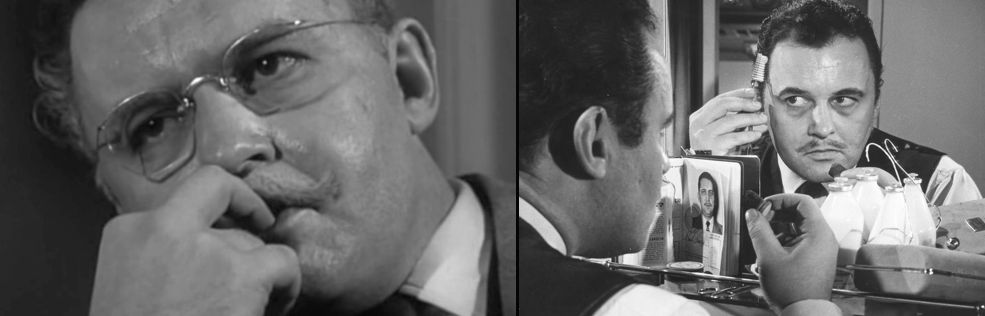
Although Edwards, or simply Claude, has a decent job and pension, he wants to be a “contractor” to make money faster. He has a meeting with an undercover mobster. Out of respect for his occupation, Edwards is very well-mannered and admits he knows nothing about contract killing
—never done it before. But in a CareerBuilder upgrade, he would like to kill people. After waiting nearly two weeks for a return call, while staying fit doing pull-ups and push-ups in his apartment, Edwards’ first contract has him posing as a barber in a period white banded collar shirt with its three-button closure on one shoulder. It would appear to be a costume screen test for his television series Ben Casey. In fact, he is dressed the same for his second assassination, actually set in a hospital. His third contract is the operative who hired him. Directed by Irving Lerner, the actual assassinations are never filmed. The viewer's assumptions are sufficient, coupled with "Claude's Theme" by Botkin.

Now that Edwards has reached an acceptable level of murder, he is sent to Los Angeles, where henchmen, Herschel Bernardi and Phillip Pine pick him up at the train station. Pine is already disgruntled because Edwards took a train rather than an airplane. With a tight window to do the hit, Pine's patience is running thin. I sensed Pine doing an exasperated Jack Lemmon. Quite uncanny. He is beside himself with Edwards’ superior attitude.
Bernardi's reasoned character seems totally out of his element. However, Edward's wise observations strike a positive chord with him. He likes the way he thinks. Some truly humorous moments between these three, mostly ignited by Edwards. Barely acknowledging his companions, Edwards, in sunglasses and a calm, restrained voice, foreshadows the likes of Dirty Harry. Claude just wants to see the sights of Los Angeles before doing any killing. He is smart, cautious, and creative, and it scares Bernardi. Edwards soon takes command of the daily routine and will do the hit when he is good and ready.


Edwards is visibly upset when he is informed that the hit is not a man. Men are creatures of habit. Predictable. Women are unpredictable. Hard to read. They are always moving about. His target is a high-profile witness, played by Caprice Toriel —her only acting role—before testifying against the henchmen and Edwards's boss. She has a pretty nasty and ungrateful attitude toward her in-house police protection. To be fair, her lack of acting experience may be partly due to her over-the-top performance, making it difficult for her to find the right balance between frayed nerves and anger.

Reminiscent of Wile E. Coyote, in a complicated process, he wires her TV to explode when she turns it on. But he did not count on a remote control keeping her at a distance from the set. Drat! Next, Edwards searches a sporting goods store for the right weapon. A rapier? No. He considers a Gatling gun. Too much. He settles on a bow and arrows. Bernardi goes through "intensive" archery practice at a target inside Claude's motel room. A lot of woodwork damage will be noted later. Security is tight at the witness’s home. The only way to kill her is to shoot her as she instinctively opens the front door despite Edwards’ aversion to guns. As a distraction, Bernardi's bull's eye training allows him to shoot kerosene-tipped arrows randomly into the nearby brush, potentially setting half of California to flames. Claude pulls the trigger on the high-powered scoped rifle as the door opens. She falls. 

The three operatives meet to share the good news based on the newspaper's headline. Then a shift that may leave you scratching your head, thinking the DVD skipped ahead several minutes or hours. Somewhat out of the blue enters Kathie Browne—a female escort when not typing by day. Edwards called the agency she worked at, but why he is in such a foul mood is equally odd. Obviously, he has issues with women in general. His disrespectful comments roll right off her, however. No one could possibly live up to his superior expectations. Her role as a slightly ditsy, unassuming lady is noteworthy in her film debut. But odd, when after only a couple of swallows of wine, she instantly becomes a little loopy. She freely shares inside information about who was actually murdered at the door and that the newspaper headlines were faked. All of which reveals why she was written into the script. Visibly rattled, Edwards now knows he actually killed the undercover policewoman. Double drat!

With this second foiled attempt, Bernardi and Pine now have orders to take out Cool Claude—and not to dinner. He suspects as much, and the tables are turned. He obtains "ACME" survey blueprints of the estate and spots a large drainage pipe some 500 yards from the house. Once near the house, he then crawls through an outdoor grate that miraculously leads to the very room where a policeman is dozing. At this point, the film starts falling way short of a perfect ending. Overtaking the officer with a blow to the head, he assumes the relief officer on duty as Toriel enters the room. Their scene together is implausible. An accomplished musician, she begins playing the piano to help calm her nerves. In fact, Edwards demands she play. And look straight ahead. But the rifle is a bit much at close range. She sees him take off his tie, yet still able to play the correct notes. I said she was accomplished. Claude does not have the nerve to strangle her. Or maybe he also considers that his boss will be put behind bars. She vows not to scream if he leaves. Thanks so much! The police fire tear gas down the drainage pipe during his escape. Triple drat! It makes for an abrupt ending.

Note: This is a B-movie that seems a decade ahead of itself in a number of ways. I recommend it. One of those quirky gems that few remember or have heard about. Edwards's laid-back performance is disturbing. An angry human with no regard for the sanctity of life. Overcompensating for his aberrant behavior, he has developed a superior attitude toward everyone else. I imagine this film disturbed a lot of young minds, including Martin Scorsese, who was highly influenced by it.

July 2, 2016

THREE CAME TO KILL (1960)


Cameron Mitchell seems to continue his role from Inside The Mafia in another association with this Robert Kent Production. This is his film and he commands your attention. Told with an opening voice-over narration in the style of  ABC’s Untouchables series, the device gives the impression this is based on a true story. But the script is sufficiently perforated with some illogical action and editing. The Los Angeles International Airport stock footage and location shoots of vintage autos will make most transportation historians perk up. The limited budget also requires a good share of studio backdrops, yet Kent can usually improve a small budget.


The film opens behind the United Nations building where a foreign interpreter is gunned down in a back alley. Mitchell and his partner, Steve Brodie, exit in a Mercury land yacht as it bobs and weaves over the pavement. The story quickly shifts to Los Angeles where special agent, Paul Langton, arrives from New York on a plastic scale model Lockheed Constellation and debarks an actual Douglas DC-6. Script perforation No. 1: the film’s editor is not interested in following through with the correct aircraft from one scene to another. Langton’s job is to get ahead of possible repercussions from the U.N. killing, hoping to avoid the assassination of a Middle East Prime Minister in seclusion in Beverly Hills. No motor lodge for him. Langton is assisted by a special agent and a local investigator played by King Calder. Calder again comes off authentic in every detail though his screen time is limited. They establish a secret route for the Prime Minister to arrive at the airport safely and return to his country.

Mitchell is the overconfident paid assassin to kill the Prime Minister and he will do it from the home of air traffic controller, John Lupton, by shooting the plane’s fuel supply on the runway as the engine's power up before takeoff. That might make some sense if you stop watching the film at the twenty-minute point. Script perforation No. 2: the studio backdrop film showing the runway appears to be more than a half-mile away. Script perforation No. 3: nevermind that Mitchell’s Fisher-Price map has the house on the wrong side of the runway. Nevertheless, Mitchell and Brodie abduct Lupton outside his house and everyone settles in to hear Mitchell boast about his perfect plan in overtones from the movie, Suddenly.

Mitchell vows to not hurt Lupton, his wife, her visiting sister, and her boyfriend if they just go about their daily routine. But the audience is skeptical. He breaks his vow immediately, threatening everyone with a gun to the stomach. Actually not part of their daily routine. Brodie brings a radio to pick up the control tower chatter (Mitchell calls him a genius as he tunes in the tower) but he is annoyed at those “stinkin’ jets!” flying over drowning out the radio. Commercial jets had only been in service less than two years and Brodie does not like the future. As the tense afternoon wears thin, Lupton is ordered back to the tower and when the plane is ready for takeoff he is to use a specific phrase signaling Mitchell when to shoot. If he does not follow through, he will start killing his family. Script perforation No. 4: it is impossible to hear over any radio, Lupton's written note being passed to the authorities in the tower. Brodie rapidly returns with news of the said development. Mitchell is angry. He grabs his revolver, and getting serious, puts on his hat before approaching the room where the family and a previously wounded federal agent are being held captive. Script perforation No. 5: why he puts on a hat is mysteriously funny. He opens the door to find the wounded special agent holding a shotgun at him. Mitchell quickly closes the door before being perforated with buckshot.


Script perforation No. 6: if I have not lost track. He made it a point earlier that he must level one table leg to stabilize his world-renowned shot. Another nod to Suddenly. Yet when it comes time to shoot the plane, he simply breaks the window and from a standing position aims for the plane's fuel tank. The one that is a half-mile away. Fortunately, he is jumped as he prepares to shoot. By then the police arrive to level the playing field in a hail of bullets. With the Prime Minister’s plane, a Boeing Stratocruiser, safely in the air, it transforms into a DC-6 after takeoff. A final curtain call for the film’s editor.

Note: Mitchell comes off flamboyant as the “big shot” getting set for his big shot. His arrogance blinds his reasoning. The authorities knew who he was thanks to some final words from the U.N. victim. Something Mitchell said was impossible. When he makes people dead, they stay dead. If that is not embarrassing enough, they know he drives a Ford Edsel. The film does not give Brodie much to do with his limited screen dialogue, but it is good to see him in another of his typecast roles. Lupton is competent and believable. With enough implausibility to elicit a groan or two, the film moves along well.

December 5, 2015

STOPOVER TOKYO (1957)


I have read that Robert Wagner was not pleased with this film. It shows. His low-energy delivery makes you wonder if he understands his role: an intelligence agent. Mumbling his lines seemingly without moving his lips. Rarely more than a blank face. Though he had some diverse mid-century roles as career highlights, he is generally not known for standout performances. Never mind. His good looks, wit, and charm turned him into a first-rate celebrity who could do no wrong.

In this unexciting tale of Communist espionage, mundane conversation, and the attempt to stop an assassination plot, is Wagner’s equal-billed co-star, Joan Collins. She’s an airline travel receptionist who cannot understand why Wagner is secretive and aloof. Neither are they that interested in one another any more than the audience is interested in finding out what happens next. Somehow, after only three days and as many conversations, she confesses her love for Wagner. Happens all the time to RJ. I expected Wagner to say, “Terrific” at least once. His favorite word in his television series, It Takes A Thief, some eleven years later.


Reiko Oyama, in her only screen role, is cute as the daughter of Wagner’s Japanese contact. He finds it difficult to tell her that her father will be gone for a long time. He starts a bedtime story that in a subtle way, may help explain her father’s murder. He never finishes the story. She falls asleep. Wagner is that boring.

Edmond O’Brien, as he often does, delivers an over-the-top performance. It is pretty embarrassing to watch his character, which never develops into anything threatening. He is nearly a buffoon in one particular scene. Buffoons are rarely on the CIA’s most-wanted list.

Note: Filmed in CinemaScope, this one-hundred-minute film was directed by Richard Breen, in his only directing assignment, and produced by Walter Reisch for 20th Century Fox. Perhaps because of its beautiful cinematography of Japan and its two attractive co-stars, the film did make a small profit. This final, thinly disguised Mr. Moto novel by John P. Marquand, might be one to remember for the aforementioned attributes but Mr. Moto's character was completely dropped from the script. Probably for the best. Peter Lorre never got a phone call.