Showing posts with label William conrad. Show all posts

January 14, 2017

DIAL 1119 (1950)


Some today find this film a sort of lost treasure, but it is not innovative. It is well-acted with enough mystery to hold the viewer in suspense for the usual Hollywood hostage staging. The script bounces around the subject of mental illness in mid-century fashion. Critics of the day generally seemed to like it. This MGM features a powerful opening score by André Previn, suggesting a winner. But despite an obviously low budget, the movie still lost money at the box office. There were no big-name stars to draw an audience, and it is almost entirely filmed on a studio backlot. I also wonder if audiences accepted a nice-looking boy, Marshall Thompson, in this early lead role. He gets on a bus with its scrolling destination sign above the canted windshield to Terminal City, a name associated with New York's Idlewild Airport. That might have been an omen, yet hardly justifies shooting the bus driver with his own personal security device.


Initially, Thompson appears only to be a chronic sleepwalker. His cold, unemotional search for his former psych doctor, Sam Levene, goes nowhere, and he eventually wanders into a bar where we meet a slice of society with their own personal foibles. Virginia Fields, Leon Ames, and Keith Brasselle (bartender) are the more notable actors, along with the bar owner, William Conrad, who knows each patron well, holding contempt for a few regulars. On the bright side, his bar is equipped with a state-of-the-art, remote-controlled television monitor suspended over the counter that would be the equal of most sports bars today. This had to cost a pretty penny. And for what? Wrestling. And the newsbreak about an escaped mental patient whom Conrad recognizes at the end of the counter. When he calmly goes to the back to call the police, Thompson is right behind him, putting Conrad’s life on permanent hold with a bullet. This instantly gets the attention of all the patrons, and the previously invisible young man becomes larger than life itself. This innocent-looking, unassuming, and perspiring man happens to have no regard for human life. Especially his own. This initiates the stereotypical hostage situation with the police plotting their next move to end the situation.

Through clichéd interaction between the killer and hostages, Thompson lays out his mental disqualifications, blaming the military for teaching him to kill. The Army was referring to the enemy, by the way. In his eyes, all the patrons are pitiful excuses, and he is not impressed with their petty problems. His comments put the patrons in a reflective, albeit terrifying mood. His only demand, other than having the patrons not move a muscle, is that he talks with Dr. Levene. Though unadvised repeatedly by the police, Levene sneaks inside the bar where Thompson confronts him about his historically bad advice. The doctor’s blunt assessment quickly reduces Thompson to a frightened child. He shoots Levene when pushed too far (below).


The revolver that Conrad kept behind the counter is spotted by Fields, whose character seems to know her way around firearms. She wounds Thompson, who then tells her she had no right to do that. The patrons disagree wholeheartedly with his assessment. After a seventy-five-minute running time, all hope was seemingly gone with the words, “The End” approaching. He slowly escapes out the back entrance and well covered by armed police. Welcome to Terminal City.

November 14, 2015

-30- (1959)


This over-scripted box office flop would almost appear to be a television series pilot movie. Directed and produced by Jack Webb for his Mark VII Limited Company, this part sitcom, part drama, reveals the day’s happenings in the life of a competitive Los Angeles newspaper. Always a stickler for realism, Webb uses it here to a fault, with ingratiating dialogue slightly embarrassing as if you are an uninvited guest to a private party.

The somber opening with soap opera score under white titles against a stark black background quickly switches to a "cha-cha theme song" used occasionally throughout the film. Ray Heindorf's music score is certainly an odd mix. There is enough humor in the film, however, that the cha-cha tune starts to, strangely, make some sense. Webb appears to have taken "77 Sunset Strip," "Ben Casey" or "Lassie" themes of the period and suggested using them with select scenes.
The film's portrayal of a big city newspaper is dated since every department head possesses the personal discernment to never politicize a story.


The film, set entirely in a newspaper office set, can be momentarily captivating with enough personal issues to tug at your heartstrings. One example, Whitney Blake plays the on-screen wife of Webb who wants him to accept the idea of adoption. Their past finds it difficult for him to make such a commitment. Another is the search for a small child who may have drowned. Both challenges weigh heavily on Webb's conscience.


Though respectably acted, there are enough uncomfortable moments to make you cringe as the occasionally corny scrip by William Bowers jumps from tearjerker to comedy. William Conrad's face fills the screen as he opens the film. He has been provided the most comedic dialogue. His performance is so over the top you may find yourself blushing as he chews up the office furniture. He berates copy boys, David Nelson specifically, throughout the eighty-eight-minute film making it a recurring amusing device. Conrad's delivery will probably make you chuckle. Still, his character is unnecessarily crude. Underlying all his toughness, though, is a large sensitive man with an enlarged heart. I will say, Webb gives his most animated performance with a full range of emotions and comes in a close second to Conrad's funny quips. He is fun to watch. Momentary humorous encounters include a young staffer, Richard Bakalyan, who has the honor to escort a prominent couple to view the newspaper's operation in full swing with all the limited experience he can muster. His run-in with "staff artist" Richard Deacon puts him in his place in comedic form. Look for William Bell, Howard McNear, and Joe Flynn. I found the closing credits, visually identifying the actors and their portrayed characters, not worthy of the style. It is an odd choice for something other than an epic historical film.

Note: The term "-30-" signified "the end," originating from several code tables for telegraph operators. The title was used at the end of this movie and explains its meaning. Ironically, it was the end to Webb's Warner Bros. contract. 

September 12, 2015

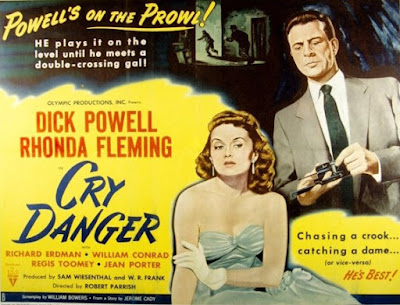
CRY DANGER (1951)


Directed by Robert Parrish, this seventy-nine-minute film noir was produced by W.R. Frank and Sam Wiesenthal. Hats off to William Bowers for writing snappy and glib dialogue for the two male leads, from Jerome Cady's story. The powerful score was written by Paul Dunlap and Emil Newman. Lending suspense to this movie is a speeding passenger train at night beneath the opening credits. Getting off the train by daybreak is Dick Powell, sent to prison for a robbery and murder he did not commit. His life sentence is drastically shortened when an alibi comes forward. 

Distributed by RKO Radio Pictures for Olympic Productions, this is a tidy crime drama with lots of fun dialogue as Powell seems to be carrying over his Richard Diamond radio character with its glib humor, acting more like an experienced P.I. than a blackmailed ex-con. Though there is a heavier dose of sarcasm here. The lines roll off him second to none. Few had his ability to spit out these comebacks so charmingly yet with a tough guy hidden underneath. The guy providing Powell's alibi and subsequent prison release, Richard Erdman, turns out to be a total stranger to Powell, and not serving in the same division during the previous war. Erdman, a war amputee, confesses that he is simply hanging around Powell in hopes of getting a reward from the stolen one hundred grand if it is recovered. Powell is suspiciously grateful for his fake alibi.
 

Powell sets out to clear himself and another inmate—the husband of Ronda Fleming's character—sent up for the same crime. Most of the time she looks blandly aloof with a voice resembling a comforting cup of hot cocoa with marshmallows. Causing some speed bumps along the way is a detective, Regis Toomey, who shadows Powell. Toomey has plenty of reasons to follow Powell and one includes Fleming. 

Powell and Erdman end up sharing a singular grungy mobile home in the trailer park where Fleming lives. Erdman is immediately attracted to a sunbathing neighbor, Jean Porter, almost as much as he is to alcoholic beverages. Porter plays a scene-stealing tart, who, when not modeling, is a highly trained pickpocket, as Erdman finds out. He is the other glib character. A notable example is when he is recovering in the hospital after his Nash "Bathtub" is riddled with bullets, resulting in an improbable five-mile-per-hour dismantling of his car before exiting the trailer park. It was a case of mistaken identity as the hit was meant for Powell. From his hospital bed, he mockingly demands the police chief provide him with a new wooden leg. In knotty pine. To match his den.  


Adding a despicable element is William Conrad, the double-crosser who is responsible for Powell's incarceration. Powell's first pounding of Conrad knocks him to the floor. Late in the film, Powell returns, and with a one-armed swoosh to clear off Conrad's desk, demands he lie down on it. He tells him they get along better when he is on his back. It is an edgy scene for the era as Powell plays Russia Roulette with Conrad's head. The truth is expelled from Conrad.

Note: Eventually, 
David Janssen would be connected with three actors from this film. Toomey would revive a similar role during the first season of television's "Richard Diamond."  Janssen carried the Diamond torch at the suggestion of Powell. Of course, William Conrad provided the narration for Janssen's hit series, The Fugitive.