Showing posts with label rhonda fleming. Show all posts

July 10, 2020

SLIGHTLY SCARLET (1956)


This soap opera slash crime film is loosely based on James Cain's novel Love's Lovely Counterfeit, a title the film should have kept for this ninety-nine-minute film. The film falls into the B-movie noir category with few arguments. It was produced by Benedict Bogeaus, distributed by RKO Radio Pictures, and directed by Western director Allan Dwan. The occasionally implausible screenplay is by Robert Blees. There are notable actors in this one, and they probably ate up most of the budget. However, its widescreen “Superscope” cinematography by John Alton is the highlight. The interiors are lavishly detailed and colorful. The mobster’s mansion would seem to have experienced a power outage, as the only lighting appears to come from the props to highlight a specific interior detail or an actor’s face. The resulting shadows are foreboding, befitting any sinister surroundings. In contrast, the mob boss’s open-concept beach house is a modern-designed gem.


John Payne’s role as a tough guy with a dark side will not be a surprise during this decade. Yet those previously gray crime movies never had the musically talented actor playing the piano, as he does here. Payne always improves a film, and his character's intensity is not lessened by color. Adding a ruthless quotient is his boss, the quintessential gangster, Ted de Corsia. Payne is his “public relations” man, whom he sarcastically calls “Genius.” Payne works both sides of the law, yet he is tired of his powerless position under the boss’s thumb. In a double-cross, he sets him up de Corsia with a phony front-page headline about a recent murder. Thought to be untouchable, de Corsia angrily buys a one-way airline ticket to Mexico, leaving Payne to take over operations, his beach house, and his Chrysler. Mayoral candidate Kent Taylor had come down hard on de Corsia’s manhandling of city officials. Payne’s own manipulation secures the unsuspecting Taylor of an election victory.

What better excuse to use “Superscope” than to feature two Technicolor scarlet starlets, Rhonda “sultry” Fleming and Arlene “klepto” Dahl. Neither could be considered acting powerhouses, and their screen time together is a suds-fest. Not entirely their fault. Fleming seems to treat her little sister like a high school graduate, though only two years separated them in real life. Fleming comes off okay, and her limited alto vocal range is not as monotonous here.  She is Kent's secretary and girlfriend, but Payne temporarily disrupts their future as he and Fleming become attached at the lips on more than one occasion. Give Dahl credit for being a convincing obnoxious adult brat. Naturally, like the average female, they sleep in full makeup and a permanent...permanently.


The film’s opening concerns Dahl's prison release for petty theft. Her lack of awareness, smart-aleck attitude, and the fawning over any male assume she is irresistible. To get an idea of her unconsciousness, later in the film, she picks up a speargun at the beach house and pulls the trigger to see what might happen. The spear barely misses Payne’s head, embedding itself in the wall. She thought it funny. He angrily grabs her by the shoulders, whip-lashing her fore and aft, scarlet tresses bobbing every which way, with her enduring airhead smile intact. Payne’s bending the law to suit his personal desires never grows old as he continues to intervene after Dahl is arrested for stealing a necklace. But kleptomania is not her only underlying problem.

News of Payne’s dominance reaches de Corsia and he returns to the beach house for revenge. Dahl is the lone occupant until Fleming arrives. The mob boss knows all about her. She is on his Christmas death list. Drunken Dahl is flippant about the whole standoff. Fleming stumbles onto another loaded speargun on the deck. The mobster gets speared in the shoulder, and then she shoots him twice with his dropped gun. Dahl is one actress very aware that cameras are rolling. Her instant attitude change is so over-the-top as if the director may have told her, “On the count of three, you scream hysterically, okay? You'll need to do it twice.”


The beach house lighting during the closing is an aesthetic and graphically superior element. The wide, shallow stairway creates horizontal dashes of contrast juxtaposed with the square, dark walls and angular ceiling shadows. Payne and the "scarlet duo" are in an adjoining room when de Corsia manages to call him out. Payne faces de Corsia one last time and growls out several cutting insults before being perforated. Fleming’s future is in doubt, leaving her to speculate whether she can continue as the mayor’s secretary since he has fallen in love with Dahl's mental health. I would not be surprised that the facts surrounding the mayor's future wife might affect his re-election bid.


Notes: After Payne takes over the mob from de Corsia, he also takes over his car, the Chrysler above, with no windshield. Standard on the Imperial, the mob boss never realized it was an option on the New Yorker. I suspect there were plans to film from the hood of the car, or the footage ended up on the cutting room floor. Even funnier is when Payne picks up his old beater at the parking garage, where the Chrysler has been cleaned and polished. The young attendant admires the car, being especially proud of the streak-free windshield. The kid asks if he can borrow the Chrysler for a hot date. Imagine her false eyelashes ending up in the back seat. The lad starts the car, and we hear an explosion. What we see is smoke gently rising from the dash, and he instantly keels over on his right side in a less-than-convincing special effect. Apparently, toxic gas.

September 24, 2016

THE KILLER IS LOOSE (1956)


Budd Boetticher lays out a well-paced movie and the many on-location scenes add reality to a traditional script. There are enough hypothetical situations to slot the film into a B-movie category. Though the ending is contrived and implausible, it is an incredible performance by Wendell Corey. The ever-competent Joseph Cotton sometimes works hard to make his script believable.. He seems irritated throughout the film, perhaps for good reason. His wife, Rhonda Fleming, constantly wants him to change careers because his life is in the balance every day. She is one-dimensional as a self-centered, harping wife.

Though initially touted as a hero for tackling one bank robber, Corey is discovered to be part of an inside job, and the police close in on his apartment, expecting a standoff after he fires through the entrance door. Inside the darkened interior, Cotton accidentally shoots a moving silhouette, which happens to be Corey’s wife. The supposed mild-mannered, gentle bank teller begins his journey into a mentally unbalanced world. Being a model prisoner hoping for an early release, he is transferred to a prison honor farm. Corey's idea of an early release is not quick enough. While en route to make a produce delivery, he kills the driver and makes his escape. As a disguise, he goes without eyeglasses for a period. Not the best plan for highway driving.

Corey looks deranged, in a trance, as he walks through a middle-class neighborhood looking for the Cotton home. His slow and slightly hesitant gate adds to his unsettling persona. I like to think this was Corey's idea. He stops at John Larch’s house, an old army buddy who used to tease Corey, calling him “Foggy” for his deep voice and for wearing spectacles. An irritating jab from an entire life of ridicule. Larch tries to reason with Foggy, I mean Corey. He suggests he does not have much chance of getting far. He says he could probably take him down like he could in basic training. Corey seems to understand and remorsefully, momentarily, thinks it over. Corey disagrees. He shoots Larch right through the milk bottle he is holding near his chest as his wife screams in horror. A hungry, unshaven Corey looks away in disgust. Obviously, he is lactose intolerant. Corey uses the wife’s hooded plaid raincoat, white or yellow rain boots, and purse to transform into a six-foot-two-inch lady. Just another day in LA. This is certainly a point to burst out laughing if you want. He is quite the fashion plate.


Cotton hastily arranges a “charade vacation” to move his wife to a fellow officer’s home for safety. Not wanting to frighten her, he never mentions that she is Corey’s primary target for revenge. It is a poorly executed ruse by Cotton and Fleming quickly catches on during their ride in the studio prop car. She gives her husband little support or understanding. It is a standard premise and makes their interaction the clichéd low point in the film. After a good verbal thrashing...uh...eye-opener from police wife, Virginia Christine, Cotton’s intentions become clearer to her. She skips out, returning by bus, where she suspects Corey may be a passenger. A useless device because the audience already recognized Corey. Besides, Foggy does not have the nerve to get on the bus in that plaid raincoat and rain boots.

The police stake out the Cotton home late at night. From a nearby bus stop, Fleming decides to walk the few blocks home. How Corey knew she was on a bus, then would be walking home, is, at best, a happenstance. I assume the phone book was Corey's go-to source for finding her address. Hiding in the bushes for her to pass by, however, is strictly for the audience to gasp. The officers spot a tall lady closely following a redhead, then Cotton blasts them for not recognizing his wife! Fleming deliberately walks past her home (in a cagey police move), leaving Corey to wonder if he is tracking the right woman. At the last second, she tries to dash back to her front door with Lady Corey in pursuit. The entire neighborhood is aroused by a lot of gunfire. Just another day in LA.

Note: Aside from the horror genre, Corey’s performance newly defines scary. He is not sadistic like Widmark in his screen debut or Mitchum a year earlier. He is disturbed and helpless by his evil deeds. After killing Larch, his wife lies motionless from fainting. Corey looks down at her and in a soft, reasoning voice, says, “What else could I do? It was the ONLY thing I could do.” From teller to killer, Corey is mesmerizing and chilling. He is the reason to watch this film, and the director thought so too. I can only imagine what audiences thought of Corey during its first run. Just do not call him “Foggy.”

September 12, 2015

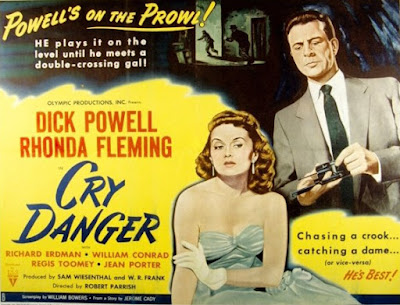
CRY DANGER (1951)


Directed by Robert Parrish, this seventy-nine-minute film noir was produced by W.R. Frank and Sam Wiesenthal. Hats off to William Bowers for writing snappy and glib dialogue for the two male leads, from Jerome Cady's story. The powerful score was written by Paul Dunlap and Emil Newman. Lending suspense to this movie is a speeding passenger train at night beneath the opening credits. Getting off the train by daybreak is Dick Powell, sent to prison for a robbery and murder he did not commit. His life sentence is drastically shortened when an alibi comes forward. 

Distributed by RKO Radio Pictures for Olympic Productions, this is a tidy crime drama with lots of fun dialogue as Powell seems to be carrying over his Richard Diamond radio character with its glib humor, acting more like an experienced P.I. than a blackmailed ex-con. Though there is a heavier dose of sarcasm here. The lines roll off him second to none. Few had his ability to spit out these comebacks so charmingly yet with a tough guy hidden underneath. The guy providing Powell's alibi and subsequent prison release, Richard Erdman, turns out to be a total stranger to Powell, and not serving in the same division during the previous war. Erdman, a war amputee, confesses that he is simply hanging around Powell in hopes of getting a reward from the stolen one hundred grand if it is recovered. Powell is suspiciously grateful for his fake alibi.
 

Powell sets out to clear himself and another inmate—the husband of Ronda Fleming's character—sent up for the same crime. Most of the time she looks blandly aloof with a voice resembling a comforting cup of hot cocoa with marshmallows. Causing some speed bumps along the way is a detective, Regis Toomey, who shadows Powell. Toomey has plenty of reasons to follow Powell and one includes Fleming. 

Powell and Erdman end up sharing a singular grungy mobile home in the trailer park where Fleming lives. Erdman is immediately attracted to a sunbathing neighbor, Jean Porter, almost as much as he is to alcoholic beverages. Porter plays a scene-stealing tart, who, when not modeling, is a highly trained pickpocket, as Erdman finds out. He is the other glib character. A notable example is when he is recovering in the hospital after his Nash "Bathtub" is riddled with bullets, resulting in an improbable five-mile-per-hour dismantling of his car before exiting the trailer park. It was a case of mistaken identity as the hit was meant for Powell. From his hospital bed, he mockingly demands the police chief provide him with a new wooden leg. In knotty pine. To match his den.  


Adding a despicable element is William Conrad, the double-crosser who is responsible for Powell's incarceration. Powell's first pounding of Conrad knocks him to the floor. Late in the film, Powell returns, and with a one-armed swoosh to clear off Conrad's desk, demands he lie down on it. He tells him they get along better when he is on his back. It is an edgy scene for the era as Powell plays Russia Roulette with Conrad's head. The truth is expelled from Conrad.

Note: Eventually, 
David Janssen would be connected with three actors from this film. Toomey would revive a similar role during the first season of television's "Richard Diamond."  Janssen carried the Diamond torch at the suggestion of Powell. Of course, William Conrad provided the narration for Janssen's hit series, The Fugitive.