Showing posts with label dick powell. Show all posts

July 19, 2026

The Hunters (1958)


This film is an adaptation of The Hunters, the first novel by Air Force veteran James Salter in 1957. The film strays from the original story most notably by incorporating a self-destructive fighter pilot. Mr. Salter was not pleased and not consulted. It was directed and produced competently by Dick Powell, with a 
screenplay by Wendell Mayes. The 108-minute film was distributed by Twentieth Century Fox. Paul Sawtell's powerful music score during the escape of three downed American pilots in Communist occupied territory is worth noting. Without a doubt, the CinemaScope aerial sequences by cinematographer Charles G. Clarke, A.S.C. are the highlight of the movie. Because the well-acted drama is another "war picture" with personal conflicts, studio cockpit "flying", and hitting the speed brake switch during a love tryst going nowhere. A film that might have stood the test of time instead lost money. Not too surprising after viewing the first quarter of the film.

The film stars Robert Mitchum, Robert Wagner, Lee Philips, May Britt, and Richard Egan. Hard to argue with this line-up, though Britt seems a bit anemic. Yet it probably is written into the script, "your character is supposed to be anemic." You can believe that if you want. Mitchum plays an experienced WWII combat ace. On the opposite end of the spectrum is a young lieutenant, a hep-talking, ego-centric new recruit, Wagner. He is quite good in the role and improves the film from his very first scene with his legendary exuberant delivery and good looks. The two do not see eye-to-eye on taking orders. Mitchum wants him out of his flight unit, but the Colonel, Egan, overrides his desire. It turns out to be fortuitous.


Philips is worth singling out with a difficult emotional role as the invented character outside the novel. He plays a promising combat pilot who has only found frustration with his inability to make a mark for himself. His escape is to drown his fears and self-loathing in alcohol consumption. Aware of Mitchum's legendary status, Philips is quite defensive about his lack of confidence (above). But Mitchum has little sympathy for the thirty-year-old and, upon meeting his wife, Britt, senses that she is on the proverbial fence over her husband's evasive maneuvers. Mitch and Britt are joined at the lips on several occasions. Philips suspects as much.


On one hunting mission, Philips is caught trying to outmaneuver a top Communist pilot when his plane is hit. He ejects, landing in a tree badly injured. Mitchum takes out the enemy plane, spots Philips' chute after a few passes, then finds a clearing to do a risky belly landing. His duty is to rescue his fellow pilot. Wagner was given an order to return to the base, but disobeying is second nature. He spots Chinese military vehicles approaching and hits the deck to strafe the convoy. But his plane is hit by anti-aircraft fire while climbing away. He has to bail. The three make a valiant effort to stay alive in Powell's action-filled climax, making good use of the term. A passing UN convoy saves their lives. Mitchum actually had enough fuel to get back to base. By deliberately destroying his aircraft, a court-martial is a likely outcome. Common sense wins, and after a light reprimand, Egan dismisses the incident.

The trio is transferred to a military hospital stateside, where Mitchum recovers from a wounded arm, and Philips improves daily. The latter indicates sincere remorse to Britt and vows to be the husband he had intended to be. She seems skeptical. The unscathed Wagner finishes his scenes humorously and with a genuine respect for "his elders."

Notes: The air combat scenes are exciting as North American F-86 Sabre Jets (above) encounter Chinese/North Korean Mig 15s. Except the Migs are gray Republic F-84 Thunderstreaks with the red Chinese stars appropriately placed. The sequence of a one-on-one dogfight is exciting, as are the beautiful rows of contrails from a multi-ship formation of Sabres at altitude. 

As is so often the case in films where relationships take precedence over aircraft continuity, famous stock footage of a North American F-100 Super Sabre crashing substitutes for a pilot's F-86. Rather than editing in this obvious out-of-place clip, let the onlooking cast convey the inevitable crash in facial horror with the provided script. Not sure Powell saw the rushes.

June 11, 2016

PITFALL (1948)


Opening in the suburbs of Los Angeles, Dick Powell is an insurance agent who is weary of his predictable life template. He and his wife, Jane Wyatt, trade humorous quips and verbal jabs in the early going as many couples might do. A son completes the family album. When he begins investigating an embezzlement case, this typical family man soon changes to a life of secrets and danger, and all humor is gradually abandoned. The plot of this B-movie suggests that the average family is not immune to a disruption of marital bliss. Powell flows through the film with ease.


Powell is to recover some expensive gifts given to Lizabeth Scott by her boyfriend embezzler who's serving time in prison. With no particular place to go, they end up spending the day on her studio prop speedboat gift, which becomes the catalyst for Hank Panky. Powell, in a business suit with a fedora that stays put without chin straps—the miracle of projected backscreen scenery. Scott falls into the Lauren Bacall category of actresses who are not classic beauties but have a niche appeal. I am not in that niche. Not sure if it was a speech impediment, an overbite from bad dental development, but her lip snarls on her right side and her pronounced “esses” are especially annoying when whispering. It does not strike me as attractive or sultry.

Raymond Burr is cast this time as a private detective working for Powell and the insurance company. True to form, however, one soon learns he is once again a bit psychotic with his obsession over Scott. In probably the largest suit in show business at the time, he tails Powell and pummels him good. Scott, wanting to help and knowing Powell’s home address, spots Wyatt at the door from curbside and yells, "I must have the wrong address." Awkward.


As the day of her jailbird lover's release from prison approaches, Scott fears for her safety. Powell is beginning to see the errors of his ways and longs for the days before he got involved with her. He has had enough of Burr as well and gives him a bit of his own medicine. Burr tells the jealous jailbird about him and he attempts to kill Powell in his darkened study. However, Powell permanently removes any chance of him ever serving additional prison time. Confident all competition has been eliminated, Burr expects Scott to go away with him. Instead, she puts him in the hospital.

Powell gives a full confession to the police department, but a tougher confession is forthcoming for Wyatt. She reluctantly gives him a second chance but is not sure their relationship will survive. No definitive outcomes are revealed, leaving it to the viewer’s speculation. At best, a shaky happy ending.

September 12, 2015

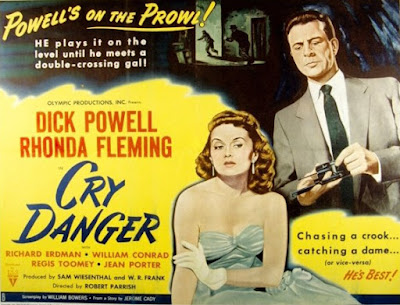
CRY DANGER (1951)


Directed by Robert Parrish, this seventy-nine-minute film noir was produced by W.R. Frank and Sam Wiesenthal. Hats off to William Bowers for writing snappy and glib dialogue for the two male leads, from Jerome Cady's story. The powerful score was written by Paul Dunlap and Emil Newman. Lending suspense to this movie is a speeding passenger train at night beneath the opening credits. Getting off the train by daybreak is Dick Powell, sent to prison for a robbery and murder he did not commit. His life sentence is drastically shortened when an alibi comes forward. 

Distributed by RKO Radio Pictures for Olympic Productions, this is a tidy crime drama with lots of fun dialogue as Powell seems to be carrying over his Richard Diamond radio character with its glib humor, acting more like an experienced P.I. than a blackmailed ex-con. Though there is a heavier dose of sarcasm here. The lines roll off him second to none. Few had his ability to spit out these comebacks so charmingly yet with a tough guy hidden underneath. The guy providing Powell's alibi and subsequent prison release, Richard Erdman, turns out to be a total stranger to Powell, and not serving in the same division during the previous war. Erdman, a war amputee, confesses that he is simply hanging around Powell in hopes of getting a reward from the stolen one hundred grand if it is recovered. Powell is suspiciously grateful for his fake alibi.
 

Powell sets out to clear himself and another inmate—the husband of Ronda Fleming's character—sent up for the same crime. Most of the time she looks blandly aloof with a voice resembling a comforting cup of hot cocoa with marshmallows. Causing some speed bumps along the way is a detective, Regis Toomey, who shadows Powell. Toomey has plenty of reasons to follow Powell and one includes Fleming. 

Powell and Erdman end up sharing a singular grungy mobile home in the trailer park where Fleming lives. Erdman is immediately attracted to a sunbathing neighbor, Jean Porter, almost as much as he is to alcoholic beverages. Porter plays a scene-stealing tart, who, when not modeling, is a highly trained pickpocket, as Erdman finds out. He is the other glib character. A notable example is when he is recovering in the hospital after his Nash "Bathtub" is riddled with bullets, resulting in an improbable five-mile-per-hour dismantling of his car before exiting the trailer park. It was a case of mistaken identity as the hit was meant for Powell. From his hospital bed, he mockingly demands the police chief provide him with a new wooden leg. In knotty pine. To match his den.  


Adding a despicable element is William Conrad, the double-crosser who is responsible for Powell's incarceration. Powell's first pounding of Conrad knocks him to the floor. Late in the film, Powell returns, and with a one-armed swoosh to clear off Conrad's desk, demands he lie down on it. He tells him they get along better when he is on his back. It is an edgy scene for the era as Powell plays Russia Roulette with Conrad's head. The truth is expelled from Conrad.

Note: Eventually, 
David Janssen would be connected with three actors from this film. Toomey would revive a similar role during the first season of television's "Richard Diamond."  Janssen carried the Diamond torch at the suggestion of Powell. Of course, William Conrad provided the narration for Janssen's hit series, The Fugitive.