Showing posts with label film. Show all posts

February 1, 2021

FORGOTTEN FILMS: TV TRANSITION

Though typically overshadowed by Hollywood's A-list, there were respectable performances by numerous actors and actresses who never became major film stars. A common career shift was to the new medium of television. These periodic posts offer insight into their transition.


Patricia Blair: Patsy Lou Blake (1933-2013)

Like numerous attractive female actresses of the era, Patricia Blair got noticed first as a model. The photogenic Blair signed a contract with Warner Brothers in the mid-Fifties, later being picked up by MGM in 1959. She appeared as a second female lead—a common occurrence—in such standards as Jump Into Hell (1955), an uncredited role in The McConnell Story (1955) followed by Crime Against Joe (1956) alongside John Bromfield and Julie London. She played the devoted girlfriend of escaped convict and heroin dealer, Vince Edwards, in City of Fear (1959), a well-produced thriller with unintentionally funny moments. He steals a canister of what he believes to be experimental heroin—worth a fortune and Blair is all-in. In reality, it is a highly contagious radioactive isotope. Next came the low-budget caper, Cage of Evil (1960), playing the self-serving love interest and temptress of police detective, Ron Foster. Her second-tier productions did little to strengthen her film career so it was back to the small screen.

Television was already a big part of her resume when she became a semi-regular for one season on The Rifleman (1958) as the spunky love interest and businesswoman, Lou Mallory. Adding her seemed like a last-ditch effort to advance the series. Unfortunately, the move spelled an end to one of the series’s strongest points—the singular father and son relationship. Her most popular recurring role was playing the wife of frontiersman, Daniel Boone, on the long-running, highly-fictionalized series starring Fess Parker. Outside of Parker's 165 appearances, she had the most credits with 118 until the show ended in 1970.

For the Texas-born beauty there were single appearances on the “DOA” comedy-western, Dusty's Trail (1973) starring Bob Denver and the more promising, yet short-lived, Petrocelli (1975). Her last television role was her one appearance in the popular comedy, Me and My Girl (1988). After retirement, she produced industrial trade shows, echoing the business savvy of Miss Mallory of North Fork fame.

January 4, 2021

FORGOTTEN FILMS: TV TRANSITION

Though typically overshadowed by Hollywood's A-list, there were respectable performances by numerous actors and actresses who never became major film stars. A common career shift was to the new medium of television. These periodic posts offer insight into their transition.


Myron Healey: Myrton Healey (1923-2005)

Myron Healey began his career during the early 1940s in uncredited and minor supporting roles at various studios, Monogram Pictures among them. Perhaps for commonality, he or the studio changed his name to Myron. There were not many by either name in Hollywood. The low-budget western film is most associated with the actor and he never abandoned the genre as television loomed. He became a familiar face yet his name usually drew a blank. Perhaps many could not make the connection with a despicable outlaw named Myron. Adding to the confusion, he was sometimes credited as Michael.

There were countless television westerns under Healey’s gun belt. His recurring roles or frequented series appearances are the only ones mentioned here beginning with The Lone Ranger (1950-57) with seven appearances. Healey was a frequent visitor on the set of Cheyenne (1955-62). He had a recurring role as Doc Holliday on The Life and Legend of Wyatt Earp (1956-59) and played a doctor twice on the forgotten adventure series, The Man and The Challenge (1959-60). Along the same period, he played Maj. Peter Horry in seven episodes of The Swamp Fox for The Magical World of Disney. Healey left his horse in the stable for several episodes of modern-day dramas, among them Schlitz Playhouse (1955-58) and State Trooper (1957-59). As the Sixties progressed his workload hardly skipped a beat in television or films.

In the Seventies the western was being replaced by detective or police shows. Healey was there as always with numerous appearances on Ironside (1969-72) or Adam-12 (1969-73). But his phone rang less and less as the Eighties drew to a close. An actor does not have much staying power if he is not a team player, like Healey. He was happy to be acting in whatever role he was asked to do without complaining. One sign of a professional. Unfortunately, his professional success did not carry over at home. His four marriages from 1943 to 1971 were all short-term for reasons unknown.

Note: Healey was a child prodigy who sang on radio and performed violin and piano recitals while still in his early teens. He served in World War II as an Air Corps navigator and bombardier in Europe. After the war he continued military duties, retiring in the early 1960s as a captain in the United States Air Force Reserve. His military discipline carried over into his acting career.

September 12, 2015

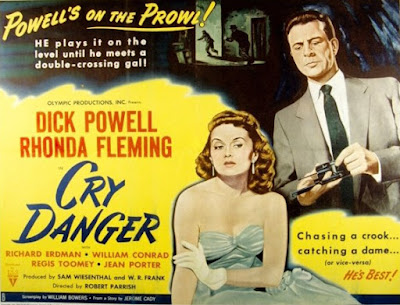
CRY DANGER (1951)


Directed by Robert Parrish, this seventy-nine-minute film noir was produced by W.R. Frank and Sam Wiesenthal. Hats off to William Bowers for writing snappy and glib dialogue for the two male leads, from Jerome Cady's story. The powerful score was written by Paul Dunlap and Emil Newman. Lending suspense to this movie is a speeding passenger train at night beneath the opening credits. Getting off the train by daybreak is Dick Powell, sent to prison for a robbery and murder he did not commit. His life sentence is drastically shortened when an alibi comes forward. 

Distributed by RKO Radio Pictures for Olympic Productions, this is a tidy crime drama with lots of fun dialogue as Powell seems to be carrying over his Richard Diamond radio character with its glib humor, acting more like an experienced P.I. than a blackmailed ex-con. Though there is a heavier dose of sarcasm here. The lines roll off him second to none. Few had his ability to spit out these comebacks so charmingly yet with a tough guy hidden underneath. The guy providing Powell's alibi and subsequent prison release, Richard Erdman, turns out to be a total stranger to Powell, and not serving in the same division during the previous war. Erdman, a war amputee, confesses that he is simply hanging around Powell in hopes of getting a reward from the stolen one hundred grand if it is recovered. Powell is suspiciously grateful for his fake alibi.
 

Powell sets out to clear himself and another inmate—the husband of Ronda Fleming's character—sent up for the same crime. Most of the time she looks blandly aloof with a voice resembling a comforting cup of hot cocoa with marshmallows. Causing some speed bumps along the way is a detective, Regis Toomey, who shadows Powell. Toomey has plenty of reasons to follow Powell and one includes Fleming. 

Powell and Erdman end up sharing a singular grungy mobile home in the trailer park where Fleming lives. Erdman is immediately attracted to a sunbathing neighbor, Jean Porter, almost as much as he is to alcoholic beverages. Porter plays a scene-stealing tart, who, when not modeling, is a highly trained pickpocket, as Erdman finds out. He is the other glib character. A notable example is when he is recovering in the hospital after his Nash "Bathtub" is riddled with bullets, resulting in an improbable five-mile-per-hour dismantling of his car before exiting the trailer park. It was a case of mistaken identity as the hit was meant for Powell. From his hospital bed, he mockingly demands the police chief provide him with a new wooden leg. In knotty pine. To match his den.  


Adding a despicable element is William Conrad, the double-crosser who is responsible for Powell's incarceration. Powell's first pounding of Conrad knocks him to the floor. Late in the film, Powell returns, and with a one-armed swoosh to clear off Conrad's desk, demands he lie down on it. He tells him they get along better when he is on his back. It is an edgy scene for the era as Powell plays Russia Roulette with Conrad's head. The truth is expelled from Conrad.

Note: Eventually, 
David Janssen would be connected with three actors from this film. Toomey would revive a similar role during the first season of television's "Richard Diamond."  Janssen carried the Diamond torch at the suggestion of Powell. Of course, William Conrad provided the narration for Janssen's hit series, The Fugitive.