October 18, 2015

THE MAN WITH MY FACE (1951)


Imagine arriving home one evening and someone who looks like you has taken over your life, your wife, your brother-in-law, and your bank account. No, I mean exactly like you. Even your dog believes you are an imposter. Talk about identity theft. This is a dupe that has taken many months of planning. And superior plastic surgery with no need for an added fake mustache. A number of low-budget movies might have been more tolerable by offering them (free) on television, as “The Alfred Hitchcock Hour.” Let’s face it, this is more predictable than blinking.

This seventy-nine-minute B-movie is a science fiction story distributed by United Artists for Edward F. Gardner Productions. It is not much of a film noir, either, though it falls into that category. The screenplay appears to have challenged the director, Edward Montagne, who was apparently stumped on how to present this intriguing idea in a convincing way. Interpreting the novel of the same name by Samuel W. Taylor, who, along with the team of Tom McGowan and Vin Bogert, wrote the screenplay.

Barry Nelson stars in one of his few motion pictures during the 1950s. Along with a cast of unknowns, the film is hard to fathom. Nelson tries very hard to make his two roles work, but in less than fifteen minutes, the balance of the movie is assumed. You will find yourself always ahead of the script. Nice Nelson may simply be a bit loopy, so he is assumed to be the imposter. There may have been a Half Nelson in the background. Nice Nelson finds his picture (or is it Evel Nelson?) plastered on the newspaper's headline as the robber of 500k, sending the police after him. Evil Nelson has trained Dobermans in pursuit of Nice Nelson, soon to be a man without a face, creating bad press for the breed. Seeing Jack Warden in his movie debut may make it worth watching as the friend who owns facial recognition software. Nah. Do not believe that either.

Note: Barry Nelson, the supporting actor in most of his 1940s films, is better known for his prolific television roles and as a Broadway leading man. He has the distinction of being the first James Bond, portrayed in an episode of television's "Climax" series. Having never read the Fleming novel, Nelson was not sure how to portray the famous character. The next decade proved to be a real eye-opener for him.  

October 11, 2015

ACCUSED OF MURDER (1956)


Filmed in Naturama, Republic’s answer to Paramount’s VistaVision, and Truecolor, where interior shots looked crisp and realistically, yet cold, this seventy-four-minute film is a pretty lackluster outing for a mostly competent cast. They lift this to a solidly average B-movie. Distributed by Republic Pictures, it is directed and produced by Joseph Kane, and is based on the novel, "Vanity Row" by W. R. Burnett. The seventy-four-minute screenplay is by Burnett and Robert Creighton Williams. A film probably dismissed once leaving the theater.
You witness a murder. You arrange to meet the assumed murderer, hitman Warren Stevens, with the intent of blackmail. How dumb do you need to be? Like Virginia Grey in this role. Her “dance for hire” job stinks and she looks marked for death from her first scene. After she confronts Stevens, he insists he did not commit any murder and decks Grey. But neither is quite through. She pesters him by phone later, with Stevens returning to severely beat her as a final warning. Grey will be the performance best remembered from this film.

Stevens is on a shortlist of suspects, the other being Vera Ralston, who portrays a singer, after a fashion, whose nightclub is frequented by Sydney Blackmer, an underworld lawyer. To him, her dubbed vocals are like sugar to a cockroach. I could have used closed captioning for some of her dialogue due to her thick accent. Despite this possible communication problem, Blackmer is interested in marriage, a thought that never occurred to her. He does not take her rejection gracefully.


During the investigation, the police lieutenant, David Brian, after hearing---translating---her story to his fellow officers, gets more involved with Ralston than official police procedures. His performance is the other one remembered. He is solid and believable, coming off strong yet compassionate. He is sympathetic toward Ralston believing she is innocent, though growing evidence provides doubts. Squint-eyed partner, Lee Van Cleef, pressures Brian, suggesting he has a conflict of interest. Cleef possesses a most unfortunate last name for an aspiring sergeant: Lackey. There are a few twists and curves to keep one guessing how Blackmer expired with an ending that may surprise you. But by shaving fifteen minutes never to be missed, it could have played better as an hour-long early television episode.

October 3, 2015

RAILROADED (1947)


Anthony Mann kept busy directing in the late forties. Distributed by Eagle-Lion Films, this seventy-two-minute film is based on a real-life case, forming the basis of a more famous film, Call Northside 777, the following year. This shoe-string budgeted film adds an extra dose of noir, so dark at times it is hard to see what’s going on. In the climactic scene, Hugh Beaumont and John Ireland aim guns in cave darkness better than most. With this very predictable, loaded script, one wonders how the police could accuse someone on hearsay and speculation and be such a bad judge of character. Obviously, things have not changed that much since. There is the usual suspense with questions and answers. Sheila Ryan is not a good judge of character either, as she assumes John Ireland is just having a bad day. Again. He was usually typecast as a bad guy or down and out loser. Hugh Beaumont, on the other hand, typically played a person in authority and is solid here as a thorough, cool and collected investigator. Just the opposite, Ireland loses his cool often with no sanctity for life.

Note: You may enjoy this one. The strangulated budget hurts the worse. Enjoy watching Beaumont's competent acting before "retiring" as an investigator and using his skills to figure out what Wally and Theodore are up to.

September 19, 2015

T-MEN (1947)


Never a dull moment as Anthony Mann directs this story about U.S. Treasury men attempting to break up a counterfeiting ring. It plays out in a pseudo-documentary style, as do many films of the era. An excellent film noir with outstanding cinematography by John Alton and an appropriate score by Paul Sawtell. Big bucks were spent on this film. Well over five million in 2015 dollars, the equivalent of 500 grand in 1947. Within the same year and budget, Railroaded is nearly forgotten. Mann certainly redeemed himself for that earlier effort. Distributed by Eagle-Lion Films, this production cleaned up at the box office. The film is not flawless, but close. One script fumble is when a federal agent comes down hard on a shop owner for not recognizing counterfeit bills. This, after the film established that it takes an expert, under a magnifying glass, to know the difference between real bills. Another takes place during the climax. After establishing a hitman's cold, vicious behavior, he becomes a spineless weasel in the end, scared of being shot at. But I digress.
Navigating through background details throughout most of the film is the narrator, the definitive and commanding Reed Hadley. After an informer is murdered, the Treasury Department chooses Dennis O’Keefe and Alfred Ryder to go deep undercover. Each has a myriad of details to memorize so they can blend into the crime underbelly without suspicion. O’Keefe is first-rate in a standout role, leaving his earlier music or comedy films behind. Both are vouched for, and all goes according to plan, for a while. The steam room scenes with a bloated, sweating Wallace Ford under a waist towel are creepy in their own right. O'Keefe visits several in a row after a tip suggests Ford frequents steam baths. In the end, he is so zapped of strength he can barely stand, noting he lost several pounds before finding the health hypochondriac. Ford is known as the "Schemer" for getting things done in secrecy and keeping evidence that could bring down a lot of the counterfeiters if he is threatened. O'Keefe and Ryder give him a hard time, spreading the rumor that the boss is on to him.

There are edge-of-your-seat moments: in transit with Ford, Ryder is spotted by a friend who uses his real name. To make matters more intense, she is with Ryder's wife. The two meet face to face. Covering for his undercover work, she says, "You are mistaken. My husband is taller and more handsome." Ryder is saved, but Ford is suspicious. But none more intense than when O’Keefe witnesses his partner's murder and cannot do anything about it without blowing his own cover. Few were as heartless in film noirs as hitman Charles McGraw. Always on the edge of volatile behavior with a voice that could, if one got close enough, leave abrasions on your face. The "Schemer" learns too late about undermining his superiors. McGraw locks Ford in the steam bath under maximum heat.

Leading up to the climax, O'Keefe is highly suspicious that everyone knows he is a Fed. The sweating agent is pitted against a savvy counterfeit expert, Jane Randolph, whose boss okays the phony plates. But the real expert is called in to confirm it. He becomes sort of a double agent and lets O'Keefe live, lying that the plates are good. Numerous federal agents arrive and scatter the thieves, chief among them, the cowardly McGraw, running for his life from O'Keefe's bullets. Funerals are scheduled.

Note: This is one of ten films for the unknown Mary Meade, four of which are uncredited. She plays the nightclub photographer/counterfeit contact, Evangeline, during this peak period of her career. Much more success came to June Lockhart, here in her sixth post-World War II film as the wife. Finally, Alfred Ryder had a prolific career in television.

September 12, 2015

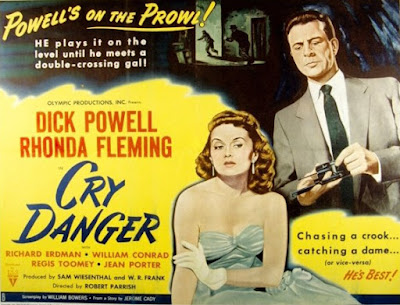
CRY DANGER (1951)


Directed by Robert Parrish, this seventy-nine-minute film noir was produced by W.R. Frank and Sam Wiesenthal. Hats off to William Bowers for writing snappy and glib dialogue for the two male leads, from Jerome Cady's story. The powerful score was written by Paul Dunlap and Emil Newman. Lending suspense to this movie is a speeding passenger train at night beneath the opening credits. Getting off the train by daybreak is Dick Powell, sent to prison for a robbery and murder he did not commit. His life sentence is drastically shortened when an alibi comes forward. 

Distributed by RKO Radio Pictures for Olympic Productions, this is a tidy crime drama with lots of fun dialogue as Powell seems to be carrying over his Richard Diamond radio character with its glib humor, acting more like an experienced P.I. than a blackmailed ex-con. Though there is a heavier dose of sarcasm here. The lines roll off him second to none. Few had his ability to spit out these comebacks so charmingly yet with a tough guy hidden underneath. The guy providing Powell's alibi and subsequent prison release, Richard Erdman, turns out to be a total stranger to Powell, and not serving in the same division during the previous war. Erdman, a war amputee, confesses that he is simply hanging around Powell in hopes of getting a reward from the stolen one hundred grand if it is recovered. Powell is suspiciously grateful for his fake alibi.
 

Powell sets out to clear himself and another inmate—the husband of Ronda Fleming's character—sent up for the same crime. Most of the time she looks blandly aloof with a voice resembling a comforting cup of hot cocoa with marshmallows. Causing some speed bumps along the way is a detective, Regis Toomey, who shadows Powell. Toomey has plenty of reasons to follow Powell and one includes Fleming. 

Powell and Erdman end up sharing a singular grungy mobile home in the trailer park where Fleming lives. Erdman is immediately attracted to a sunbathing neighbor, Jean Porter, almost as much as he is to alcoholic beverages. Porter plays a scene-stealing tart, who, when not modeling, is a highly trained pickpocket, as Erdman finds out. He is the other glib character. A notable example is when he is recovering in the hospital after his Nash "Bathtub" is riddled with bullets, resulting in an improbable five-mile-per-hour dismantling of his car before exiting the trailer park. It was a case of mistaken identity as the hit was meant for Powell. From his hospital bed, he mockingly demands the police chief provide him with a new wooden leg. In knotty pine. To match his den.  


Adding a despicable element is William Conrad, the double-crosser who is responsible for Powell's incarceration. Powell's first pounding of Conrad knocks him to the floor. Late in the film, Powell returns, and with a one-armed swoosh to clear off Conrad's desk, demands he lie down on it. He tells him they get along better when he is on his back. It is an edgy scene for the era as Powell plays Russia Roulette with Conrad's head. The truth is expelled from Conrad.

Note: Eventually, 
David Janssen would be connected with three actors from this film. Toomey would revive a similar role during the first season of television's "Richard Diamond."  Janssen carried the Diamond torch at the suggestion of Powell. Of course, William Conrad provided the narration for Janssen's hit series, The Fugitive.

September 5, 2015

HIGHWAY 301 (1950)


Produced by Bryan Foy with a screenplay by Andrew Stone, who also directed, Warner Brothers released this disturbing eighty-three-minute B-movie noir starring a real-life bad boy, Steven Cochran. The film made a sizable profit. Narration by actor Edmon Ryan, also playing a detective, provides background in pseudo-documentary fashion. Appropriate as this film is a twenty-year update on the crime spree in the Thirties by the Tri-State Gang through the nation's east coast. So the viewer is not exiting the highway that connects three states any time soon. Common for the era of low-budget crime films are comments by three of the east coast's Governors that suggest the tri-state crime is once and for all finished.

The film has all the noir visuals one would expect but it is not perfect. Standard fare in one sense, the film holds one's attention with a well-paced script. Cochran is a ruthless gang leader and cold-blooded killer. The film was a bit of a shocker during its day. His (once) girlfriend is making disparaging remarks about the truth behind the gang's activities. There are startling scenes as he tracks her down in her attempt to leave town. The apartment's elevator ascends to where she waits. As the elevator doors open, he shoots her in the back while she heads for the stairs. Needless to say, the elevator operator is a bit shaky when trying to hit the down button. Noted is the film debut of television's perennial bad guy, Robert Webber. His girl is Gaby André. After discovering the gang's real business, she wants out. There are tense scenes as she attempts to escape from Cochran. Scenes where composer William Lava does his best Dimitri Tiompkin impression. The future gets bleak for two others in the gang after playing dodge bullet with the police. B-movie regular, Richard Egan, has a small role as a fourth wheel in the gang, on-call as needed. Virginia Grey's character cannot be without a portable radio and her favorite program: organ music. Grey provides the wisecracks. With André recovering from a Cochran bullet in the hospital, he devises a ridiculous plan to infiltrate the hospital to finish her off. He thrusts Grey into a role as a newspaper reporter with a handgun and finds herself quickly in over her head with Ryan stationed next to André's room. Her constant lying buries her. After a shootout escaping the hospital, Wally Cassell's character accepts a bullet or two. Cochran meets a more definitive end facing down...well...it is worth the wait.

Note: Virginia Grey always reminded me of a bad composite drawing of Loretta Young and Lucille Ball.

August 30, 2015

JOHNNY DARK (1954)


This Universal Picture's release is a fast-paced film about a talented, young and ambitious automobile engineer, Tony Curtis with a private investigator's name, working for an independent manufacturer.  Curtis An outstanding poster illustration tells all you need to know about this movie. The eighty-five-minute film was directed by George Sherman and produced by William Alland. The actors have nothing to apologize for but it was soon shelved in the minds of moviegoers in light of Curtis' rising career. Yet this film is far more fun to watch than a similar racing-themed release the following year, The Racers, a soap opera with cars starring Kirk Douglas.

Of course, there is a love interest. Petite Piper Laurie, also on a career upswing, plays an up-and-coming automotive designer, making it the only real ground-breaking aspect of the film. Don Taylor plays Curtis' best friend, fellow driver, and competitor of Laurie's affection. Taylor wreaks the race car prototype and Curtis thinks he was showing off. Curtis has to eat crow when it is discovered there was an engineering malfunction in the brakes which Curtis had been warned about. But the two competitor's relationship is never the same. Much of the first reel includes the mundane happenings of engine testing with no dialogue. The stodgy automotive founder, Sidney Blackmer, wants no part of any sports car in his lineup, demanding the company stick with cars that seat six, the standard American family. But his long-time engineer, Paul Kelly, believes in Curtis' idea, which sets up an inconsequential rift between them. Blackmer softens his stance, finding a place for a sporty model in the company’s roster, after Curtis places in the top three of a long-distance rally race. 


In hindsight, perhaps the most interesting aspect today is the vintage racing sequences in period sports cars captured by cinematographer Carl Guthrie. Of note is Curtis's vehicle of choice (and the film's promotional car) is the Woodill Wildfire (above), an American-made sports car to compete alongside the Europeans. A climactic Canada to California rally race is nicely filmed from the air amid spectacular scenery. A mounted camera on the front of a filming car, weaving fast through mountain roads, is a dizzying experience. Beyond that, it is standard fare for the period with Curtis and Taylor “speeding” in their studio prop cars ahead of projected back screen competition. I imagine this was a must-see for teen fans of Curtis and Laurie with many licensed drivers leaving the theater wanting to get their hands on a Jaguar XK120.

Note: Don Taylor had a versatile career in acting but most have forgotten him due to his supporting roles. He gained more fame as a director for some of the most popular television series of the Sixties. His skills led him to direct several major films from the Seventies to the Eighties. His second marriage in 1964 was to English actress, Hazel Court, of British horror film fame. They remained together until his death did them part.