August 24, 2019

A STRANGE ADVENTURE (1956)


A decade before this film's release, William Witney was directing Republic Pictures cowboy serials, so he may have felt at home in the mountain setting of “Suspended Disbelief,” my alternate title for this film. The official title works. It is every bit that. It comes off, at times, like a filmed stage play with everyone knowing their cues and what expression to provide. The opening score is appropriate...if it were a soap opera. The score may also burst onto a scene without warning. Some abrupt edits give the impression that the film reel may have broken and been spliced together. This actually complements the film’s pacing.

An apparent “upper teen,” the twenty-three-year-old Ben Cooper (speaking of Westerns) assists his mom in running her mountain motel. His hobby is a souped-up 1939 Mercury coupe for which he is always in tinkering mode. His other tinkering hobby is gawking at the visiting Marla English, poolside. Her intentions are rather obvious, except to Cooper, who plays it cool like a naive high-school senior. She says she is a nightclub singer—we have no evidence of this—and completing her trio are Jan Merlin (known for many despicable characters) and Nick Adams. I am not sure how much the boy really knows about cars after these two arrive in a new Lincoln. He is "gosh-darned" impressed and heard it will do zero to sixty in six seconds. Even Road&Track found this hard to believe.


Cooper is pretty suspicious of these two after noticing that the Lincoln is actually registered to Woody Wilson, the trio's "booking agent." He is supposed to arrive at a later hour, but Cooper informs English that the newspapers say he has escaped from a midwestern jail. Golly! She is “shocked” and cannot figure that one out. Her real shock is suspecting Woody knows Merlin double-crossed him. Cooper soon discovers the trio’s new gig: an armored car robbery. He is pressured into driving his “faster than a Lincoln” hot rod as the getaway vehicle. I will say, the stunt driving convinced me of its custom nature. Nothing phony about the speeds or cornering up the mountain roads. The actual car was somewhat of a celebrity, a genuine early Fifties customized model completed some two years prior. I digress. The robbery should move that fast because Woody is in town! While English gazes at the blurred flora and fauna up the mountain, she gets something in her eye. After they stop, she tells Cooper, “I think a pebble hit my eye.” The only thing funnier would have been using the word “rock” instead. I think an ophthalmologist is needed. With all the talk and fear of Woody, I looked forward to seeing the actor. But the role was never cast.

Merlin’s character is certainly dangerous. A momentary wise mastermind and a man-child prone to temper tantrums. Things do not always pan out like he thinks they should. So frustrated, he takes it out on whoever is nearby with bursts of angry yelling, using a gun for gesturing. After the robbery, a contrived radio broadcast centers on the lighter side of the news. The amused newscaster mentions Cooper’s mother (startled, he blurts out, “Mom!”). She figures her son eloped with that 'swimming pool Delilah. Everyone in the car has a good laugh at the son's expense.


Merlin demands Cooper take a particular turn off the main highway. They come to a halt. Merlin yells, “It’s a dead-end!” The “Road Closed until Spring” sign should have been an earlier clue. The entire cast is now at an electric company’s weather reporting station, which is about to experience its first big snowfall of the season. No one in or out for six months. Merlin’s brilliance tells him this will be the ideal hiding place. Six months without anyone ever making contact with the station and stretching the food supply for two to five. Suspended disbelief at its essence. The station is run by a brother and sister team of Peter Miller and Joan Evans. For some unknown reason, Evans falls head over heels for Cooper. She knew him for his weekend races, but they had never met. He is on the same page. More tinkering. There is plenty of acting silliness until Miller purposely destroys the communications radio. With communication down, a ranger in a snow tracker heads in their direction.

The final scene is a most rushed segment, as if the director had to say, “Cut. That’s a wrap!” at the seventy-minute mark, no matter what he had intended to film. With no time left to properly resolve the film, the viewer has to settle on another radio broadcast from the car Cooper, Evans, and Miller are traveling in. 

Note: Nick Adams brings an early comedic note to the film as a guy with sinus woes due to the higher elevation. Merlin is intolerant of his constant sniffles, yelling, or throwing things at him like a child. With his black shirt, white tie, and white suspenders, Adams looks like he is part of a clichéd comedic gangster skit. He is a funny sight, later, with a “scarf” under his fedora, tied under his chin, to keep warm. But his I.Q. is a bit higher than “Merlin the Yeller” and outwits him by incrementally depositing all the loot in a "snow bank," exchanging pine cones for the money inside the bag. Neither Merlin nor English could figure out why the money turned hard and lumpy. Must be the altitude.

August 10, 2019

LADY LUCK (1946)


Directed by the very busy Edwin Marin, this light comedy will probably not elicit a second viewing, especially at a whopping ninety-seven minutes. The film has an unremarkable music score by Leigh Harline to back up an original story by the nearly unknown Herbert Clyde Lewis. Released by RKO Radio Pictures, this low-budget movie does have its humorous moments, thanks to those with comedic chops. The individually brief opening segments are fun, suggesting a screwball comedy. These historical flashbacks concern the ancestors of Frank Morgan, each with their own bad gambling decisions from the eighteenth to the early twentieth centuries. His granddaughter, in all three historical settings, is Barbara Hale. She and Robert Young are good here, but neither is funny by nature. At times, their dialogue only includes potentially funny quips. With all the clichéd anger over misunderstandings between these two, the supporting cast is the film’s saving grace on the comedy front.


It all starts with third-billed Morgan, playing a soft-hearted, gambling-distracted grandfather, a persona not far removed from the great Oz. Further down the cast is James Gleason, again playing a savvy character doling out wisdom or deadpan quips with barely a lip moving. Others help carry the comedic load like rotund Lloyd Corrigan, Don Rice, Harry Davenport and the man with the electric performance, Teddy Hart. Once again, he nearly steals another movie as a two-dollar bettor—and winning—to the slow agony of the room. Hart’s first scene sets up the tedious bulk of the movie, and this is how it happened. 

Young is a professional gambler who has done well, here and there. On the other hand, Morgan gambles habitually. The lovable old coot will bet on anything. Hale hates the odds against his “investments.” Her desire is to keep “Gramps” preoccupied before temptation is acted upon. Young places a horse racing bet with Morgan, which in turn introduces him to Hale. She gambles on him upon their first encounter. Smitten by one moonlit night, Young vows to stop gambling to Hale’s delight and skepticism. Quickly married after only their second screen appearance together, he awaits her return from shopping. Something he will have to get used to. To pass the time, he watches Hart’s timid bets, and to speed things along, volunteers to roll the dice multiple times on his behalf. As if he can control how the dice bounce. He loses Hart’s money. Young continues to gamble only to repay Hart’s deficit. Which he does. Then walks away. Hale sees Young at the table and immaturely jumps to a conclusion. Surely, only Hollywood screenwriters think like this. She refuses to hear Young’s explanation, rather than listen to reason, and takes the easy way out. Divorce. Thus begins the middle of the film, which is a bit too predictable and seems to take a fortnight to get through. By the end of the film, Hale, now a gambling whiz, has a totally new perspective on gambling to Young’s displeasure. But the ending is a positive one, thanks to Morgan and the supporting cast. For a final chuckle, Teddy “beside himself” Hart shows up at the end as a wealthy, “patron saint of gambling.” 

Note: Apparently, Hollywood thinks everyone gambles. I am always lost in gambling—dice or cards—movies. Ironically, both stars did their own personal gambling. Young was nearing his film peak here. 
He was always well-prepared but never possessed the charisma of some of his film colleagues. Still, he did well despite never having a contract with any studio! His perfect fame came in the form of a very successful career on television, however. The very pretty Hale also gambled on television, which paid off nicely, opposite Raymond Burr.

July 27, 2019

ROADBLOCK (1951)


RKO Radio Pictures provided a promising opening to this film noir. Character actor, Peter Brocco, witnesses the late-night shooting of Louis Jean Heydt by Charles McGraw. He is abducted by McGraw at gunpoint but swears not to mention it to the police. He cannot. He is on the lame for theft. He makes a deal to split his one hundred grand, kept in his late uncle's cemetery vault. As Brocco removes the floor tile, he first grabs a gun from underneath. McGraw's fist is introduced to Brocco, and to his shock, in walks Heydt. The two insurance investigators have just wrapped up another case. Just like that. Do not expect a lot of action after this. The film is bookended by this intriguing opening and an exciting, though predictable, closing. But you will witness something McGraw rarely gets to do. Smile.


We find McGraw awaiting a plane back to Los Angeles. With an air of sophistication, petite Joan Dixon, unable to afford a full-price single ticket, requests a husband/wife discount ticket. She chooses McGraw as her husband. He does not understand but likes the idea. A lot. The flight has to land short of their destination due to bad weather and both assess each other during the delay. She bluntly tells him they have no future together. Never misquote the Bible: money is not the root of all evil. It is the love of money. Just ask Dixon. Her demeanor suggests a teenager as she dreamily envisions her future, “I’m on a rocket ship to the moon” or “I’m going for the World Series.” McGraw looks puzzled. He cannot afford tickets to the World Series on his salary! This greatly bothers him and we learn his left brain is packed full of stupid. Now settle in for a lot of conversation until well past the halfway point.

The good news is, Dixon now wants to marry McGraw. He needs a lot of money and fast. And so it goes. He proposes a railway mail car robbery to underworld figure and Dixon’s former sugar daddy, Lowell Gilmore. McGraw’s inside knowledge of over a million-dollar cash shipment is the target. He wants Gilmore to stash his take inside a commercial-sized fire extinguisher and mail it to their mountainside honeymoon cabin offered to them by Heydt. I think most have mailed fire extinguishers at some point. To liven up his alibi honeymoon, he confesses his deal with Gilmore. The bad news, money is not as important as her new husband. D'oh! Dixon is ashamed of herself for how low McGraw has descended for her.


The robbery goes well except a railroad employee later dies from the mail car explosion. This, according to a police detective, Milburn Stone. The department tracks down the pilot of the seaplane used for the robbers’ getaway. He identifies one of the robbers. Methodically, the noose gets tighter around McGraw, who arranges to meet Gilmore with a plan to solve their predicament. Gilmore attempts to draw his gun but square-jaw McGraw gets the upper hand. The unconscious Gilmore is placed in his car before it goes over an embankment in flames. Predicament solved.

In a restaurant meeting, Heydt disappointingly explains McGraw’s slip-up. It was the extra fire extinguisher. He had just bought a new one for the cabin. D'oh! A beer bottle on the head temporarily slows Heydt, but soon he and Stone are racing to apprehend husband and wife as they predictably flee to Mexico via the classically famous and frequently used, Los Angeles riverbed, hydro-foiling across the water. It never seems like anything good comes from driving down there, but the low traffic volume made it simpler for a few directors during this era, to say nothing about it being unique. These closing chase scenes are the most memorable moments. The seventy-three-minute film ends with mixed feelings among the remaining cast as Dixon walks away amidst the Los Angeles smog.

Note: For any film buff, this film hardly deserves to be in an unknown category. McGraw's career never skipped a beat because of this film and a jumpstart with RKO's previous dandy, “Armored Car Robbery” or the later “The Narrow Margin.” His co-stars in this film did not burn up the screen, however. Gilmore’s weak character is not memorable. Dixon is rather one-dimensional in this, the most famous role of her short career.

July 13, 2019

THE WASP WOMAN (1959)


Roger Corman found his infamous niche in recycled teenage drive-in horror movies. Ignore his sensational text in the above poster. It has nothing to do with the film. This self-directed and produced film is another bad representation. Not William-Castle-bad, however. Roger's brother, Gene, maintaining the Corman gene, produced Beast From Haunted Cave, which was double-billed with this film and better. The screenplay was written by the perennial Western bad guy, Leo Gordon. For an estimated fifty grand, I suspect a chunk of the money went for hiring Susan Cabot again from the previous year for War of the Satellites, and Corman's superior, Machine Gun Kelly. It should be no surprise that the production quality is lifeless, with a waste of about twelve minutes at the opening as we follow a “Doctor of Waspology,” Michael Mark, through the woods looking for a wasp’s nest. He is also ostracized by the local beekeeper union because he is not a team player. Bees, dude, not wasps! But he has made an incredible discovery. There is a wasp enzyme serum that can turn back the aging process. Truly, what sinks this film is the hilariously poor wasp head costume at the end. That alone makes this a "horror-ble" movie.

The opening score by Fred Katz is mesmerizing, yet annoying. A very dissonant and chaotic arrangement that supports the background image of bees making honey. Never mind the movie is about wasps. The film score was used several times for Corman's science fiction movies. The score, with dominant xylophone, specifically during an in-car camera drive and general "investigating" filler scenes, is a sensory experience of bargain-basement filming. 


Susan Cabot does a good job in her final film and with the best special effects in the film. As the CEO of a major cosmetic company, her initial appearance gives the impression of a dowdy, middle-aged female with no social life. Ever. Yet wasps are very social. But then, so are bees. I digress. Product advertisements have featured her image since the launch of her company, but recently, sales have tanked with her current image. An extremely "complex" bar graph, made by a middle school project, needs clarification from Fred (Anthony) Eisley to explain plummeting sales. Using something called a pointer, he offers a blunt suggestion: replace Cabot’s image with someone younger. His assessment is applauded by the entire board. Cabot lowers her head in self-awareness.


Excentric “Dr. Waspy” re-enters the picture and shares his research with Cabot. Vanity, thy name is wasp. Of course, she needs to look younger, and after a few injections, violá, she reveals her new, confident self. From a wasp’s perspective, she could not look more vibrant. It becomes her new line of injection cosmetics. Then the headaches start. Cabot’s stunt double goes into action, turning into a blood-sucking vampire wasp (head). Much easier than what the poster suggests, a wasp's body with Cabot's face. Hello, CGI. Needless to say, the board members will be voting on a new CEO.

Note: Barboura Morris, with her attention-getting first name, plays Cabot’s assistant and a flirting target for Eisley. She was well-versed in low-budget movies and may have recognized the film score since it was used for her first Corman outing, “A Bucket of Blood.” Always on cue is character actor Frank Gerstle, naturally playing a police detective. A filler to pad the film's length is two attractive office tarts, one of whom manicures and buffs her nails down to the cuticle. In another uncredited role, Corman plays the doctor attending to "Dr. Waspy" after his jaywalking accident.

June 29, 2019

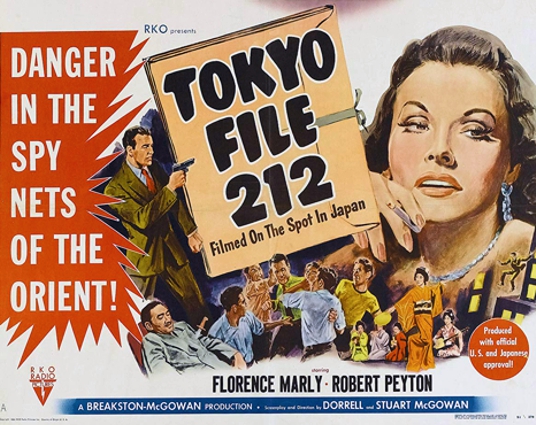
TOKYO FILE 212 (1951)


This American-Japanese double-billed film, distributed by RKO Radio Pictures, could not get any more “B.” From the start of filming to it being put "in the can" took about two months. The acting is okay, but any scintillating dialogue was left in a manila folder, perhaps File 207. The bland dialogue may be an effort to suggest the film was “shot as it happened” using the everyday people involved. I am being kind. Except for some actual military personnel, it is simply a cast of unknown actors in a speculative story filmed entirely in Tokyo, a Hollywood first. It is an innovative take on the Korean War, suggesting Communist spies were working from Japan to sabotage American operations. Certainly not a preposterous premise. Despite the film’s average packaging, the pacing is good, and the Tokyo settings add realism and mystery. Albert Glasser’s rousing opening score certainly gets your attention. The eighty-four-minute movie was not a success, with mixed reviews from critics and ticket buyers alike.

The story is told with voice-overs by a U.S. Government Agent, the sometimes billed, Robert Peyton. His voice and mannerisms seem too intimate for the big screen and better suited for television, where one can get small but perceived as big. The bulk of the movie is told in flashback after a briefcase bomb explodes near his chins. Since he is telling the story, we know he survives the blast, but we do not know what miracle befell him. The climax does have a logical, eye-opening resolution. Officially, he was not a body double for Fred MacMurray, but one might disagree, below.


After checking in at the front desk, Peyton finds Francis Marly, a mature Euro-tart making herself at home in his room. Perhaps the funniest thing in the movie is that she talks seductively in the third person. Being a debonair geek, he is attracted to her "fit of flirts." We are never sure if she can tell the truth. They become an odd team even though he suspects her of being a Communist sympathizer.

Peyton came to Japan to find an old college classmate, Katsuhiko Haida, who is suspected of joining the Communists. Haida’s father tells Peyton of his son’s backstory in a World War II Kamikaze 101 class, where they use scale models for practice. One student is slapped by the tough instructor for timidly and repeatedly not zooming his plane in the right area of a carrier model, thanks to an improper grip on the model. No successful Kamikaze 101 student gets a typical diploma. They get funeral rites. But the war comes to an end, and Haida is crushed that he will never be able to go on frequent Kamikaze missions. He is despondent and vulnerable to Communist propaganda.


The leader of the Communist ring, Tetsu Nakamura, is all very honorable when in Peyton’s presence. Just a sweetheart. Peyton’s informer, however, tells him to be wary of his secret ingredient when he dines with him. Poison. Peyton makes an attempt to add a bit of (awkward) suspenseful humor to this scene. 

The girlfriend of Haida is played by the exceptionally cute Reiko Otani. She is abducted by the Commies, then dumped on the road without so much as an apology. While in the critical care unit, Haida secretly visits, and they express their undying love for each other. Never use any form of the word “dying” in her presence at this point. Haida has an epiphany and is no longer on the dark red side, using all his kamikaze skills to defeat Nakamura. For Peyton, it is on to File 213.

Note: The film provides the moviegoer with good exposure to mid-century Japanese culture. If the film has any assets, it would be this. Many of these scenes carry no dialogue as we follow Peyton through the streets and bars of Tokyo. This in itself saved a ton of production money. There is a scene in a sleazy Japanese-only bar where rowdy, drunk, tattooed men are doing what they would not do unless in a crowd. There is a fully clothed female dancer, after a fashion, on a table. When Peyton and Marly enter in search of Haida, the place becomes dead silent. like two Jewish men entering a Nazi bar. The U.S. Military Police tell them that the bar is off limits and suggest, for their own safety, that they leave.

June 15, 2019

THE PACE THAT THRILLS (1952)


You can thank the producer, Lewis J. Rachmil, for helping make this RKO Pictures release just sixty-three minutes long. Howard Hughes' tread marks are evident in this film, with opening dramatic action shots of motorcycle racing appearing to have been filmed a decade earlier. No music score beneath the credits, just the roar of racing. The historic motorcycle fan may like it. Plaudits go to good rear camera work right in the thick of the racing sequences. Of course, sandwiched in between are the familiar fuzzy studio-projected backgrounds of the actors' pseudo-racing." A predictable script with supporting actors, more C-movie than B-movie, it becomes simply a time-filler, as it was for me. Despite these things, the entertainment value is pretty high.


With a similar visual opening, do not confuse this film with the motorcycle gang film, The Wild One. The dweebs in this movie certainly could use some road manners, but their Clover Leaf "Sickle" Cub (as one character pronounces it) becomes a gang only to play cycle soccer, have a cola, or ride together, weaving between oncoming traffic. Or feel the thrill of your best girl hanging on for dear life when they "pack double," as those crazy cavorting young adults used to say. But it is not, as the poster suggests, murder on wheels. Death on wheels? A distinct possibility.

The movie centers around the misunderstood era of motorcycles and winning anyway you can. Bill Williams' style of racing has taken a cue from the roller derby circuit as he, quite literally, kicks challengers out of a race to win. When your company does not have the fastest bike, cheating levels the field. Encouraging “Long Leg Williams” is his boss and cycle builder, Robert Armstrong. He feels bad that Williams has to play dirty, yet he can live with that. The chief engineer and childhood friend of Williams, Michael St. Angel (RKO changing his name to Steve Flagg), is building a new cycle with fluid drive, as per Chrysler transmissions of the day, I assume. He thinks Williams is the best rider in the city limits. If Williams rides it, they are sure to win. Possibly without cheating. But one never knows. 


Enter female newspaper reporter, Carla Balenda, who is sent to do a hard-hitting story about what these nuts do on weekends. When she witnesses William's lack of riding etiquette in the ring of dirt, her story berates Williams to the point of tears. Well, unlikely. She gets a new perspective on cycling, though, when she and Flagg take to the road with other club members. There is a lot of filming as actors recite dialogue in the movie’s middle. Enough said. Flagg’s new “sickle” still has flaws to work out, but no dough to do it. Williams racks up funds by racing and stunt riding on the Daredevil circuit, county fairs, and Girl Scout cookie fundraisers. Flagg again pilots the new bike in a major race while graciously, carefully, Williams takes himself out on the final lap in a controlled crash, giving Flagg and the new cycle the win. But that is all he wins. Williams gets the girl.

NOTE: Williams is half of the acting glue that barely holds this film together. Robert Armstrong is the other half. Frank McHugh is on hand to do his trademark high, lilting laugh. Balenda holds her own, but that cannot be said of the handsome Flagg. His lines are delivered like a polished amateur. The name change did not help. A red flag that his career was not going to be remembered.

June 1, 2019

UNDERTOW (1949)


Distributed by Universal Pictures, produced by Ralph Dietrich, and directed by William Castle, this film is not ground-breaking, but it does fly by thanks to a screenplay by Arthur T. Horman and Lee Loeb. Unfortunately, they offer an assumed outcome in the first ten minutes of this seventy-one-minute film. How it plays out is well handled with a couple of (obvious) surprises. The filming in Chicago may bring back memories if you lived there during this era. It is yet another B-movie noir with little to fault or remember. Paul Sawtell took the reins as the composer, but none of the themes in this movie will be hummed after the ending.


Scott Brady, doing a great job here as a handsome I-take-care-of-myself former Chicago mobster, ex-con, and war veteran, turning over a new leaf as manager of a lodge in Reno. Before leaving on a quick trip back home to Chicago and “mend a fence” or two, he spots his old friend and colleague from the Windy City, John Russell, a fellow casino owner. As both get up to speed on their seven-year separation, each is excited to share a glimpse of their engagement rings for their respective girl. Strolling through the casino, Brady accidentally bumps into vacationing Peggy Dow. Pardons are accepted, but they stumble upon each other a second time, laughing at the coincidence. 

He and Dow are so comfortable together that there is little surprise they will have a future together within the hour. She is an unassuming elementary teacher from Chicago with zero gambling experience, but has won twice with only two dice rolls. After seeing the handler change the dice after a nod from Russell, Brady makes an astute gambling decision on her behalf so she can win again. Russell is not amused and feigns his disappointment that Brady has to leave so soon. This is that ten-minute point. Based on Russell’s early film roles with his angular face and “dangerous” arching eyebrows, there is no surprise, either, that he has ulterior motives. It will be no surprise, as well, that Dow and Brady are on the same plane back to Chicago. Good odds. She may not be any good at it, but she is willing to gamble on a relationship.


No sooner than hitting the pavement from the airliner steps, Brady is met by a childhood friend, now detective, Bruce Bennett, above, with the nearly invisible Roc (Rock) Hudson in his fifty-second stint as a police detective. Bennett has orders to bring Brady in for questioning. The police captain is especially hard on Brady, accusing him of returning just to kill mob kingpin, Big Jim. The police tail him with little success. Brady reunites with his girl, Dorothy Hart, Big Jim’s niece, at Buckingham Fountain along Lake Shore Drive. Brady wants to make peace with him so they can get married. Later that night, Brady is attacked, shot in the forearm, and placed in a car across the road from a dinera revolver placed beside him. Gadzooks! Then, perhaps the only surprise in the film, the character actor with the over-the-top Southern drawl, Robert Easton, shows up as a parking valet of sorts for the country diner. Cars are parked willy-nilly in the gravel lot, and he offers to park Brady’s car. Spotting a parked police car, Brady makes a quick exit and finds out Big Jim is suddenly not available for any future scenes, and a clichéd frame is afoot. Dow goes the extra “magnificent mile” to protect Brady, while Bennett, unfairly suspended by the captain for supporting an innocent man, has evidence to help clear Brady.


Unsurprisingly, Russell shows up in Chicago with Hart in the mansion she inherited from “Big Dead Jim.” Brady expects help from both, but she is pretty icy about it. He then notices the chunk of “ice” around her finger that Russell had shown him in Reno. Again, no surprise who orchestrated the murder and frame-up. A rapid, happy ending evolves for Brady and Dow, at least.

NOTE: Some suggest Peggy Dow was bland in this outing. Perhaps hard to argue with, casting her did seem appropriate. She is sweet in this role. Probably best she ended her three-year acting career after marrying an oil baron. Otherwise, she might have been lost in guest-starring roles after her television transition. Dorothy Hart never set a film frame on fire, either, but she should have. She is pretty one-dimensional as a devious female with hardly more than a smirk or smile. Smoki Whitfield has three brief and effective scenes as Big Jim's long-time aide, out to get whoever killed his boss. Perhaps the most memorable takeaway from the movie other than Robert Easton's obligatory performance.