January 18, 2021

NIGHT TRAIN TO PARIS (1964)


Ending in an appropriate sixty-five minutes, this film’s lackluster direction by actor Robert Douglas never becomes an exciting espionage yarn, hinting that he should stay in the television medium where he was best suited to direct. The repeated filming of the same sequences only lengthens the film. He uses a momentary rocking camera motion only for the train’s first interior filming to my annoyance. An opening jazz score by the modest British composer, Kenny Graham, assumes a treat ahead as if to mimic Henry Mancini. The underlying cartoon train graphic—I expected the Pink Panther as the engineer—shaves any dangerous edges off the film. So one might anticipate a little humor, and that is all one gets. Unlike a secure day train, only on a night train does one experience death. Filmed by Shepperton Studios in London, it was released by Twentieth Century Fox. It assumes a cool caper television pilot that the networks passed on.


The excitement begins and ends with two men exchanging wrapped deli sandwiches...er...a reel tape and cash at a phone booth. The guy with the cash never makes it home. The other guy retains a fake reel as a deception. The scene shifts to the office of an airline travel agency and its public relations man, Leslie Nielsen, a former intelligence officer in the OSS. He is charming and flippant, but not convincing, whether serious or comedic. Squeezing laughs out of an unfunny script by Harry Spalding is not easy. At this stage in his career, Nielsen is not a notable star, yet the average television viewer in America at the time would recognize his face if not his name. For any fan of Nielsen's comedic career crescendo, it may be difficult to entirely remove him from his Lt. Frank Drebin character. 

Arriving at his office in a modest tribute to the hairstyle of the bride of Frankenstein's creation is Alizia Gur in all her exotic allure. A frequent guest star on many American television shows during the period, her acting has not matured since her single Bond film appearance. She arranges a meeting between Nielson and Hugh Latimer—credited as playing Jules Lemoine—a fellow OSS officer who wants his pal off to Paris for a secret mission to deliver the (real) tape containing defense information. But Latimer's fake reel becomes his fatal drawback. Upon discovering his body, Nielson gathers unknown material from his apartment for a tedious waste of film. Without any music score, it seems even longer.


Nielson poses as an assistant to a professional photographer, and to further the gambit, they take along two models, one of whom turns out to be an impostor. Gur fills in as a third model. But even before packing for the special New Year’s Eve Bear Ski Club train, the photographer is stabbed in the back by the short-spiked end of a ski pole. I might have believed his immediate demise had he been struck in a carotid artery. With Gur as his companion,
Nielson arrives at the costume party in a “Groucho Marx” prop—Drebin undercover. By midnight, the party is in full swing with era music and “ants in your pants” dancing.

On board is the large, high-cholesterol Eric Pohlmann, responsible for all the deaths in the film. The ski club has an inebriated bear mascot that interacts with Nielson for no apparent reason. The mascot gets a throttling as well, and after the boat docks, Pohlmann dons the bear costume to the unknowing travel agent. Their confrontation in Dunkirk is pretty silly, but it was not meant to be. He is able to beat the bear costume into submission with repeated blows to the stomach. Meanwhile, Gur’s been busy with her own plan for the tape, and her inept pursuit of Nielson is preposterously dull. Nielson ends the film with a lighthearted, freeze-framed expression in Police Squad fashion.

Notes: Hugh Latimer is credited with playing Jules Lemoine. Adding some confusion, he is introduced to Gur as Georges Freneau. She claimed to be a friend of Lemoine, yet, oddly, she never flinches when his undercover name is mentioned.

Finally, back in the day, a ferry shuttled specialty trains from Great Britain to France across the English Channel. Once docked in Dunkirk, the train would continue on to Paris and Switzerland’s slopes. Despite the film’s title, neither the audience nor the cast ever gets to Paris. Perhaps a more accurate, but less intriguing title, “The Dunkirk Night Ferry.”

January 11, 2021

HOT ROD (1950)


Monogram Pictures did the right thing by keeping this a sixty-minute film. One could blame an idealistically inane screenplay by Daniel Ullman for these “breakout” kids who use proper grammar and handle adversity with unselfish common sense. Lewis Collins
—known for his many Westerns—directed. Hollywood had its influence on this film, but these mid-century people actually existed in smaller cities across the United States. In five years, MGM’s Blackboard Jungle will portray a harsher rebellion far removed from this milquetoast outing.

Opening voice-over narration describes what a hot rod is against the backdrop of stock footage at El Mirage Dry Lake in California. Edward Kay’s score with frenetic violins supports the film’s opening, reminding one of a 1930s action serial. Poignant, as the hot rods in this film are souped-up Thirties coupes. With World War Two stagnating the auto industry’s creativity, the hot rod culture was born out of a need for something completely different. The music takes a serious tone as we see an overturned hot rod along a county road. Racing in the desert is legal and safer. Street racing is for “Club Ignorant” members. The crux of the film.


Six hot rods, two rows three-abreast, race on a straight stretch of road for bragging rights with the pavement barely wide enough to stay on the concrete. Unbelievably, the road’s finish line is lined with high school fans, many standing on the edge of the pavement. Though the starting point is logically out of sight, the gang is already cheering wildly. The fans are looking across—not down—the road, but Hollywood gives the impression they have the same vantage point as the camera crew. Filmmaking at its essence. It takes the racers forever to speed past their classmates due to repeated views of the previous footage. Topping the preposterous scene off is a motorcycle cop—heading in the opposite direction—attempting to halt the speeding hot rods by waving his arms wildly. His death is averted.


James “Henry Aldridge” Lydon (left) seems to reprise his iconic character this time as the son of the town judge, Art Baker, who apparently runs the town. He is not wavering about cracking down on illegal street racing, so that the teen gene pool is not completely drained. In a rare instance, Myron Healey does not play a villain but a police officer, the older brother of Lydon. Trying to convince “Pop” to support a legally timed strip will not be easy. Lydon buys an old beater and, being level-headed, does not add any “soup.” It is just a tired dog of transportation. His best bud and comic relief, Gil Stratton, is full of sarcastic jabs about it. This from a guy whose imprinted cap design—from the front—makes it look like his hair is in curlers. Gloria Winters, Lydon’s spoken-for girl since grade school (aka elementary), is embarrassed to ride in his turtle junker. Local demon of speed, Tommy Bond (right) is a hit with the ladies and a twisted crankshaft to Lydon. Lydon and Stratton set out to piece together the fastest rod within the city limits.

Jealous, Bond steals Lydon's pride and joy, then sideswipes a sedan in town, parking the car nearby. The police and the entire town, including Winters, assume Lydon is guilty without any proof. This, back when social media was actually social. He escapes a “public hanging” when Bond jumps up in the courtroom to confess. “Judge Dad” is lenient, but orders his own son to get rid of the hot car nonetheless. But...fate moves its huge hand—my apologies to screenwriter, Stanford Whitmore. A bank robber saves the day as Lydon’s hot rod catches up with an escaping Cadillac’s license plate. A motorcycle cop and patrol car quickly catch up with Lydon and Stratton, who lead the police in the waning moments of the pursuit. This is a pretty realistically filmed chase. For his heroism under preposterous circumstances, Lydon gets a motorcycle police escort back home as the officers vouch for the kid to his father. Hot rods and law enforcement are on the same side. There is a highly contrived closing as the judge’s public apology falls on deaf ears at the drag strip’s groundbreaking ceremony.

Note: Gloria Winters is best known to Baby Boomers as Penny on the action-adventure Saturday morning show, “Sky King.” Kirby Grant starred as Schuyler "Sky" King, while Penny portrayed his niece, who was always consumed by unexpected trouble. The television version began in 1951, and the popular show ran for eight years. As for Tommy Bond, he was the original Jimmy Olson in the Superman movie serials.

January 4, 2021

FORGOTTEN FILMS: TV TRANSITION

Though typically overshadowed by Hollywood's A-list, there were respectable performances by numerous actors and actresses who never became major film stars. A common career shift was to the new medium of television. These periodic posts offer insight into their transition.


Myron Healey: Myrton Healey (1923-2005)

Myron Healey began his career during the early 1940s in uncredited and minor supporting roles at various studios, Monogram Pictures among them. Perhaps for commonality, he or the studio changed his name to Myron. There were not many by either name in Hollywood. The low-budget western film is most associated with the actor and he never abandoned the genre as television loomed. He became a familiar face yet his name usually drew a blank. Perhaps many could not make the connection with a despicable outlaw named Myron. Adding to the confusion, he was sometimes credited as Michael.

There were countless television westerns under Healey’s gun belt. His recurring roles or frequented series appearances are the only ones mentioned here beginning with The Lone Ranger (1950-57) with seven appearances. Healey was a frequent visitor on the set of Cheyenne (1955-62). He had a recurring role as Doc Holliday on The Life and Legend of Wyatt Earp (1956-59) and played a doctor twice on the forgotten adventure series, The Man and The Challenge (1959-60). Along the same period, he played Maj. Peter Horry in seven episodes of The Swamp Fox for The Magical World of Disney. Healey left his horse in the stable for several episodes of modern-day dramas, among them Schlitz Playhouse (1955-58) and State Trooper (1957-59). As the Sixties progressed his workload hardly skipped a beat in television or films.

In the Seventies the western was being replaced by detective or police shows. Healey was there as always with numerous appearances on Ironside (1969-72) or Adam-12 (1969-73). But his phone rang less and less as the Eighties drew to a close. An actor does not have much staying power if he is not a team player, like Healey. He was happy to be acting in whatever role he was asked to do without complaining. One sign of a professional. Unfortunately, his professional success did not carry over at home. His four marriages from 1943 to 1971 were all short-term for reasons unknown.

Note: Healey was a child prodigy who sang on radio and performed violin and piano recitals while still in his early teens. He served in World War II as an Air Corps navigator and bombardier in Europe. After the war he continued military duties, retiring in the early 1960s as a captain in the United States Air Force Reserve. His military discipline carried over into his acting career.

December 28, 2020

FILM BRAKE: A SYNDICATED DETECTIVE


CORONADO 9 (1960-61)

Suddenly it's 1940! Reminiscent of a twenty-year-old movie premise, this thirty-nine-episode syndicated series, produced by Revue Studios' shoestring budget, starred the popular Republic Pictures Western star, Rod Cameron. The Canadian-born actor played a former United States Navy intelligence officer who is now an always-in-demand private detective in this, his third and final law enforcement series. Business-savvy Cameron figured he would be better served financially by starring in another syndicated series. Producers may have hoped the no-nonsense Cameron would carry the series on the heels of his popular, long-running series, State Trooper. This show possessed nothing unique and even with an ideal time slot on either of the three major network's prime-time schedules, it would not have survived long.

The Navy provided a good pension. The show's title represents his phone exchange in the affluent suburb of San Diego where the iconic Hotel del Coronado got the attention of photographers. Owning the massive slab of Lincoln Continental that got about seven miles per gallon with a tailwind is another tip-off. He may reluctantly take on an investigation being a wee bit tired of dodging bullets, getting beaten up, or not trusting a client's motives.

Cameron's baritone voice provides narration to introduce his assignment—periodically informing the viewer of his progress—and typically wraps an episode to tie up any loose ends. His persona might not solicit Mike Hammer or Philip Marlowe, though one cannot help but like the towering star. A friend one could flawlessly reconnect with no matter how long the separation. Reconnecting with the receiving end of Cameron's fists is another matter. He has a permit to carry them. His stunt double can be quite obvious—ironic in that Cameron used to be one himself—in his younger days. It also explains why he is never winded after an intense fistfight. 

Not to be too harsh, television's number one action man—according to the series promo ads—did have a winning smile and could charm the ladies. He could also be a role model to the local lad looking for summer work swabbing his boat. Aside from the projected background shots, the San Diego filming adds flavor. Several episodes were well-directed and well-paced with a twist or two. But sixty years later, any twist may be untwisted sooner than later by a viewer. Some episodes climaxed with a chase up a stairway or on rare occasions, end with a touch of humor, sometimes at Cameron's expense. The writers generally did a pretty good job in an era of equally talky, and generally boring shows—Peter Gunn or Mr. Lucky come to mind. Coronado 9's first episode is particularly dull due to being filmed almost entirely in the confining space of his sailboat. A fun trivia journey for boomers may be the familiar guest stars, yet Revue's casting net was not wide, hiring actors with limited television credits.

Cameron's stalwart persona was perhaps better suited for holding reins than a steering wheel. The Ford Motor Company appears to have been a sponsor of the show. They were always convertibles because Cameron sat tall in the vinyl. With Cameron's start in Hollywood, his Western-style might be best associated with  Randolph Scott. If possible, imagine stalwart Scott as a modern-day private detective behind the wheel. Do not expect to see automobiles associated with the show's release date as the series began filming in 1958. Do not expect the ubiquitous music to be a signature element—unlike Peter Gunn—any more than the nondescript opening theme as Cameron scans the bay, guessing where he last anchored his boat.

Finally—it can be assumed—due to his Naval Intelligence years, “Dan Adams” had a deep social network that eventually took him from Coronado to strange, exotic locales around the globe as more adventurer than mere detective. Implausibly, it suggests everyone's only crime-solving choice had to be a somewhat weary fifty-year-old P.I. from California.

December 21, 2020

COVER UP (1949)


 THE MURDER THAT SAVED CHRISTMAS

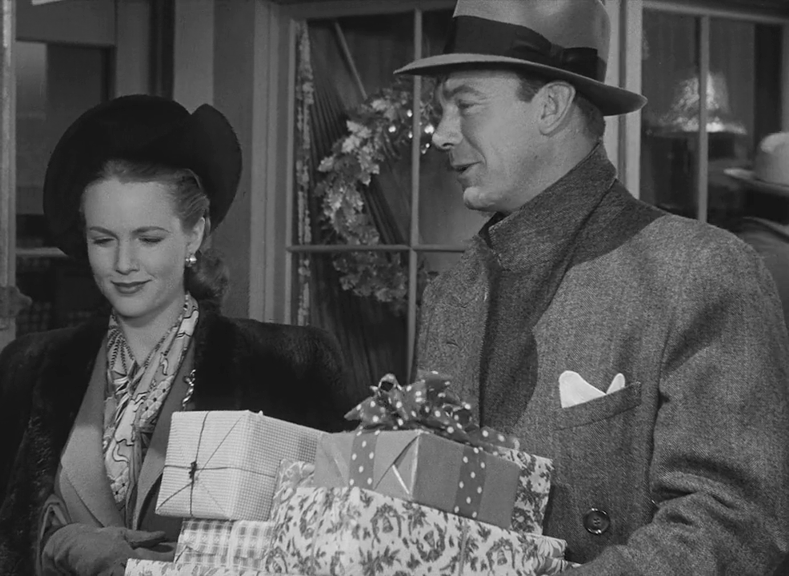
This light mystery is hard not to like from its opening scene thanks to the appeal of Dennis O'Keefe and Barbara Britton. In their first clever exchange, Britton pretends to have not noticed O’Keefe on the train even though he sat across from her, facing backward. He is skeptical of her memory and hooks her, "You know I snore pretty badly when I ride backward." “Not true...your eyes were open all the...” His icebreaker is successful. Their delightful dialogue—though not unique—is provided by a screenplay by Jerome Odlum and Jonathan Rix aka O'Keefe. They do a fine job of not revealing the climax in the early stages where one simply has to endure the last thirty minutes or so. Both know how to keep a secret under wraps. United Artists’ released the eighty-three-minute film in February though the story is set at Christmastime. Ignore the poster suggesting this is a hard-hitting murder story.


The leads are heading to a small mid-western town where everyone knows who's who. Britton is coming home for the holiday. She lights up the screen with every smile and may never have looked more appealing. Her teenage sister may be the film's cliched annoyance. She is all ga-ga over O'Keefe, an insurance investigator. He is arriving to confirm an apparent suicide but all clues lead to an obvious murder. He should feel right at home in a role he often played. He certainly knew his strengths. Much to O’Keefe’s disappointment, clues are pointing to Britton's father—
the likable Art Baker. His Luger is the assumed murder weapon with his vintage beaver coat figuring into the evidence. However illogical, the small town wants to ignore the past incident.


O’Keefe gets little cooperation from William Bendix, the county sheriff, who also owns a Luger. Falsely depicted in the poster above, he is about as violent as Jed Clampett. The two pros have witty chemistry from their first meeting. The sheriff’s cryptic behavior does not endear him to the investigator initially. Bendix tries to change the suicide subject more than once, suggesting twice he abandon cigarettes and switch to a pipe, his preferred habitual mode. O’Keefe says it is okay—
he owns stock in a cigarette company. The sheriff knows the truth will eventually unravel, but he is not keen on helping the investigator.


It is a rapid climax as the incident is revealed by a single witness. The man killed was not liked by anyone. He was bent on destroying the town, the people, and their future, with hate and gossip. So whether suicide or murder, the locals considered it good fortune. Children will long remember the murder that brought new joy to Christmas.

Notes: There are three characters with amusing scenes. First up is Bendix’s deputy, Dan White, who has no dialogue, finding it more convenient to simply shrug or point. But we first see him hanging up the phone at the end of a conversation! O’Keefe tells him to tone down his chatter on one visit.

Then there is the theater scene with an inquisitive and savvy youngster, George McDonald. He turns around and stares at O’Keefe and Britton for a while before giving opinions about the lame movie playing and some romantic advice. By then, O’Keefe is trying to buy him off with money for another theater across the street. Except the kid has seen that movie. He finally gets what he wanted all along: money for bowling. He and his buddy duck out of the theater.

But by far the most amusing performance is by Baker’s maid to end all maids, Doro Merande (above right). She is a walking encyclopedia of everything that goes on in the family and in town. Her unique delivery suggests she is completely daffy, yet her astute, cutting opinions are delivered like compliments. Her exchanges with O’Keefe are highlights. In their final greeting at the door, he jokingly grabs her at the shoulders, lifts her off her feet, and feigns an attempt to kiss her madly. She is aloof yet not completely against his advances. Later, to help cover for Baker during the investigation, she deliberately sets fire to his old college coat, destroying any evidence of it. She nonchalantly confesses to him before abruptly leaving the scene, "I had a little accident with your beaver coat. I was cleaning it, and it caught fire...burned up completely."

December 14, 2020

THE WRONG ROAD (1937)


The early scenes setting up the premise of this American crime drama may remind you of those old “etiquette films” where there is a life lesson to be learned. Appropriately, the music under the introductory titles can best be described as sappy. There is not much to fault here, however, other than the now-dated script by Gordon Rigby, which will sometimes stretch the believability factor. Yet, his main focus is still relevant. I do credit him with an unpredictable script with an ending that is a well-kept secret. There are sly usages of humor as well, making the film an entertaining fifty-three minutes. Competent acting is evident from the outset, with no one needing to apologize after the premiere. The film was directed by silent film director and actor James Cruze and released by Republic Pictures.

However.

Fresh-faced sweethearts Richard Cromwell and Helen Mack are moping over their dream plans, which never panned out after graduation. The eternity of that first summer out of college really stunk. Mack, born into a wealthy family, had dreams of an easy life as a society girl until her father lost everything during her senior year. She cannot bear the thought of doing manual work. Cromwell, expecting a career in a high-paying engineering job, ended up getting fired a few months in. Now, in his third year as a disgruntled bank teller, he had also expected a promotion by now. They even go so far as to suggest it is their right to have decent jobs. Sounds like they are on the wrong road to Socialism.

Cromwell’s character, with his wide mood swings, might be diagnosed as bipolar in the future. His plan is to gradually steal one hundred grand as Mack “withdraws” quite a stack each time she comes in. Their blinding love leads to greed. They agree to never deny the theft because going to prison is the only way his plan will work. Oh...kay. He figures they will be in prison for a year or two, then once out, retrieve the money hidden in the bottom of an antique music box. Keep in mind, neither are seven-year-olds.


Prior to being arrested, they meet with an insurance detective, Lionel Atwill, who astutely and compassionately explains their predicament. He offers them a pardon if they divulge where they hid the money. He bluntly tells them that a sentence of up to ten years with no chance of parole is likely. He further explains that the money has become something called "hot." They can never spend it. A fact that, unbelievably, Cromwell ignores throughout the film. Mack’s eye-opener is that they cannot get married for ten years. When the sentence is passed down, she nearly collapses under the weight of stupidity. Cromwell belligerently sticks to his plan, finally getting that dream job as a drill press operator in prison. Never really attentive during “prison orientation days,” he starts passing notes to Mack on the advice of a cellmate, the conniving Horace McMahon (above right). Every inmate soon knows of "loverboy," and it costs him eight weeks of good conduct. Despite his short screen time, McMahon is dandy.

Atwill remains optimistic for the two brats...uh... youngins. Giving them parole will likely lead him to where they hid the money. But the thick-headed Cromwell refuses the offer. He insists they have “earned” the stolen money with their two years in prison. Yes, stupid goes back ions. Thanks to some wise advice from Mack, he has a change of heart, and the parolees get sales jobs for a vacuum sweeper business. The manager shows them their sales region with each competitor represented with pins stuck to a wall map. He explains what they are looking at thusly, ‘Every salesman is a pinhead.’ Cromwell even found this amusing.

McMahon is released from prison and sticks to Cromwell like Vitalis hair tonic. The latter continues his idiotic reasoning, ignoring McMahon’s deadly threats. The duo flees with the music box. Be prepared for a ubiquitous studio prop car chase with enough left-and-right steering movement to guide a Mississippi paddle steamer. McMahon puts them in a life-or-death situation, and the two inmates struggle for dominance. With a rock on the head, Mack proves her dominance. In a bit of contrived timing, Atwill arrives on the scene. Mack has had it up to you-know-where with Cromwell’s poor planning skills. She finally gets through to the dullard. The film closes as the two deliver the most unlikely dialogue.

Note: Mack’s uncle, where the music box was sent for safekeeping, has died, and all his effects are now going to the highest bidder. The collegians race to the auction house but are outbid by Rex Evans. Amusingly, he turns out to be quite the wordsmith. In an attempt to buy back the music box, the couple visits him later at his apartment, which is crammed full of items from his unlimited budget. He treats auctions as a sport, like wild game hunting. He has no real use for most of it. In a faint British accent, he excitedly compliments Cromwell on the way he dealt with that “buttinsky” during the auction. He feels absolutely “wonky” with embarrassment for giving the music box to Marjorie Main, a “fabulously ripping old dodo.” His persona, though eccentric, would seem well-reasoned. That might be true until his nurse enters and reminds him of his bedtime. She puts his favorite hat (a flat, feathery item) on his head to which he commands, “Call me Pinky.”

December 7, 2020

FORGOTTEN FILMS: TV TRANSITION

Though typically overshadowed by Hollywood's A-list, there were respectable performances by numerous actors and actresses who never became major film stars. A common occurrence was their transition to the new medium of television, often becoming familiar faces in homes across America. These periodic posts offer insight into their transition.


Richard Denning: Louis Albert Heindrich Denninger, Jr. (1914-98)

Richard Denning got his start in Hollywood starring in a few popular radio programs of the 1940s and early 1950s. The most famous was being opposite Lucille Ball in the radio comedy, My Favorite Husband, which set the groundwork for her Lucy Ricardo character. But with no face for radio, the handsome Denning soon was singled out, first as a bit player then gained starring roles in mostly low-budget films. He was always fun to watch in spite of being cast in some forgettable films.

Denning was successful at garnering many supporting film roles during his early years in Hollywood as in the musical comedy, The Farmer's Daughter (1940), or The Glass Key (1942), and Black Beauty (1945) all the while rubbing elbows with some major film stars. He was the lead in numerous routine B-movies where he often played cool, easygoing characters able to hold his own in a fistfight. The 6’ Denning could deliver sarcastic quips with coolness in a Dick Powell fashion. Perhaps his most infamous role was in Creature from the Black Lagoon (1954) supporting Richard Carlson and Julie Adams followed by his lead in another science-fiction cult classic, Target Earth (1954). He had a nice turn in The Crooked Web (1955) as an undercover government agent routing out a German war crimes officer.

Television credits began to pile up with the lighthearted crime show, Mr. & Mrs. North (1952-54). Denning played a mystery magazine publisher who—along with his wife—moonlight as amateur detectives, echoing the Thin Man film series of the 1930s. The show was also a follow-up to a decade-old film as well as a radio mystery program of the same name. Denning kept busy with lead roles in the series The Flying Doctor (1959) and as the private investigator, Michael Shayne (1960-61) tooling around Miami in a 1960 Oldsmobile convertible. Beyond his screen time, the show was a dud. The comedy dud, Karen (1964-65), was next followed by his being called out of retirement to play Hawaii’s governor in seventy-three episodes of the classic police show, Hawaii Five-O (1968-80).

Note: Richard Denning was born in Poughkeepsie, New York but his family moved to Los Angeles before his second birthday. He attended Manual Arts College earning a Master of Business Administration degree from Woodbury Business College in Los Angeles. Denning married horror film and B-movie actress Evelyn Ankers in 1942. Their marriage lasted until her death in 1985.