June 29, 2019

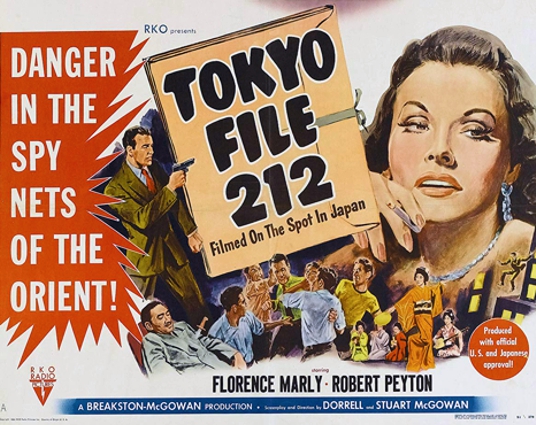
TOKYO FILE 212 (1951)


This American-Japanese double-billed film, distributed by RKO Radio Pictures, could not get any more “B.” From the start of filming to it being put "in the can" took about two months. The acting is okay, but any scintillating dialogue was left in a manila folder, perhaps File 207. The bland dialogue may be an effort to suggest the film was “shot as it happened” using the everyday people involved. I am being kind. Except for some actual military personnel, it is simply a cast of unknown actors in a speculative story filmed entirely in Tokyo, a Hollywood first. It is an innovative take on the Korean War, suggesting Communist spies were working from Japan to sabotage American operations. Certainly not a preposterous premise. Despite the film’s average packaging, the pacing is good, and the Tokyo settings add realism and mystery. Albert Glasser’s rousing opening score certainly gets your attention. The eighty-four-minute movie was not a success, with mixed reviews from critics and ticket buyers alike.

The story is told with voice-overs by a U.S. Government Agent, the sometimes billed, Robert Peyton. His voice and mannerisms seem too intimate for the big screen and better suited for television, where one can get small but perceived as big. The bulk of the movie is told in flashback after a briefcase bomb explodes near his chins. Since he is telling the story, we know he survives the blast, but we do not know what miracle befell him. The climax does have a logical, eye-opening resolution. Officially, he was not a body double for Fred MacMurray, but one might disagree, below.


After checking in at the front desk, Peyton finds Francis Marly, a mature Euro-tart making herself at home in his room. Perhaps the funniest thing in the movie is that she talks seductively in the third person. Being a debonair geek, he is attracted to her "fit of flirts." We are never sure if she can tell the truth. They become an odd team even though he suspects her of being a Communist sympathizer.

Peyton came to Japan to find an old college classmate, Katsuhiko Haida, who is suspected of joining the Communists. Haida’s father tells Peyton of his son’s backstory in a World War II Kamikaze 101 class, where they use scale models for practice. One student is slapped by the tough instructor for timidly and repeatedly not zooming his plane in the right area of a carrier model, thanks to an improper grip on the model. No successful Kamikaze 101 student gets a typical diploma. They get funeral rites. But the war comes to an end, and Haida is crushed that he will never be able to go on frequent Kamikaze missions. He is despondent and vulnerable to Communist propaganda.


The leader of the Communist ring, Tetsu Nakamura, is all very honorable when in Peyton’s presence. Just a sweetheart. Peyton’s informer, however, tells him to be wary of his secret ingredient when he dines with him. Poison. Peyton makes an attempt to add a bit of (awkward) suspenseful humor to this scene. 

The girlfriend of Haida is played by the exceptionally cute Reiko Otani. She is abducted by the Commies, then dumped on the road without so much as an apology. While in the critical care unit, Haida secretly visits, and they express their undying love for each other. Never use any form of the word “dying” in her presence at this point. Haida has an epiphany and is no longer on the dark red side, using all his kamikaze skills to defeat Nakamura. For Peyton, it is on to File 213.

Note: The film provides the moviegoer with good exposure to mid-century Japanese culture. If the film has any assets, it would be this. Many of these scenes carry no dialogue as we follow Peyton through the streets and bars of Tokyo. This in itself saved a ton of production money. There is a scene in a sleazy Japanese-only bar where rowdy, drunk, tattooed men are doing what they would not do unless in a crowd. There is a fully clothed female dancer, after a fashion, on a table. When Peyton and Marly enter in search of Haida, the place becomes dead silent. like two Jewish men entering a Nazi bar. The U.S. Military Police tell them that the bar is off limits and suggest, for their own safety, that they leave.

June 15, 2019

THE PACE THAT THRILLS (1952)


You can thank the producer, Lewis J. Rachmil, for helping make this RKO Pictures release just sixty-three minutes long. Howard Hughes' tread marks are evident in this film, with opening dramatic action shots of motorcycle racing appearing to have been filmed a decade earlier. No music score beneath the credits, just the roar of racing. The historic motorcycle fan may like it. Plaudits go to good rear camera work right in the thick of the racing sequences. Of course, sandwiched in between are the familiar fuzzy studio-projected backgrounds of the actors' pseudo-racing." A predictable script with supporting actors, more C-movie than B-movie, it becomes simply a time-filler, as it was for me. Despite these things, the entertainment value is pretty high.


With a similar visual opening, do not confuse this film with the motorcycle gang film, The Wild One. The dweebs in this movie certainly could use some road manners, but their Clover Leaf "Sickle" Cub (as one character pronounces it) becomes a gang only to play cycle soccer, have a cola, or ride together, weaving between oncoming traffic. Or feel the thrill of your best girl hanging on for dear life when they "pack double," as those crazy cavorting young adults used to say. But it is not, as the poster suggests, murder on wheels. Death on wheels? A distinct possibility.

The movie centers around the misunderstood era of motorcycles and winning anyway you can. Bill Williams' style of racing has taken a cue from the roller derby circuit as he, quite literally, kicks challengers out of a race to win. When your company does not have the fastest bike, cheating levels the field. Encouraging “Long Leg Williams” is his boss and cycle builder, Robert Armstrong. He feels bad that Williams has to play dirty, yet he can live with that. The chief engineer and childhood friend of Williams, Michael St. Angel (RKO changing his name to Steve Flagg), is building a new cycle with fluid drive, as per Chrysler transmissions of the day, I assume. He thinks Williams is the best rider in the city limits. If Williams rides it, they are sure to win. Possibly without cheating. But one never knows. 


Enter female newspaper reporter, Carla Balenda, who is sent to do a hard-hitting story about what these nuts do on weekends. When she witnesses William's lack of riding etiquette in the ring of dirt, her story berates Williams to the point of tears. Well, unlikely. She gets a new perspective on cycling, though, when she and Flagg take to the road with other club members. There is a lot of filming as actors recite dialogue in the movie’s middle. Enough said. Flagg’s new “sickle” still has flaws to work out, but no dough to do it. Williams racks up funds by racing and stunt riding on the Daredevil circuit, county fairs, and Girl Scout cookie fundraisers. Flagg again pilots the new bike in a major race while graciously, carefully, Williams takes himself out on the final lap in a controlled crash, giving Flagg and the new cycle the win. But that is all he wins. Williams gets the girl.

NOTE: Williams is half of the acting glue that barely holds this film together. Robert Armstrong is the other half. Frank McHugh is on hand to do his trademark high, lilting laugh. Balenda holds her own, but that cannot be said of the handsome Flagg. His lines are delivered like a polished amateur. The name change did not help. A red flag that his career was not going to be remembered.

June 1, 2019

UNDERTOW (1949)


Distributed by Universal Pictures, produced by Ralph Dietrich, and directed by William Castle, this film is not groundbreaking, but it does fly by thanks to a screenplay by Arthur T. Horman and Lee Loeb. It is another B-movie noir with little to fault and only one surprise. How it plays out is well handled, yet they spill out an assumed outcome in the first ten minutes of this seventy-one-minute film. The filming in Chicago may bring back memories if you lived there during this era. The same goes for the filming in Reno. The ever-present Paul Sawtell took the reins as the composer, but none of the themes in this movie will be hummed after the ending.


Scott Brady, doing a great job here as a handsome I-take-care-of-myself former Chicago mobster, ex-con, and war veteran, who is turning over a new leaf as manager of a lodge in Reno. Before leaving on a quick trip back home to Chicago and “mend a fence” or two, he spots his old friend and colleague from the Windy City, John Russell, a fellow casino owner. As both get up to speed on their seven-year separation, each is excited to share a glimpse of their engagement rings for their respective girl. Strolling through the casino, Brady accidentally bumps into vacationing Peggy Dow. Pardons are accepted, but they stumble upon each other a second time, laughing at the coincidence. They are so comfortable together that there is little surprise they will have a future together within the hour. 

Dow is an unassuming elementary teacher from Chicago with zero gambling experience, but has won twice with only two dice rolls. After seeing the handler change the dice after a nod from Russell, Brady makes an astute gambling decision on her behalf so she can win again. Russell is not amused and feigns his disappointment that Brady has to leave so soon. This is that ten-minute point. Based on Russell’s early film roles with his angular face and “dangerous” thirty-degree ascending eyebrows, there is no surprise that he has ulterior motives. It will be no surprise, as well, that Dow and Brady are on the same plane back to Chicago. Good odds. She may not be any good at it, but she is willing to gamble on a relationship.

Candid images of Scott Brady and John Russell on location between filming in Reno 
Dave Celinas Collection

No sooner than hitting the pavement from the airliner steps, Brady is met by a childhood friend, now detective Bruce Bennett. He has orders to bring Brady in for questioning. The police captain is especially hard on Brady, accusing him of returning just to kill mob kingpin Big Jim. The police tail him with little success. Brady reunites with his girl, Dorothy Hart, Big Jim’s niece, at Buckingham Fountain along Lake Shore Drive. Brady wants to make peace with him so they can get married. Later that night, Brady is attacked, shot in the forearm, and placed in a car across the road from a dinera revolver placed beside him. Gadzooks! That one surprise in the film is the character actor with the over-the-top Southern drawl, Robert Easton, a well-worn Hollywood dialect coach. He is the parking valet of sorts for the country diner where cars are parked willy-nilly in a gravel lot. Spotting a parked police car, Brady makes a quick exit and finds out Big Jim is suddenly not available for any future scenes, and a clichéd frame is afoot. Dow goes the extra “magnificent mile” to protect Brady, while Bennett, unfairly suspended by the captain for supporting an innocent man, has evidence to help clear Brady.


Unsurprisingly, Russell shows up in Chicago with Hart in the mansion she inherited from “Big Dead Jim.” Brady expects help from both, but she is pretty icy about it. He then notices the chunk of “ice” around her finger that Russell had shown him in Reno. Again, no surprise who orchestrated the murder and frame-up. A rapid, happy ending evolves for Brady and Dow, at least.

NOTES: Some suggest Peggy Dow was bland in this outing. Perhaps hard to argue with, casting her did seem appropriate. She is sweet in this role. Probably best she ended her three-year acting career after marrying an oil baron. Otherwise, she might have been lost in guest-starring roles after her television transition. Dorothy Hart never set a film frame on fire, either, but she should have. She is pretty one-dimensional as a devious female with hardly more than a smirk or smile. Bennett's fellow police detective is the nearly invisible Roc (Rock) Hudson in his fifty-second appearance in a dark police lab. Smoki Whitfield has three brief and effective scenes as Big Jim's long-time aide, out to get whoever killed his boss. Perhaps the most memorable takeaway from the movie, outside Easton's obligatory performance.

May 18, 2019

BORDERLINE (1950)


There is not much of anything hard-hitting in this eighty-eight-minute crime noir-ette about narcotics smuggling. Directed by William Seiter with a decent screenplay by Devery Freeman, this Universal International-released B-movie eventually slipped between theater seats rather quickly. Fans of Claire Trevor or Fred MacMurray may be pleased, however. Fans of Raymond Burr, not so much, as his screen time carries less weight than he appears, playing a ruthless drug dealer in a widescreen suit. A music score by Hans Salter supports the film.


The opening establishes this extra-light comedy with Trevor slightly daft, as per Madeline Kahn some twenty years later. Trevor’s character is “Madeleine” by the way. Policewoman Trevor is being ignored as the right undercover officer to infiltrate the drug-dealing gang. With her face framed in a “V” between two male sleeves, their superior thinks she is not tawdry enough. Glancing her direction, one guy thinks she would probably pass. Two seconds later, Trevor's expression reacts to the remark. Another makes it a point to mention she was in the OSS during the war and speaks “Mexican,” training she never uses throughout the film.

The film cuts to Mexico as Salter’s score decidedly adds a theme seemingly pulled from a music library shelf labeled, “Mexican.” Trevor arrives by dusty bus, walks into a cantina, and in the very next frame, she is dancing in a chorus line! Their second assumed purposely humorous number has all six girls displaying their training from the Lucy Ricardo School of Music and Dance. A number that could have used at least one run-through backstage. None are in sync with the melody nor the difficult lyrics of 'la-la-la, la-la-la, la-la-la.' Sounding uncomfortably like barnyard chickens. Trevor seems especially out of her element. It is a funny scene. She tries, in a not-so-subtle fashion, to get Burr to make eye contact. After making several passes, at one point she kicks her left, then her right leg high on both sides of him. I imagine the breeze felt good in the stuffy nightclub.


Trevor is making inroads into Burr’s circle of noir-do-wells, but all is interrupted when MacMurray enters the film with gun in hand, confronting Burr about a shipment of narcotics. He wants credit for the sale. There is a tussle, some gunpowder, and MacMurray absconds with Trevor, assuming she is part of Burr’s inner circle. Narcotics boss, Roy Roberts, arranges for them to pose as husband and wife as they head toward the borderline of a studio set. 


I could not accept Fred MacMurray as a hardened criminal, as his first screen appearance might suggest. He does wear a frown most of the way, but I expected dry quips at any moment. The script lightens up, and not surprisingly, so does MacMurray. No real secret, owing to the comedic music score. Avoiding the Mexican authorities, they ditch their strategically muddied car. Now on foot, there are shades of It Happened One Night, or It's A Wonderful World, as both share their phony background to hide their true identity. There are a lot of assumptions between them. The last ten minutes are worth the wait as big surprises await the leads. Other than the early tussle with the big Burr, the only real excitement comes in the last two minutes.

Note: This is purely an innocuous drama/comedy movie that happens to have respected leads. A film that starts promising and ends pleasantly enough. Trevor had a flair for subtle comedy. MacMurray was no stranger to comedy, either. But as a memorable film noir crime saga, it is borderline at best. 

May 4, 2019

THE CHASE (1946)


Michel Michelet's opening Cuban “piano concerto” for this film noir seems to fit crashing waves along an ocean shore. A place the female lead longs to be. It is befitting a passionate love story, too, but passion is in short supply during its eighty-six-minute run. He got plenty of mileage out of his score, doubling as a spinning record tune and for badly faked piano playing for this United Artists release. The score beyond this does not seem noticeably necessary. On the camera front, there are a few slow transitional shots that may try your patience. In particular, one long pause of the female lead as she stares out a ship's porthole window.

Robert Cummings plays a penniless Navy veteran with a small prescription bottle. His easy-going acting style made him friendly to audiences. His vocal tone is comforting and trustworthy. Just a nice young man. He is every bit that in this film. On the opposite scale is Steve Cochran, a ruthless Miami gangster with an accountant-assassin, Peter Lorre, who eliminates any competition by death. In another signature role, Lorre is always concerned about Cochran's expenses. Renowned French-born actress, Michèle Morgan, is Cochran’s property wife of three years. Cochran's rather brief screen time ignites the film, unlike Morgan's extended film time.


The film opens with a light moment as we witness Cummings salivating outside a diner window as a cook flips pancakes and turns bacon. In resignation, he departs, stepping on a loaded wallet. After his breakfast, he returns the wallet and remaining cash to Cochran at his ostentatious mansion. Their first meeting is a gem. Being uncomfortable in his surroundings and fending off many questions, Cummings shyly admits he returned the wallet, probably because he is just a sucker. This elicits a singular chuckle out of deadpan Lorre. Given his own lifestyle, Cochran is amazed that anyone would do this. He likes Cummings' unassuming nature and honesty. He is immediately hired as the new chauffeur while the current one is fired. Perhaps fired upon.

Cochran certainly has a screw loose upstairs. His menacing glare makes one wonder what is turning inside his head. He may also have a death wish of sorts. He has access to an additional accelerator and brake pedals at the floorboard from the rear seat. He can override the chauffeur anytime he wants. He is quite amused by it, though Lorre seems bored with it all. All the driver can do is steer. It brings a whole new dimension to driving dynamics. He surprises Cummings with his toy by going over one hundred miles per hour to beat an approaching train. Cochran applies the brakes just in time, only skidding about fifteen feet. A testament to the amazing stopping power of skinny, radial tires, drum brakes of the era, and the audience's gullibility.


Morgan came into Cochran's life with nothing and now wants to be let go the same way. Who better to arrange a getaway trip than a chauffeur? Thus begins a tedious, forty-minute middle section, which is simply used to lead the audience on a fantasy journey by way of two subtle transitional film scenes. One may wonder why Cummings makes some clichéd decisions in the face of danger. Illogically, he leaves his meek persona behind to become a debonair risk-taker. Once he awakes in a cold sweat, your first words might be, “You have got to be kidding!” Cummings suffers from “anxiety neurosis” due to combat shock, which explains the prescription bottle he carries. In hindsight, though established better in other films, the dream excursion adds the only real excitement beyond Cochran's backseat driving. Too bad it never happened.

The recurrence of amnesia sends Cummings back to the Navy hospital to consult with his former Commander and current doctor, Jack Holt. In the back of his memory, Cummings seems to think he is supposed to be somewhere and constantly watches the time. To help take his mind off things, Holt takes him to a nightclub, the same haunt of Cochran. What are the odds? They sit on opposite sides of a partition. Intense. After taking a phone call, Holt is spotted by Cochran, who was briefly a patient after his own discharge. Considering Cochran’s behavior, he should re-establish those appointments. Predictably, before Holt returns, Cumming's memory kicks in, and he leaves to get Morgan off to Havana.

Near the film’s beginning, “Fats,” played by the famous announcer, Don Wilson, spotted Cochran’s new chauffeur buying tickets for Havana. Assuming they were for him and his wife, he mentions this during the aforementioned club scene. Awkward. The two gangsters are in extremely hot pursuit of his lousy, stinking, dishonest chauffeur. The ending scale model train/car chase is quite obvious, but good movie-making. Still, the old sedan going one hundred ten miles per hour around thirty-mile-per-hour curves is a bit much. Lorre, never a fan of Cochran’s pedal toy in the back seat, only hopes he and his rear-seated boss can again make the rail crossing before the train. Perhaps an alternate meaning behind the movie's title.

April 20, 2019

NIGHT AND THE CITY (1950)


Twentieth Century Fox released this interestingly creepy film noir set in London and directed by Jules Dassin. There are countless reviews of this movie’s involved storyline. Today, in hindsight, most seem to place it higher on a pedestal than I. Most of the characters have few redeeming qualities, so I found it an unpleasant story. There is no denying the great cinematography by Max Greene. One would expect nothing less of a film set in foggy London. This is Richard Widmark's film, with his co-stars coming in a distant second.


If one had been following Widmark’s career to this point, his role here would not be a surprise. Undoubtedly, the standout of the movie. His emotional range is astounding. Whether one liked his characters or not, moviegoers were familiar with his talent. He portrays a slice of humanity living a day-to-day existence. He is a desperate American con artist always planning his next moneymaker, borrowing “investment” money, and lying about his successes. Widmark’s pipe dreams put their trust in untrustworthy people, however, dooming his every venture.


His co-stars turn in credible performances. Francis Sullivan is an overweight, slimy nightclub owner who has Widmark on a leash to hustle money into his club. One would expect him to expire in this film, either by self-implosion or at the hands of an angry Widmark. His extended hysterical laughter after Widmark tells him of his wrestling scheme is a bit much. However, I imagine it was the director’s way of humiliating Widmark's character even more. Google...um, no...Googie Withers plays Sullivan’s estranged wife with schemes of her own. An underplayed performance by Herbert Lom is of note. As the promotional kingpin of the wrestling world in London, he does not take competition kindly. There are always serious consequences.

Gene Tierney may be the weakest link in the film. She barely exudes an emotion beyond sadness. She sympathetically tries to help Widmark rid himself of his habitual demons. Her character is without fault, unlike his. Opposites do not attract in this case. She could have been easily replaced without skipping a beat. Perhaps with Jane Wyman or Evelyn Keyes.


The final scene with real-life wrestler, Stanislaus Zbyszko (above), takes a back seat to no one. His bout with (fellow wrestler) Mike Mazurki packs a disgusting wallop as both men are intertwined to gain final dominance with bare-chested slaps and grunting. His death from an overworked heart, head cradled in his son's arms, is worth is gut-wrenching. With a face showing the ravages of time in and out of the ring, he gives a fine performance while personifying the film’s dark, unattractive premise.

Note: Hugh Marlowe is once again a supportive third wheel, this time for Tierney and her roller-coaster relationship with Widmark. He is preparing “pasta flambeau” when Tierney, his apartment neighbor, knocks on his door. His scream forces her entry, finding him engulfed in smoke. Judging by Marlowe’s total panic, one would expect him to be surrounded by a consuming fire of imminent death from burning pasta in water. Maybe it was supposed to be humorous, but there is no hint of it in the scene. For me, it simply establishes a weakness in his character...cooking over an oven in a turtleneck is not his thing.

April 6, 2019

TEENAGERS FROM OUTER SPACE (1959)


Quoting the opening lyrics from the movie theme, Love Story, by Andy Williams, "Where do I begin?" This independent production, infamously known to MST3000 fans, will have your shoulders going up and down from laughter. At the same time, those tears of laughter will turn to pity for the incompetent, unknown cast, which forces me to use their character name in this review. Pinning down who is the funnier in this film depends on how often it is viewed. As if the cast did not want to be remembered or assaulted, almost everyone has an alias in the long opening cast list that would rival the film Spartacus. Its budget would barely allow you to buy a pre-owned sedan today. The money not spent was pretty obviously used on props. Apparently, with some money to burn, Warner Brothers distributed this one, doing a complete one-eighty from their legendary television westerns of the same period. My comments address the edited version of this oddity, clocking in at eighty-five minutes. The full-length version, for no other reason than being forty-four minutes longer, is best left on the editing floor.

All apologies to any junior high drama departments, but that best describes the acting level of this Tom Graeff Production. The opening scene sets the stage for what the viewer is about to experience. Two men in an observatory, the older astronomer of the two with a questionably authentic Van Dike, recites dialogue on his “twenty-third take” after constantly reassuring the director, “I can do that better if you want.” All blame for this film rests on Graeff's shoulders as the director, the producer, the screenwriter, the cinematographer, and the editor. And...he wrote the music, which at one point reminds one of the Leave It To Beaver sitcom. And...he plays the reporter in this debacle. 


Three of the four twenty-something teenagers from space are obviously from the angry red planet, Mars. A disgruntled group if ever there was one. How they traveled so far without killing each other might make a pretty good prequel. Speaking without contractions makes the dialogue feel slightly Shakespearean with a pinch of Amish. One thing is for sure: it accentuates poor acting. Memories of those Italian sword and sandal dubbed movies may come flooding back. The travelers have mythological-type names of Thor, Moreal, Saul, and how he was accepted into this group, Derek (above left, with Thor), the sensitive member of the expedition, holds sanctity for life. 

Thor is one unhappy space teen. No point trying to reason with hate. Out of this hatred for all things unknown, he kills a dog with his “Dollar Tree” plastic ray gun, turning it into a skeleton. This special effect is a good bit of editing and is pretty effective whenever it occurs. Which is often. Derek reads the dog tag and tells the crew there really is intelligent life on this planet, barring the costars. Angrily, Thor growls out, “Of what concern are foreign beings?!” Derek, with all the thespian power he can muster, lethargically replies, “Of none to you, Thor.” The deliberate-speaking Derek manages to escape with the dog tag.


These “adultified” teenage hoodlums have come to release giant
lobsters...er...Gargons to eliminate all Earthlings. Thor is left on Earth to track down Derek and bring him back to their home planet for a trial. Thor’s first experience in an automobile and verbal lesson on how to drive is pretty funny as he keeps repeating angrily, “What’s that for!” Derek shuffles into a nearby town searching for the dog’s owner. The address on the tag is the home of two gracious individuals, Gramps and his granddaughter, Betty. She has the voice capacity of a newborn sparrow and the acting skill of the average seven-year-old. Gramps is a rotund, congenial dolt, clueless and unassuming as they come. He figures the stranger wearing white “tennies” and a one-piece jumpsuit with pant legs tucked into his white socks is part of the military. They happen to have a rental room and assume Derek is interested. In reality, he has no idea what he is doing, nor does he know the concept of “rental.” To say nothing about Earth's currency.


Before long, the sidewalks are littered with skeletons. The police, after a fashion, surmise there might be something afoot here. Thor is perpetually growling out commands to everyone, always threatening to “skeletonize” them if they disobey. The police descend on Thor, and he gets wounded by two Earth bullets. He escapes and hides in the back of Betty’s car. When she and Derek return, Thor demands they get him to ‘...a man of surgery to remove the metal pellets from my flesh. One sudden move and I will slay you both!’ Thou art angry! They take him to a manikin-like medical doctor to remove the bullets. Mister tough teen refuses any anesthesia and gets a surprise when he passes out during the removal of the bullets. Both Derek and Betty escape. There is a reveal about Derek’s lineage with little bearing on the movie, nor does the audience care at this point. 

The plainclothes policemen, still with their plastic revolvers drawn, use them as pointers at the bloodstains on the sidewalk. We never see the police again. After the doctor’s nurse unknowingly gives aid to Thor, he gets behind the wheel of his non-levitating Earth vehicle. Once again in pursuit of Derek, he loses control of the sedan and his first gravity lesson finds him down a mountainside. Off-screen, he is subsequently arrested. The slow-witted Derek cons everyone, interrupting the transfer of Thor at the police station, and they both head back to their special effect “guide ship” logo. Derek makes the ultimate sacrificial decision to save Earth from the Gargons. And Thor.

Note: Finland had a long wait for the film's television release: 2005!