April 24, 2020

ACROSS THE BRIDGE (1957)


This slightly longer-than-necessary, one-hundred-three-minute British film is notable for Rod Steiger's gravitating performance, along with some interesting camera positions and closeups in the film's early stages. His propensity for offbeat, often volatile characters is legendary, though his range seemed to have few boundaries. All other characters fade by comparison. Yet for this film, he is almost an absurd figure of illogical attitudes and intents while channeling fellow method actor Brando. His German accent is no better than Artie Johnson from Laugh-In television fame with his “Vely Intelesting” signature comment. What might have been another signature role, the film's believability factor takes a hit as he flees the UK's prosecution. Still, it is an unusual, yet forgotten Steiger film.

Based on a short story of the same name by Graham Greene, the film was produced by The Rank Organisation and directed by Ken Annakin and filmed at Shepperton Studios, Middlesex, England, UK, and in Spain. The set-up is quite engaging as Scotland Yard arrives with embezzlement charges at Steiger's British office. The grand doors are opened, providing visual evidence that they have the right man as they witness a self-aggrandizing floor-to-ceiling “Stalinesque” self-portrait of himself. But Steiger gets the warning while at his New York headquarters. With inevitable escape procedures always planned ahead, he makes his immediate departure to Mexico for a planned three-month hideout. Scotland Yard sends an inspector across “the pond” to apprehend the condescending egoist.
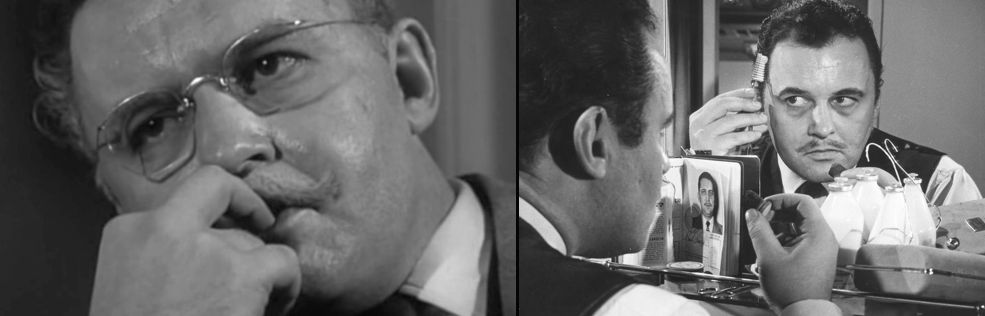

The panicked Steiger is placed in some forced, compromising suspense sequences as he begins his cowardly escape from justice. He assumes the identity of a rail passenger by matching the duped man's passport picture, allowing him to cross the Mexican border. In a heinous act, he shoves the drugged passenger from the speeding train. Embezzlement is one thing. Murder is another. Steiger retains the passenger's suitcase for identity purposes with a plan to dispose of it alongside the road. It snaps open, revealing that the man is wanted in Mexico for the assassination of a Mexican governor. An unfortunate twist. But Steiger's sweaty fingers have apparently lost the man's passport. But it gets worse. The man survived his abrupt train departure. Rescued and secretly treated by his “personal” doctor, the assassin is recovering in a singular motel along a Texas thoroughfare. Bandaged and in traction from head to toe—similar to the hilarious final scene in It's a Mad, Mad, Mad, Mad World—the man is threatened by Steiger at gunpoint for his passport.


There is a fair amount of assuming throughout the film. Steiger gets apprehended at the Mexican border, and the authorities assume he is their wanted man. But the smug thief tells them who he really is. They could not care less. Steiger is further stunned. The assassin's wife confesses that he is her husband! Hard to believe there was no initial question about why he was assuming that particular man's identity. Finally, Steiger's angry demands assume he is above the law, even offering a bribe to the Mexican police chief to get “his” passport back.

The police chief and the British inspector conspire to keep Steiger trapped in the Mexican border town to pressure him into escaping across the bridge back to America for prosecution. But the agreement is a one-sided affair in Mexico’s favor. He is never getting out of Mexico. Steiger is content to settle in the town for as long as it takes. His wealth buys him whatever he desires until the political assassin’s body is returned home, killed in a Mexican raid at the motel. I am not sure why the townspeople feel Steiger is responsible for leaving behind a widow and child, but they band together, refusing his money or his existence.

Note: After assuming that unfortunate identity, Steiger is unaware that he is now the owner of an adorable spaniel. Rather risky when the baggage car handler has to remind him not to leave his previously fawned-over pet behind. The dog seems to recognize the impersonated face and follows him around town. When Steiger disposes of the assassin's suitcase, he also tries to leave the dog behind. Weary and exhausted from escaping, his life is spared by the whimpering dog alerting him to a scorpion on his trousers. Steiger has a change of heart toward the dog, and it eventually becomes his only friend. Yet the catalyst for his death.

April 17, 2020

IRON MAN (1951)


This eighty-two-minute film noir, directed by Joseph Pevney, is helped by a strong cast starring Jeff Chandler, Evelyn Keyes, and Stephen McNally. Produced by Aaron Rosenberg and distributed by Universal Pictures, it is a few notches below the likes of the previously released The Set-up or Champion, and despite the title, it is not a marvel. It will help to have an affinity for boxing, Hollywood style. Even so, this is simply another one from an extremely long list. Just enjoy watching these professionals perform.


The film is told in flashback through the eyes of Keyes, who gets effectively watery by the end. Agonizingly watching her husband, Chandler, in the ring for perhaps the last time, the film transitions to a “romantic” Pennsylvania coal town where we are introduced to the main cast. Among the hearty group of coal miners is James Arness in a small role. He is always bad-mouthing Chandler in the hopes of picking a fight. He apparently hates him because he seems smarter than himself. Not surprisingly, a cave-in occurs, but Chandler recovers. The other men trapped have an unknown future, as we never see them again. Due to the speculative encouragement by the older brother, McNally, Chandler never returns to the "miner leagues." McNally has always envisioned a future boxing career for his kid brother.


McNally is a thick-headed deal-maker, gambler, and manipulator out to make a buck, ignoring any knowledgeable advice. He remembers Chandler's explosive temper as kids would laugh at him because of his towering height. That killer instinct signifies a champion to McNally. However, after a few practice matches, his face becomes quite intimate with the mat. Fans start laughing at him for a different reason. But Chandler goes into a rage, ripping into his opponent in a savage display of anger. A smiling McNally blurts out, “There it is!” Unfortunately, McNally knows no more about what makes a boxer than Jack Benny.

Winning his bouts with unsportsmanlike conduct has earned him a reputation as a lousy fighter, and sportswriter Jim Backus says as much in his columns. He has no business being in the ring, and the crowds agree. McNally still thinks his brother will eventually gain his undeserved respect. In somewhat of a surprise, Backus turns out to be an understanding mentor of sorts as he learns of Chandler’s backstory. Oddly, Keyes feels totally responsible for Chandler’s fighting fate, when it is clearly McNally's fault.


Rock Hudson, who desperately wants to be called “Speed” when his time comes to get into the ring, sounds as though he inhaled a slight dose of helium. He comes across well as a golly-gee-whiz naive kid who thinks Chandler is the epitome of a champion. It does not take long, however, before Chandler’s lousy attitude alienates everyone in his circle. At the badgering of McNally, Backus informs the trainer to let Chandler fight the young upstart, now “Mister Speed.” The title bout is pretty exciting with the best boxing choreography of the film, though it all looks familiar. To everyone’s surprise, Chandler fights legit and gets the tar beaten out of him near the end of the match. The crowd’s boos turn to cheers out of respect and to the delight of the facially dented, nearly blind Chandler. He has used his face as a metaphor for obliterating his past.

April 10, 2020

MACAO (1952)


You are not alone if you think this might be a follow-up to His Kind of Woman, released the previous year, or perhaps its backstory from The Las Vegas Story, released the same year. The film opens with a voice-over introduction about Macao being its own Las Vegas. Coincidence? Of the three RKO Radio Pictures, “Woman” was superior to this box office failure. Jane Russell seemingly uses a slightly altered script and wardrobe of a nightclub singer looking for a gig while snarling a few lame comebacks to any advancing male. Despite its star power, this eighty-one-minute film plays out slower than a one-person rickshaw. That responsibility falls heavily on director Josef von Sternberg, who had few fans among the cast. The screenplay by Bernard Schoenfeld and Stanley Rubin did not make this a memorable experience, either. Everyone’s low-key performance is sleep-inducing, and it takes nearly sixty minutes to get enough energy to overcome narcolepsy. Producer Alex Gottlieb hired the uncredited Nicholas Ray to step in and revitalize the climactic fight scene between Robert Mitchum and Brad Dexter. The result is not noteworthy, so I can only imagine how Sternberg originally planned it.


Memorable is Mitchum's chemistry opposite Russell, his kind of woman. He always earns his salary but glides through this film to ensure his house payment is on time. His trademark walking, as if his knees bend fore and aft, skims across floors with a manikin's upper body. He plays a laid-back drifter avoiding authorities in America. Russell is the only detail that he and Dexter have in common.

Painted into a familiar white strapless dress, Russell could never be called diminutive at 5’ 7” plus heels. Once again, a fabulous necklace fills the vast trapezoid below her neck. Despite a limited vocal and acting range, Russell was blessed with a fine alto voice. Though she appears to be belting out some notes, there is not an equal amount of sound coming out. The curse of early lip-syncing. Also limited is her vocal dynamic, never rising past mezzo-forte for these easy-going numbers. True enough, she was popular just standing still. Russell’s role is not precisely defined, yet she is good enough to pickpocket Mitchum’s wallet in the early going without him immediately noticing. The script subjects both to clichéd misunderstandings, making waves even in port.


Also from that “Vegas” movie is Dexter, again in his stereotypical, mid-century role. He plays the conniving casino owner and underworld boss who hires Russell to sing at his club. He appears to lack sleep for most of the film, perhaps thinking of her night and day. Though wanted by the authorities, he remains safe inside the three-mile limit of international waters. On his leash, doing his dirty work is a knife-throwing Philip Ahn and a slimy police lieutenant, Thomas Gomez, who informs him that Mitchum is an undercover cop. Jealousy over Russell, Dexter tries to bribe Mitchum into leaving Macao with the additional intention of ridding himself of the assumed detective.


William Bendix is introduced as a salesman. Not completely legit, he offers Mitchum a commission if he helps sell a stolen diamond from a necklace to Dexter, who is not interested because it is the same necklace he recently tried selling in Hong Kong. Later, mistaking Bendix for Mitchum from behind, Ahn sends a knife into an obvious protective “corkboard” under his suit coat. The knife wobbles a bit, nearly dropping from his back—Bendix has to hold it in place—before he falls. Ahn is disabled—possibly killed—improbably fast, quicker than a Vulcan nerve pinch by Mitchum’s arm around his throat. Bendix shares his final “sales pitch” with Mitchum.

Note: The three leads all have a turn at potentially funny quips. Rarely do they work all that well. However, there are a couple of noteworthy instances best suited for Mitchum. He asks Bendix what the “C” in his middle name stands for. He sheepishly replies, “Cicero. But keep it under your hat.” Understanding the obvious, Mitchum says matter-of-factly upon leaving the room, “What else would I do with it?” Mitchum is given another zinger after he delivers Dexter to the authorities in international waters. Drenched from going overboard, Mitchum climbs aboard where Russell awaits. They start to embrace, but she cautions him, “You’re all wet!” to which he replies, “You had better start getting used to me fresh out of the shower.” Their future is anchored with a kiss.

April 3, 2020

FORGOTTEN FILMS: TV TRANSITION

Though typically overshadowed by Hollywood's A-list, there were respectable performances by numerous actors and actresses who never became major film stars. A common occurrence was their transition to the new medium of television, often becoming familiar faces in homes across America. These periodic posts offer insight into their transition.


John Bromfield: Farron Bromfield (1922-2005)

John Bromfield was a leading man in B-movies during the mid to late 1950s who possessed a fine voice and a square-jawed handsomeness. While still in his mid-twenties he became a contract player for Paramount Pictures. His early acting gigs placed him shoulder-to-shoulder with some big names in Sorry, Wrong Number (1948) and Rope of Sand (1949). Bromfield was an obvious candidate for leading man status by mid-century. His brief career churned out such forgotten films for Bel-Air Productions as, The Big Bluff (1955), Three Bad Sisters (1956), and Crime Against Joe (1956), co-starring another transition to television, actress-singer Julie London. Like most of these features, the film possessed some unintentionally funny moments in between London’s comatose performance. A decent script and on-location filming helped make Hot Cars (1956) his most authentic of the era. His role for Universal International Pictures, Revenge of the Creature (1955),  “earned” him cult status, after a fashion.

Bromfield’s transition to television was instant, bringing him notoriety from living rooms across America. The syndicated modern-day western series, The Sheriff of Cochise (1956-60) was a big success as officer Frank Morgan chased bandits by station wagon, not on horseback. The Chrysler Corporation was a sponsor and late episode viewers could see a DeSoto Fireflite Explorer station wagon complete with a shotgun clipped to the driver's side door panel. Due to the show’s success—thanks to Bromfield, location filming and accurate portrayal of law enforcement—he was made an honorary deputy by the real sheriff of Cochise County. Morgan was promoted to U.S. Marshall status and the entire state of Arizona was under his purview and the third season gained a new title, U.S. Marshal. Bromfield embraced the television medium and the show wholeheartedly. His co-star for one season, Stan Jones, playing Deputy Harry Olson, was the creator of the series.

Note: Bromfield was born in South Bend, Indiana, and soon developed strong athleticism. Hollywood knew him as a health enthusiast. Female fans knew him as a hunk. After leaving acting abruptly in 1960, he produced sports shows. Before being discovered by an acting agent he was a tuna fisherman. He returned to those roots in retirement as a commercial fisherman off Newport Beach.

March 27, 2020

THE MAN ON THE EIFFEL TOWER (1950)


This American, eighty-seven-minute noir mystery released by RKO Radio Pictures was directed by Burgess Meredith. He also stars, along with two other high-caliber actors, Charles Laughton and Franchot Tone. The original director, Irving Allen, gladly departed after a barrage of tomatoes was thrown his direction, chief among them, Laughton. The film was somewhat of a team effort as it was co-produced by Tone and Allen. A minor but noticeable point, there are no French-speaking actors within a three-mile radius of the Eiffel Tower. Even a local newsboy speaks perfect English. The fine music score by Michel Michelet provides appropriate themes, especially the first ascent up the tower. Ansco Color's overall "burnt-sienna" murkiness certainly degrades the enjoyment of this complicated, suspenseful thriller with a disjointed story and jarring edits. Still, it would not be difficult to imagine that this film might have been a celluloid classic in more capable hands. In my astute assumptions, few will bother watching this film. Hench, a few spoilers below.

The story begins with a mousey Meredith, again wearing thick eyeglasses, a prop that may have made an impression on him. There is at least one other film role where he is cast with “coke-bottle” lenses, though his most noted role was as the bookworm in the television series, The Twilight Zone. Similar to that episode, his lenses get broken after stumbling, this time over a corpse in the dark. Out of the shadows appears a pair of slacks with shoes or feet wrapped in burlap. Perhaps this unexplained detail was to establish an abnormal individual. Let the speculations begin. He taunts Meredith with his commands, and the viewer is (literally) in the dark as to their connection or why Meredith is at this location. Leaving behind numerous fingerprints and a pair of broken spectacles, Meredith is arrested for the murder.


The manic-depressive, egocentric intellectual medical student wash-out, and Meredith's mystery man is Tone. A creepy sociopath responsible for the corpse, the wealthy aunt of the spineless Robert Hutton, who nervously paid to have it done. As a “favor” to tie up any loose ends, Tone also kills the aunt’s maid, hoping to pin both murders on the unsuspecting Meredith. Blackmailing Hutton for a chunk of the inheritance is also part of his scheme. In a subplot seemingly lifted from a separate movie, Hutton completes an infidelity trio with wife, Patricia Roc, and Jean Wallace. Roc is quite aware of her husband's affair with the latter, and the ladies exchange sarcastic barbs, like two sisters who do not get along. 


Mush-mouthed Laughton plays the pipe-smoking Jules Maigret, a fictional French police detective created by writer Georges Simenon. Laughton usually steals every scene with facial expressions and body language, sometimes humorously, as in the handwriting analysis scene regarding Tone’s notes. He does not believe in Meredith’s guilt, so he arranges his prison break to have him tailed. To Laughton’s ire, his men lose him after he jumps from a bridge into the river. I guess it never occurred to them to follow his slow swim along the river’s bank and wait for him to come ashore. Laughton methodically goes about his investigation while Tone taunts and mocks his progress. First in phone calls and messages, then in person, in the tower’s open-air restaurant. Dining together, we first witness Tone’s eccentricity with his diatribe against Laughton. The tower is his sanctuary and a metaphor for being above everyone else. He suggests to Laughton that, with his seeming lack of evidence, he will never be caught.

There are a few exciting moments in the film. The first has a young William Phipps chasing Tone on Parisian rooftops. The climactic tower scene also makes for good filmmaking, but suggesting Tone can climb preposterously fast in leather dress shoes on the angled grids of iron is beyond belief. The only thing more unbelievable is having the introverted, first-time tower climber, Meredith, rapidly chase him up the tower in retribution. The ending is not what you might expect after the killer ascends to the tower’s top platform. Laughton asks him to climb down. Yet knowing Tone’s self-imposed courage and importance, maybe just let him jump.

March 20, 2020

BENEATH THE 12-MILE REEF (1953)


20th Century Fox distributed this one-hundred-two-minute, big-budget film, the third motion picture made in CinemaScope. This fad was a stand-out element of the film. It alone may account for its box office success, though its two young co-stars probably contributed. The widescreen format enhances some nice underwater sequences by the film's cinematographer, Edward Cronjagerand, and his occasional sunset or sunrise near Tarpon Springs, Florida. But on terra firma, it is a routine romantic drama centered around family heritage amid ‘the most dangerous of all occupations, sponge diving.’ Not firefighters. Not police officers. Not bomb disposal personnel. Intertwined is an ethnic war between Greek culture and sponge pirates, the Conch fishermen. 

As the credits open, the composer of the film may stump you, but the music becomes unmistakably Bernard Herrmann. The harp played a role in a number of his scores, and it is used appropriately during some underwater sequences. There is one scene, however, where the score is nearly overkill as symbols crash and French horns soar as we watch two lowly fishing boats creep out into the gulf during a calm sunrise. But without a doubt, Herrmann’s score enhances the film.

Swashbuckling Gilbert Roland, with shirt unbuttoned forming a V, is in command of the film in its early going, making it more fun. His swagger and confidence are indelibly imprinted on his son, Robert Wagner, who, oddly, along with his on-screen sister, is the only Greek in the film without a hint of an accent. But Wagner’s curly studio permanent is pure family lineage. Completing the trio of spongers is the heavily accented J. Carrol Naish with some humorous lines.


The twenty-three-year-old Wagner catapulted to fame during these years and shared top billing with Roland and Terry Moore. There is little doubt that the two young stars have a destiny. One could rightfully assume they anchored off-screen as well. Moore had a ten-year advance on Wagner’s career, though only a year separated their births. Eventually, Wagner’s popularity overwhelmed Moore’s, but both were celebrities rather than acting powerhouses. Wagner does alright in this role, especially in the first half. They both pretend to be in their late teens, with Moore giggling a lot in the early going. Like a number of others in Hollywood, she seems aware that the cameras are rolling and works hard to make a screen impression after hearing the words, “Action!” from the director, Robert Webb. I am sure their equally young fans were not aware of these occasional shallow performances.


Richard Boone, looking vibrant and fit, plays Moore’s father and the “Conch Master” over his crew. They do not want any Greeks diving in “their waters.” After Roland gathered his day’s worth of sponges, Boone’s crew, on Peter Graves’ lead, intercepts and steals their take. Roland laughs off the theft, knowing he will get revenge on Boone. They come to an understanding. Graves is navigating to marry Moore, but becomes a squeaky third wheel beside the cocky Wagner. Graves is jealous of the young punk and gives him a beating as a warning shot over his brow.

On his final pre-scuba gear dive, Roland succumbs to a deadly case of the bends. Wagner confidently soldiers on. During another sponging, Roland’s family boat accidentally goes up in flames. Graves tries to put the fire out with no success. Angry Wagner then steals the Conch boat and, with the help of Moore, adapts it for more sponge baths...uh...diving. They are a bit giddy, like in an Andy Hardy film where Rooney and Garland pull together a neighborhood show as a fundraiser. On Wagner's first diving experience, he encounters a large octopus. Posters of the day over-emphasize this as the film's major element. It is a very believable, however, with Wagner surviving with only a couple of hickeys. 

The climactic ending brings sudden character turnabouts. Moving in on their stolen boat for another sponge robbery is the conch crew. Boone, previously level-headed and showing sympathy for Roland’s short script, now wants his daughter back, "stolen" by Wagner. Yet to everyone's surprise, including the audience, they have already gotten married. Somewhere. Once alongside, Graves jumps on board, going at it with Wagner again as they go overboard. A lot of splashing later, the young punk ends up saving Graves from drowning in a seaweed entanglement. Back on deck, Boone is hesitant to accept Wagner, but Graves reminds him that he just saved his life. Oh, yeah. To dissolve Boone's displeasure, Wagner confidently exudes, "Look who you got for a son-in-law. I'm a very beautiful young man!" The Greek-Conch hatred dissolves instantly into laughter and acceptance. Sponge Conch, LLC is formed.

Note: Harry Carey, Jr., a frequent co-star on Boone’s popular television western series, plays one of his sons here. Boone’s show, on more than one occasion, also featured two other characters from this film, Jay Novello and Jacques Aubuchon. The studio assigned the brief, uncredited opening narration to the unknown Roy Harold Scherer, Jr., aka Rock Hudson.

March 13, 2020

TRAPPED (1949)


This seventy-eight-minute film arose from a story written by George Zuckerman and Earl Felton. It was directed by a master of realism, Richard Fleischer, and released by Eagle-Lion Films, the poster child of the semi-documentary. The moody cinematography was by Guy Roe, who would, a year later, film Lloyd Bridges in The Sound of Fury, then later the quintessential B-movie crime noir, Armored Car Robbery. Trapped was produced by the oldest of the "Seven Little Foys," Bryan. Like many low-budget crime films of the era, it uses voice-over narration to inform the audience about the thoroughness of law enforcement. In this case, the United States Treasury Department shut down a counterfeit ring. The score was by the dependable Sol Kaplan, whose opening measures sound like a cross between a weekly television private investigator theme and an old movie serial.

Though there may be familiar faces throughout the film, many of whom became prolific on the small screen, it really centers around the characters of Lloyd Bridges, Barbara Payton, and John Hoyt. As an up-and-coming leading man with a casting agent earning his salary, Bridges gets top billing. He was very busy during 1941-42 with thirty-eight films with mostly uncredited roles, learning the ropes. Leading roles became more common after the war. Not classically handsome, his closely set eyes are offset by a distinctive voice, a winning smile, and an abundance of charisma. The established character actor, Hoyt, has nearly identical screen time, however, and is third-billed. It is a nifty crime tale of treasury agents wanting to enlist the help of a counterfeit operative, Bridges, who is currently a model inmate in an Atlanta prison. With seven more years on his sentence, he could be released much earlier if he cooperates to help find the counterfeit plates and those who are circulating the phony bills. The savvy, arrogant, gum-chewing Bridges essentially tells them what they can do with their offer. 


The screenplay pulls off a couple of clever double twists near the beginning. Nighttime finds Bridges on a bus headed for Kansas City, handcuffed to a Deputy Marshall. A car pulls up alongside the bus in the passing lane, the driver looking for Bridges. They make eye contact, then Bridges grabs the revolver of the dozing detective and commands him to “take the jewelry off” and exits the bus for the sedan, driven by Richard Karnes. The whole “escape” was planned in advance with Bridges, giving legitimacy to a phony AP wire story. The officer’s gun was not loaded, and Karnes is a federal agent. During an overnight stay in a motel, at the opportune moment, Bridges initiates a fist-fight with Karnes. Apparently suspecting as much, Karnes “throws the boxing match” to let Bridges be tracked to Los Angeles.


We first see Hoyt as a frequent Los Angeles nightclub visitor, trying to pour on the charm to the cigarette girl, Payton, Bridges’s girl. She assumes he must own two or three oil wells because of his generous ten-dollar tips. Hoyt is actually an experienced undercover Secret Service agent posing as a racketeer. Bridges vouches for Hoyt and enlists him to help “convert” a real twenty-five grand into a quarter million in fake bills.

Hoyt reports to his superior, Russ Conway. In Conway’s first scene, we see him taking notes over the phone, handwriting gibberish on a notepad. Surely one of the worst executions of fake handwriting in film. Like the undecipherable notes taken in a college class while suspended over a cliff of sleep. Then, a few days later puzzled as to why the exam score was so below average. I digress. Admittedly, play-acting is rarely filmed authentically. In another Conway moment, an oft-used scene showcases the clever and effective undercover work during the phone booth era. In order to touch base on the agency's progress, Conway is seated in a diner as Hoyt strolls in. Conway steps to a booth and places a call to the adjoining booth to get Hoyt’s report. A local call.

The counterfeit exchange is set with “the big guy,” James Todd, who owns the counterfeit plates. Todd is no Ted de Corsia. He is too easy-going, naive, and skittish to be believed as the ruthless boss of operations. Rather humorous that undercover agents are placed in several locations within running distance of the exchange location. I assume the homeowners were notified that a guy would be cleaning their screens, mowing their lawn, or who is hand-lettering words on a grocery store’s front window. Turns out to be Todd’s test run because he was not sure he could trust Hoyt. The fake quarter million is nothing more than authentic cut paper.


To raise the level of excitement, later an old Army buddy recognizes Hoyt in the nightclub and addresses him by his real name. Finally picking up on Hoyt’s persistent denial and knowing his government position, he apologizes, and Hoyt thinks he survived a close call. Except Payton overheard the conversation. She and Bridges then find the microphone in her apartment. Livid Bridges wants the real twenty-five grand as payback for being double-crossed. Hoyt gets the money from the bank, but on route to the spurious hotel, meeting with Todd, Bridges tells him, at gunpoint, to keep driving. They turn off the highway onto an ocean-side cliff. Both cautiously exit the car, then Hoyt kicks the gun from Bridges’ hand, and their stunt doubles take over. Bridges loses the fight, gets booked, and is jailed. Oddly, it is the last time we see the leading man, yet twenty minutes of film remain. All we know for sure is, that no early release is indicated on the warden’s Mobil Oil calendar.

The ending is fairly exciting as Hoyt decided to complete the exchange anyway based on bogus information provided to “Todd the Naive.” Hoyt is compromised again by Payton’s unexpected appearance at the gang’s warehouse. Less exciting is the commonplace chase of multiple agents pursuing Todd between streetcars in a maintenance garage. It is the typical scenario with bullets bouncing off a lot of metal. Todd climbs to the roof of one streetcar but uses its overhead electrified cable to balance himself. The good news, he will not serve any jail time. “What's that smell?”

Note: The only humorous dialogue could get overlooked because of its subtlety. When Bridges is booked at another precinct, Hoyt tells the policeman to keep it secret and book him with a different name. The officer suggests, “How about Briggs? It’s my mother-in-law’s name. I just want to see what it looks like on a police blotter.”